Table of Contents
- Why Playground Surfacing Decisions Carry the Highest Stakes
- What Is Playground Turf and Who Needs It?
- Playground Safety Standards and Certifications Explained
- Fall Protection: Critical Fall Height and Shock Pad Systems
- Turf Types, Fiber Options, and Infill for Playgrounds
- Playground Turf vs. Other Surfacing Options
- Installation Process for Playground Turf
- Cost Breakdown and Long-Term Value
- Playground Turf Design Ideas by Playground Type
- Maintenance, Seasonal Care, and Texas Climate Considerations
- Frequently Asked Questions
- Get a Free Playground Turf Consultation
Why Playground Surfacing Decisions Carry the Highest Stakes
Choosing the wrong lawn turf means you deal with a patchy yard. Choosing the wrong playground surfacing means a child gets hurt.
Playground surfaces face a unique combination of demands: federal safety standards, accessibility requirements, equipment-specific fall protection ratings, and the daily abuse kids dish out. A standard lawn turf installed under a swing set doesn’t meet any of them.
Parents, schools, daycares, churches, and city parks departments all face the same challenge. They need a surfacing solution that absorbs impact, remains accessible to wheelchairs and walkers, holds up under heavy use, and doesn’t require constant replacement.
That’s what this guide covers. Every safety standard explained in plain English, every surfacing option compared honestly, and the Texas-specific heat and soil considerations most guides skip entirely.
We’ve installed playground turf for backyard play areas, school campuses, church facilities, and community parks across Texas. The information here comes from over 10,000 installations and a decade of getting these projects right, so you benefit from every lesson we’ve already learned. We don’t take shortcuts, and we don’t make exceptions.
Learn about our installation process.
What Is Playground Turf and Who Needs It?
Playground turf isn’t standard lawn turf with a foam pad underneath. It’s an engineered system built from the ground up for impact protection, and every layer serves a purpose.
A complete playground turf system includes a compacted aggregate sub-base for drainage and stability, a shock-absorbing pad sized to the equipment’s fall height, playground-grade synthetic turf with dense fibers and reinforced backing, and a specialized infill that supports the fibers and contributes to the system’s safety rating.
Each component is tested together as a system. Swap one element, and the safety certification may no longer apply, which means your kids may not be protected at the rated fall height.
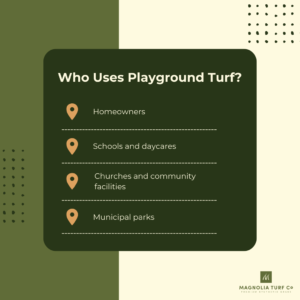
Who Uses Playground Turf?
Homeowners with backyard play areas, swing sets, trampolines, and climbing structures want a surface that protects kids without turning into a mud pit every time it rains. Aging rubber mulch that scatters across the yard and wood chips that attract insects and decompose are the pain points driving most residential inquiries.
Schools and daycares face stricter regulatory pressure. ADA-compliant surfacing, documented fall protection ratings, and low-maintenance surfaces that can handle hundreds of kids daily make artificial grass playground systems a practical choice for institutional settings.
Churches and community facilities often operate playgrounds with limited maintenance staff. A surface that performs year-round without weekly raking, leveling, and top-offs frees up volunteer time and budget.
Municipal parks need surfaces that meet public safety requirements, survive high traffic from diverse age groups, and maintain ADA accessibility for inclusive playground designs.
Learn more about our playground turf solutions.
Playground Safety Standards and Certifications Explained
Playground surfacing safety isn’t optional. It’s governed by federal guidelines and ASTM standards that every installer and facility manager needs to understand.
We walk every customer through these requirements. Proper certification protects kids and protects you from liability.
CPSC Public Playground Safety Handbook
The Consumer Product Safety Commission publishes the primary guideline for playground design and surfacing. It recommends impact-attenuating surfacing under and around all equipment, prohibits hard surfaces like concrete or asphalt in use zones, and requires accessible routes meeting ASTM F1951 standards.
The handbook stresses matching equipment fall heights to the surfacing’s tested critical fall height and maintaining performance over time.
ASTM F1292: Impact Attenuation Testing
This standard determines whether a surface can absorb enough impact to protect a child’s head during a fall. Testing uses an instrumented headform dropped from specific heights onto the surface. Two measurements decide pass or fail:
- GMax can’t exceed 200 (measures peak deceleration on impact)
- HIC (Head Injury Criterion) can’t exceed 1,000 (measures severity of head impact over time)
Both values must stay below these thresholds at or above the equipment’s fall height for the surface to pass. The highest drop height where both values pass becomes the surface’s critical fall height, the maximum equipment height it can safely serve.
ASTM F1951: Wheelchair Accessibility
This standard measures whether a playground surface is firm and stable enough for wheelchair access. Testing compares the effort required to push a test wheelchair across the surface versus a reference surface.
Playground turf systems installed over properly compacted bases and shock pads typically pass this test, making them one of the easier surfaces to design for ADA compliance.
ASTM F3313: Field Testing After Installation
Lab testing proves a product can perform. Field testing proves the installation actually does.
ASTM F3313 uses the same GMax and HIC criteria as F1292 but tests the surface as installed, capturing site conditions, installation quality, and wear over time. This is where shortcuts in base preparation and pad installation show up, and where you find out whether your installer did the job right or just said they did.
IPEMA Third-Party Certification
The International Play Equipment Manufacturers Association runs a certification program that verifies playground surfacing through independent lab testing. IPEMA certification requires system-specific testing, documented quality-control procedures, installation guidelines, and periodic inspections.
Why it matters: A manufacturer saying their product “meets ASTM F1292” isn’t the same as an independent lab confirming it. IPEMA certification provides third-party verification, which carries more weight for liability protection, school district procurement, and municipal compliance.
See how Magnolia Turf’s installation process meets these standards.
Fall Protection: Critical Fall Height and Shock Pad Systems
The tallest piece of equipment on the playground dictates the entire surfacing system. A six-foot climbing wall needs a different pad than a 10-foot slide tower.
Critical fall height is the maximum height from which the surface can protect a child’s head during a fall and keep GMax below 200 and HIC below 1,000. The shock pad beneath the turf does the heavy lifting for impact absorption, and pad thickness determines the fall height rating.
Shock Pad Options and Fall Height Ratings
Foam pads are the most common choice for playground turf systems. Magnolia Turf uses recycled foam padding designed to cushion falls from six feet to over 10 feet, depending on density:
- Medium-density foam (1.1 inches): Rated for falls up to five feet. Suited for smaller play structures and toddler areas. Adds $3.40 per square foot.
- High-density foam (2.1 inches): Rated for falls up to eight feet. Handles taller slides, climbing structures, and standard swing sets. Adds $3.70 per square foot.
Poured-in-place rubber underlayment achieves higher fall ratings (up to 12+ feet) but costs $12–$18+ per square foot installed and requires specialized installation. It’s typically reserved for commercial playgrounds with tall equipment.
Engineered aggregate bases contribute some impact absorption but don’t replace dedicated shock pads for equipment above three to four feet.
Standard Practice: Overbuild the Safety Margin
Professional installers size the shock pad for a fall height rating above the tallest equipment, not exactly at it. If the tallest structure is seven feet, specifying a pad rated for eight to 10 feet builds in a safety margin that accounts for settling, wear, and real-world conditions that differ from lab testing. That extra margin means the surface still protects your child at year five the same way it did at year one.
We’ve seen installations where the pad was sized right at the equipment height. Over time, settling and wear reduce performance. Overbuilding the margin costs a few hundred dollars more and prevents expensive problems later.
Turf Types, Fiber Options, and Infill for Playgrounds
The turf and infill you choose affect safety, comfort, heat, maintenance, and cost. Here’s how the options compare for playground surfacing applications.
Fiber Types for Playground Turf

Polyethylene is the standard for playgrounds. It balances durability, skin-friendliness, and lower friction burn risk, so kids can slide and tumble without the rug-burn injuries common on stiffer fibers.
Nylon is tougher but stiffer and hotter, making it better suited for hybrid yarns or specialty applications. Polypropylene works for light-duty areas but lacks the UV stability and resilience for high-traffic playground zones.
For playground applications, look for pile heights between 1.25 and two inches with face weights in the 50–80 oz per square yard range. Magnolia Turf’s playground products include Kid Play 60 (polyethylene, 60 oz face weight, 1.5-inch pile height) and Magnolia Xtreme Play (polyethylene, 40 oz face weight, 0.5-inch pile height for multi-use surfaces).
Both products use reinforced W-, S-, and C-shaped blade profiles that spring back under heavy foot traffic instead of matting flat. On a playground where the same spots take daily abuse, blade shape is the difference between turf still looking good at year eight and turf worn flat by year three.
Playground Infill Options
Silica sand: The lowest-cost option. It drains well, supports fibers, and doesn’t degrade from chemical contact. It won’t provide much cushioning on its own and needs more frequent grooming to prevent compaction.
Crumb rubber (SBR): Adds bounce and cushioning, making it popular for sports surfaces. The black rubber absorbs heat aggressively and leaves black dust on skin, clothes, and shoes. Federal research (EPA, CDC, CPSC) found no elevated health risk from typical exposure, but data gaps remain. Many playground specifiers now avoid crumb rubber thanks to ongoing parental concerns and the availability of cleaner alternatives.
Coated sand (Envirofill): Polymer-coated round sand with built-in Microban antimicrobial protection. It controls bacteria, mold, and odors better than uncoated sand, which means less smell and fewer germs where your kids play. It runs about $0.40 more per square foot than standard infill.
Organic alternatives (zeolite, coconut husk, cork): These offer cooling properties and odor control, making them appealing for hot climates. They can break down, float, or drift during heavy Texas rainstorms and require periodic top-offs.
TPE (thermoplastic elastomer): Rubber-like resilience with less off-gassing and often lower heat than black SBR. It’s more expensive per pound but a cleaner, color-stable option for artificial grass playground installations.
Cooling infills (TCool, HydroChill): These use evaporative cooling to reduce surface temperatures by 30–50°F compared with standard systems, which can mean the difference between a playground that’s usable at 2 p.m. in July and one that sits empty. They’re worth serious consideration for any Texas playground turf installation.
We install PFAS-free products on every playground project. Your family’s health isn’t negotiable, and you shouldn’t have to worry about forever chemicals in the surface your kids roll around on every day. Quality manufacturers have eliminated these chemicals without compromising performance.
Compare all our infill types in detail.
Playground Turf vs. Other Surfacing Options
Every surfacing type has trade-offs. Here’s an honest comparison.

Where Playground Turf Wins
Playground turf offers the longest functional lifespan among unitary surfaces, strong ADA compliance when properly installed, a consistent year-round appearance, and lower long-term maintenance than any loose-fill option. The pad system beneath the turf can outlast the first turf layer and be reused during a re-turf, saving you thousands on your next replacement.
Where Playground Turf Faces Challenges
Upfront cost is higher than loose-fill options. A 1,000-square-foot playground turf installation with proper pad and base work runs $12,000–$18,000 versus $800–$1,200 for rubber mulch or $3,500–$5,500 for engineered wood fiber.
Heat retention in direct Texas sun pushes surface temperatures above ambient air. On a 100°F day, turf surfaces can reach 120–150°F without shade or cooling measures. This is manageable with shade structures, cooling infill, and scheduled water rinses, but it’s a real consideration.
Professional installation is non-negotiable. Unlike rubber mulch that a maintenance crew can spread, playground turf requires proper sub-base preparation, pad placement, seaming, and infill application. Cutting corners on any step compromises safety ratings. We’ve repaired enough failing playground installations to know what happens when companies skip the base work.
When Another Surface Makes More Sense
For tight budgets with large areas, engineered wood fiber may be the practical choice if your team commits to maintaining proper depth. For heavily shaded, small areas where heat isn’t a concern, poured-in-place rubber delivers a smooth, uniform look. For temporary installations expected to last under five years, loose-fill materials offer lower upfront investment.
Compare turf vs. grass costs for Texas and Florida homeowners.
Installation Process for Playground Turf
Playground turf installation follows the same base-first approach as every Magnolia Turf project, with added steps for safety pad placement and fall-height verification.
Step 1: Site Assessment and Excavation
The process starts with evaluating existing conditions: soil type, drainage patterns, equipment layout, and fall zones. Excavation depth accounts for the aggregate base (three to four inches minimum), shock pad thickness, and turf with infill.
Step 2: Sub-Base Preparation
This step separates lasting installations from failing ones. We’ve repaired playground surfaces where the original installer skimped on base work.
The pattern is always the same: settling, pooling water, uneven impact protection. It’s the same problem we see in every turf application, and the fix is the same.
David Turner has a simple rule for playground projects: “If you won’t cut corners on a backyard, you definitely won’t cut them where kids are falling.” That standard drives every playground installation we take on.
In Texas, where expansive clay soils shrink and swell with moisture changes, proper sub-base work matters more than anywhere else. Clay movement causes heaving, settlement, and cracking in rigid surfaces.
Magnolia Turf installs three to four inches of crushed limestone or decomposed granite, compacted in lifts and graded for drainage. This aggregate layer keeps water moving through the system rather than pooling on the clay, stabilizes fall-height performance, and helps the surface dry quickly after storms.
Step 3: Shock Pad Placement
The foam pad goes down over the compacted base, covering the entire use zone around equipment. Pad selection matches the critical fall height requirement with a built-in safety margin. Seams between pad sections are butted tight to prevent gaps, so your child gets the same impact protection no matter where they land.
Step 4: Turf Layout, Seaming, and Securing
Playground turf is rolled out, trimmed to fit the space, and seamed using adhesive and seam tape. Proper seaming matters on playgrounds, since loose seams create trip hazards. Turf edges are secured to border containment systems, typically steel edging, poly board, or treated nail board ($6 per linear foot for each option).
Step 5: Infill Application and Grooming
Infill is spread evenly across the surface using a drop spreader and worked into the fibers with a power broom. Uniform infill distribution keeps drainage, fiber support, and impact performance consistent across the entire play area, so every square foot is equally safe.
Texas-Specific Installation Considerations
Expansive clay soil demands over-excavation and thicker aggregate bases. Skimping on base depth in DFW clay is the fastest way to end up with a buckled, uneven surface within two years. That $3 per square foot in base work prevents a $15 per square foot fix later.
Drainage for heavy rain requires proper grading at the sub-base level. Texas thunderstorms can drop inches of rain in minutes, and flow-through turf backing handles 900 inches per hour, so your playground is usable again within minutes of the rain stopping. The water still needs somewhere to go beneath the surface, which is why proper sub-base grading matters.
Learn more about our drainage solutions.
Border containment matters more in playground settings, since kids will test every edge. Steel or combination edging systems hold up better than basic bender board under playground traffic.
See our full cost breakdown guide.
Cost Breakdown and Long-Term Value
Playground turf costs more upfront than loose-fill alternatives. Over a 10-year period, the math often reverses.
Quality costs more upfront. Shortcuts cost more in the long run.
Total Installed Cost Components

Total installed cost for playground turf runs $9–$14 per square foot, depending on project size, pad thickness, infill selection, and site conditions. Larger commercial projects benefit from economies of scale.
10-Year Total Cost of Ownership
Loose-fill surfaces look inexpensive at installation. They don’t stay that way.
Rubber mulch and engineered wood fiber require annual top-offs to maintain proper depth for fall protection compliance. Those recurring costs add up.
Over a 10-year period, playground turf’s annual maintenance costs are minimal: occasional brushing, debris removal, infill redistribution, and periodic field testing. Magnolia Turf offers professional maintenance plans from $0.70 to $1.60 per square foot per visit.
Compare those costs with annual top-off expenses for loose fill, which can rival the original installation cost every three to five years.
What Drives Cost Variation
Project size, fall height requirements, infill selection, site accessibility, and existing soil conditions all affect the final number. A 200-square-foot backyard play area costs more per square foot than a 5,000-square-foot school playground thanks to fixed mobilization and minimum project costs.
Higher fall height requirements mean thicker (more expensive) pad systems. Clay soil remediation adds excavation and aggregate costs.
We’re not the cheapest option. We’re the right one. And we’ve seen enough playground projects fail from cut corners to know the difference matters more here than almost anywhere else.
Calculate your project’s price and ROI.
Playground Turf Design Ideas by Playground Type
Residential Backyard Play Areas
The most common residential playground turf project integrates turf around existing swing sets, climbing structures, and trampolines. Key design considerations include extending the turf surface at least six feet beyond equipment in all directions to cover the full use zone, transitioning smoothly between playground turf and standard lawn turf in adjacent areas, and incorporating natural play elements like boulders or log steppers into the turf layout.
Color zones and custom inlays (hopscotch grids, number paths, letter patterns) add built-in games that keep younger kids engaged without added maintenance requirements or extra toys cluttering the yard.
Schools and Daycare Facilities
Institutional designs often include age-zoned play areas with different pad thicknesses for toddler equipment versus older-kid structures. Multi-use fields that serve as both playground and PE space benefit from durable, high-face-weight turf that handles cleats, running, and play equipment traffic, giving you one surface instead of two separate budgets.
Inclusive and Adaptive Playgrounds
ADA-compliant playground turf enables wheelchair access throughout the play space, not limited to paved pathways. That means every child can reach every play station, not just the ones next to the sidewalk. Unitary surfaces like turf over pad provide the firm, stable surface F1951 requires and the impact protection F1292 demands.
Design elements include flush transitions between turf and adjacent hardscape, sensory play stations accessible from wheelchair height, and clear visual contrast between activity zones using different turf colors.
Churches and Community Facilities
Community playgrounds often serve wide age ranges with limited maintenance budgets. Designs that prioritize durability and low maintenance over elaborate custom features deliver the best long-term value for these settings.
Browse our completed playground turf projects.
Maintenance, Seasonal Care, and Texas Climate Considerations
Playground turf requires less maintenance than any loose-fill surface. It still requires some.
Regular Maintenance Schedule
Monthly: Brush or groom high-traffic areas (under swings, slide exits, climbing wall landings) to redistribute infill and keep fibers upright. Remove leaves, debris, and organic matter that can trap moisture.
Quarterly: Inspect seams, edges, and border systems for wear. Check infill levels in heavy-use zones and redistribute or top off as needed. Clean biological residue with a mild detergent rinse.
Annually: Schedule a full inspection of pad integrity, seam condition, and infill depth. For commercial and institutional playgrounds, periodic ASTM F3313 field testing documents ongoing fall protection compliance.
Texas Heat Management
Artificial turf gets hot under direct sunlight, particularly between noon and 4 p.m. from June through August. Surface temperatures can reach 120–150°F on a 100°F day.
Shade structures are the most effective permanent solution. Covered play areas eliminate heat concerns entirely and extend usable hours during summer months, so your kids aren’t stuck indoors from noon to 5 p.m. every day from June through September.
Cooling infills (TCool, HydroChill) store moisture and release it as the turf heats, reducing surface temperatures by 30–50°F. Combined with lighter-colored fibers and LusterGuard technology that diffuses sun rays, these systems make a measurable difference in DFW summer conditions.
Water rinses work right away. A one-minute rinse with a sprinkler or hose cools the turf down for several hours. For school and park playgrounds, a quick rinse before recess or opening is a simple, effective practice.
Common Maintenance Mistakes
Ignoring infill redistribution under high-traffic zones leads to uneven surfaces and inconsistent impact protection. Using metal tools or sharp equipment on the turf surface damages fibers and backing.
Allowing organic debris to accumulate traps moisture and accelerates biological growth. Skipping periodic impact testing on commercial installations creates liability exposure.
Get our full maintenance guide.
Frequently Asked Questions
Is playground turf safe for toddlers?
Playground turf installed with a properly rated shock pad is one of the safest surfacing options available. The system passes ASTM F1292 impact attenuation testing at the certified fall height, and the turf surface provides a clean, consistent area free of splinters, insects, and loose material that toddlers tend to put in their mouths. Match the pad thickness to the tallest equipment in the play area.
Does artificial turf get too hot for playgrounds?
In direct Texas summer sun, turf surfaces can reach 120–150°F. That’s too hot for bare feet or prolonged contact.
Cooling infills, shade structures, and water rinses bring surface temperatures down to comfortable levels. Schedule outdoor play during morning hours, provide shade, and rinse the surface before use during peak heat months.
Is crumb rubber infill toxic?
Federal research from the EPA, CDC, and CPSC found no elevated health risk from typical crumb rubber exposure. Data gaps remain and studies continue.
Many playground designers now specify alternative infills (coated sand, TPE, organic options) to avoid the question entirely. Magnolia Turf recommends PFAS-free, non-rubber infill options for any playground project.
How long does playground turf last?
Quality playground turf over a proper pad lasts 10 to 15 years depending on UV exposure, traffic volume, and maintenance. The pad system beneath often outlasts the first turf layer and can be reused during a re-turf, reducing replacement costs.
Proper base work and installation matter as much as material quality for longevity. We’ve seen cheap installations fail in five years, and our installations are still performing at 10+.
Can playground turf be installed over existing concrete or asphalt?
It can, with proper preparation. Concrete or asphalt provides a stable base, but the shock pad still goes down to achieve fall protection ratings.
Glue-down installations on concrete eliminate sub-base costs but require the existing surface to be clean, level, and properly draining. Drainage is the primary concern, since water needs a path off the surface.
What certifications should I require from my installer?
Ask for IPEMA-certified products with documented ASTM F1292 test reports at the specific fall height your equipment requires. For ADA compliance, request F1951 test data. Any installer who can’t provide these documents isn’t installing to playground safety standards.
How do you clean playground turf?
Regular debris removal, periodic rinsing with water, and occasional cleaning with a mild detergent solution handle most maintenance needs. For institutional settings, Magnolia Turf offers professional maintenance plans that include grooming, infill management, and biological cleaning.
When does infill need to be topped off?
Check infill levels quarterly in high-traffic zones (under swings, at slide exits, near climbing structures). Most residential playgrounds need a minor top-off every one to two years. Commercial playgrounds with heavy daily use may need infill attention every six to 12 months.
Can damaged sections be repaired without replacing the entire surface?
Individual sections of playground turf can be cut out and replaced without disturbing the surrounding surface.
Seam repairs, infill replacement, and localized pad repairs are all possible, so a damaged spot doesn’t mean paying to redo the whole playground. This is an advantage over poured-in-place rubber, where patch repairs can be visible and difficult to color-match.
Get a Free Playground Turf Consultation
Every playground is different. Equipment heights, usage patterns, soil conditions, shade coverage, and budget all affect the right surfacing solution.
Magnolia Turf provides free consultations for Texas homeowners, schools, churches, and facility managers considering playground turf. We’ll assess your site, recommend the right pad and infill system for your equipment, and provide a detailed quote with no pressure and no shortcuts.
Every Magnolia installation includes three to four inches of crushed granite or limestone base, compacted correctly, so your surface won’t settle, buckle, or pool water two years from now. Premium turf with flow-through backing drains 900 inches per hour, meaning your kids are back outside minutes after a Texas downpour. Microban antimicrobial coating reduces bacteria, mold, and odor between cleanings.
PFAS-free materials mean no forever chemicals touching your kids’ skin. And a 15-year warranty, backed by 10,000+ completed projects, covers you longer than most roofing warranties.
We’re an owner-operated company, not a franchise. David Turner’s name is on every project, so if anything goes wrong, you’re calling the owner, not a customer service line. That’s the accountability you get when one person’s reputation is on the line.
We’ve built our reputation on getting playground projects right the first time.
Contact Magnolia Turf for a free consultation. Call us today or request a free estimate online. We serve Dallas, Houston, Austin, San Antonio, Tampa, and Sarasota.
References, Standards, and Additional Reading
- CPSC Public Playground Safety Handbook
- ASTM F1292: Standard Specification for Impact Attenuation of Surfacing Materials
- ASTM F1951: Standard Specification for Determination of Accessibility of Surface Systems Under and Around Playground Equipment
- ASTM F3313: Standard Test Method for Determining Impact Attenuation of Playground Surfacing Within the Use Zone of Playground Equipment as Installed
- IPEMA Surfacing Certification Program