Table of Contents
- Understanding the True Cost of Artificial Turf
- Artificial Grass Cost Snapshot: What to Expect in Your Market
- Complete Cost Breakdown: Materials, Labor, and Operations
- Material Quality Tiers: Budget vs. Premium Performance
- Cost by Application: Residential, Pet Turf, and Specialty Uses
- Hidden Costs and Add-Ons: Budget Beyond the Base Quote
- DIY vs. Professional Installation: Real Cost Comparison
- Long-Term ROI: Artificial Turf vs. Natural Grass Over 15 Years
- Payment, Financing, and Warranty Protection
- How to Evaluate Quotes: Red Flags and Quality Indicators
- Frequently Asked Questions
- Get Your Free Estimate: Expert Installation from Magnolia Turf
Understanding the True Cost of Artificial Turf
You’ll see artificial turf quotes ranging from $5–$22 per square foot. That’s a massive spread for what looks like the same product.
It’s not the same product. And more importantly, it’s not the same installation.
We’ve installed over 10,000 artificial turf projects across Texas and Florida. We’ve also repaired hundreds of failing installations where homeowners went with the lowest bid.
The pattern is always the same: The company saved money by skipping the base work, using cheaper materials, or rushing the installation. It looked fine initially. Two years later, you’re looking at wrinkles and bubbling from settling, seams that have separated and curled up, standing water that won’t drain, edges pulling away from borders, and discolored patches where the turf has matted down permanently.
This guide breaks down exactly what high-quality artificial turf installation costs and why. You’ll learn what drives pricing, how to spot shortcuts in quotes, and how to calculate the real long-term value of your investment. Just the numbers and the reasoning behind them, based on a decade of installing turf the right way.
Whether you’re in Dallas dealing with clay soil, Houston managing drainage issues, or Tampa navigating humidity concerns, the fundamentals of high-quality installation remain the same: Proper base work determines whether your turf lasts 15 years or fails in five.
Learn about our installation process.
Artificial Grass Cost Snapshot: What to Expect in Your Market
National averages: Expect to pay $8–$22 per square foot installed for high-quality artificial turf. Materials alone run $2–$6.40 per square foot, depending on the product. Labor typically accounts for 50–60% of your total project cost.
But averages don’t tell you what drives your actual cost. Your final price depends on your market, project size, material quality, and installation complexity.
Texas Market Pricing
Dallas: $7–$20 per square foot installed. The higher end reflects proper sub-base preparation and premium materials that handle Texas heat and heavy use.
Houston, Austin, San Antonio: $10–$18 per square foot for most residential installations. Urban areas with difficult access or soil conditions may run higher.
Florida Market Pricing
Tampa: $11–$17 per square foot installed. The Florida humidity and frequent rain demand superior drainage systems, which affects pricing.
Sarasota: $8–$13 per square foot installed. Less competitive than Tampa, with more straightforward installations in many neighborhoods.
Learn more about our products’ drainage capabilities here.
Project Size Impact
Larger projects benefit from economies of scale:

These ranges reflect different installation quality levels: budget installations that skip proper base work, mid-range installations with adequate materials, and premium installations with proper base preparation and advanced features like antimicrobial coating.
Understanding the difference between a $6 quote and a $15 quote requires breaking down where your money actually goes.
Complete Cost Breakdown: Materials, Labor, and Operations
Most companies give you a total price per square foot. That tells you nothing about where your money goes or what corners might get cut.
Here’s how high-quality artificial turf installation breaks down:
Turf Material: $1.60–5.10 Per Square Foot
The grass itself is actually the smallest variable in high-quality installations. You’ll typically see about a $1 per square foot difference between basic and premium turf products.
What drives material costs:
Fiber type: Polyethylene (most common) runs $2.20–4.10/sq ft. Nylon (most durable) costs $5–6.40/sq ft. Polypropylene (budget option) ranges from $2–6.35/sq ft.
Face weight: The density of grass fibers, measured in ounces per square yard. Higher density (60–90 oz) costs more but lasts longer and looks more realistic.
Backing technology: Flow-through backing that drains 900 inches of fluid per hour costs more than standard backing. It prevents standing water, eliminates odor issues with pets, and keeps your yard usable after heavy rain.
Advanced features: Antimicrobial coating, UV protection, reinforced blade shapes. These add $0.50–1.50/sq ft but prevent bacteria growth, color fading from sun exposure, and premature blade flattening under heavy use.
Sub-Base Preparation: $0.60–1.20 Per Square Foot
This is where high-quality installations separate from failing ones. Proper base work requires three to four inches of Class II road base, decomposed granite, or crushed limestone. That depth provides the drainage and stability that keeps your turf looking and performing great for 15 years instead of five.
The process includes:
- Remove existing grass and soil to proper depth
- Grade for drainage away from structures
- Install and compact base material in lifts
- Fine-grade to final elevation
Companies skip this step because it’s labor-intensive and expensive. We never skip it, even though it takes more time and costs more money. We’ve seen what happens when companies cut corners here: turf develops soft spots that feel unstable underfoot, wrinkles form as the base settles unevenly, water pools in low spots creating muddy patches, and edges lift away creating tripping hazards.
We’re not interested in being the ones who fix it in five years.
Labor: $3.20–8 Per Square Foot
Professional installation is physically demanding and technically precise. High-quality crews handle:
- Site excavation and material removal
- Base installation and compaction
- Turf cutting, seaming, and securing
- Infill application and grooming
- Final inspection and cleanup
Experience matters. A crew that’s installed thousands of projects works faster, creates invisible seams, achieves proper slopes for drainage, and avoids costly mistakes that teams learning on your lawn will make.
Real Project Example: 1,000 Sq Ft Residential Installation
Here’s how a high-quality mid-range installation pencils out:

Companies quoting $6 per square foot aren’t including proper base work, premium materials, professional labor, or essential items like weed barrier and quality infill. They’re cutting something, and it’s usually the base work.
What that means: They might use one to two inches of base instead of three to four. They skip proper compaction. They use cheaper infill. Two years later, you’re dealing with visible wrinkles across the lawn, standing water after every rain, edges that have pulled loose, seams separating and curling upward, matted areas that won’t spring back, and infill washing away to expose the backing.
The “savings” evaporate when you’re paying for repairs or a complete reinstallation.
Material Quality Tiers: Budget vs. Premium Performance
Not all artificial turf is created equal. The material you choose affects both upfront cost and long-term performance.
Fiber Types: What You’re Really Buying
Polypropylene (Budget Option)
- Cost: $2–6.35/sq ft
- Lifespan: 8–12 years
- Best for: Low-traffic decorative areas
Polypropylene is the most affordable option but also the least durable. It works for accent areas or spaces that don’t see heavy use. In Texas heat, it can fade faster and feel hotter underfoot than other options.
Polyethylene (Standard Choice)
- Cost: $2.20–4.10/sq ft
- Lifespan: 12–16 years
- Best for: Residential lawns, general landscaping
Most of our installations use polyethylene. It’s soft, realistic-looking, and holds up well under normal family use. It’s the sweet spot for balancing quality and cost.
Nylon (Premium Option)
- Cost: $5–6.40/sq ft
- Lifespan: 15–20 years
- Best for: High-traffic areas, extreme climates, pet areas
Nylon is the most durable fiber. It resists heat better, bounces back from heavy use, and maintains its appearance longer. If you have dogs or kids who spend hours outside daily, nylon pays for itself through longevity.
Advanced Features That Matter
Face Weight and Density
Higher face weight (measured in ounces per square yard) means more grass fibers. For a natural look, you want at least 60 oz. For heavy-use areas, 75–90 oz performs better.
For your lawn, heavier face weight costs more but lasts longer and looks more realistic. A 50 oz product might save you $1/sq ft upfront but look thin and worn in five years. A 75 oz product looks lush throughout its 15-year lifespan.
Flow-Through Backing
Standard turf backing drains slowly. Our flow-through backing drains at 900 inches per hour: 2,900% faster than typical systems.
This matters in Texas thunderstorms and Florida downpours. It matters more if you have pets. Proper drainage prevents odor issues and keeps your turf usable year-round.
Antimicrobial Coating
Products with Microban protection resist bacterial growth. For pet owners, this $1–1.50/sq ft upgrade prevents persistent urine odors and keeps the surface cleaner between rinses.
Blade Shape and Reinforcement
Premium turf uses W-, S-, and C-shaped blades instead of flat blades. Shaped blades stand upright better and create a more natural appearance. They also resist matting under heavy use.
PFAS-Free Commitment
We only install PFAS-free products. These “forever chemicals” persist in your body and the environment and are linked to cancer, immune system damage, and hormone disruption. Quality manufacturers have eliminated them without compromising performance.
Bottom line on materials: Moving from budget to premium turf typically adds $2–4 per square foot to your project cost. Over a 15-year lifespan, that’s pennies per day for turf that maintains its appearance, resists matting, and lasts three to five years longer.
Cost by Application: Residential, Pet Turf, and Specialty Uses
Different applications require different approaches. Here’s what quality installation costs for specific uses.
Residential Lawn Installation
- Typical project size: 800–1,200 sq ft
- Cost range: $10,000–18,000 installed
- What’s included: Full base preparation, premium polyethylene turf (60–75 oz), weed barrier, standard infill, edging
The standard residential lawn makes up most of our work. These installations balance durability, appearance, and cost for families who want a great-looking, low-maintenance yard.
Pet Turf Systems
- Enhanced features required: Flow-through backing, antimicrobial infill, potential shock pad
- Additional cost: $1–3/sq ft above standard installation
- Why it matters: Dogs are hard on turf, and urine needs to drain quickly
Pet turf isn’t just residential turf with a dog on it. Proper pet installations need enhanced drainage and antimicrobial features. Without them, you’ll fight persistent urine odors that won’t rinse away, bacterial growth in poorly draining areas, matted spots where your dog runs that won’t bounce back, and backing that deteriorates from constant moisture exposure.
Learn more about our pet turf installations.
The extra cost for pet-specific features ($1–$3 per square foot) helps prevent persistent odor problems, bacterial growth, and premature replacement. We’ve installed pet turf for hundreds of dog owners. The ones who invested in proper systems from the start are glad they did.
Putting Greens
- Cost range: $15–30/sq ft installed
- What drives the price: Precision grading, specialized short-pile turf, sand infill (4–6 lbs/sq ft), cup installation
Putting greens demand tighter tolerances and premium materials. The turf itself is different: it’s a shorter pile (0.5–1 inch), designed for true ball roll. Installation requires careful attention to slopes and breaks.
For a 500-sq-ft putting green, expect to invest $7,500–15,000 depending on complexity and features.
Playgrounds and Sports Fields
- Shock pad underlayment: Adds $2–3/sq ft for impact absorption
- Heavy-duty turf: Nylon or high-density polyethylene
- Cost range: $12–18/sq ft for playground installations
Anywhere children play demands extra safety considerations. Shock pads cushion falls. Heavy-duty turf withstands constant use without matting or tearing.
Hidden Costs and Add-Ons: Budget Beyond the Base Quote
A professional installer’s quote includes turf, base work, labor, weed barrier, edging, infill, and site cleanup. But some situations require additional work that adds to the base price.
Site Preparation Challenges
- Grass removal and disposal: Included in most quotes at $1–2.50/sq ft, but difficult access can increase this
- Tree root removal: $50–200 per root, depending on size
- Slope modification: Complex grading adds 10–20% to base costs
- Irrigation system removal or modification: $200–800, depending on system complexity
Edging Options
Basic bender board runs $2–4 per linear foot. Decorative options like stone or brick edging cost more but create cleaner visual transitions.
For a typical 1,000-sq-ft lawn, you’ll need about 120–150 linear feet of edging.
Infill Selection
The infill choice determines odor control, blade support, and maintenance needs:
Silica sand: $8–18 per 50 lb bag. Standard choice if you don’t have pets. Needs 1–3 lbs per sq ft.
Antimicrobial infill (Envirofill): $18–25 per 50 lb bag. Recommended for pet owners. Costs double what standard sand does but prevents odor issues.
OptiFILL+: $25–35 per 50 lb bag. Natural odor-control option that works well for pets.
For a 1,000-sq-ft installation, budget $500–2,000 for infill depending on type selected.
Curved Areas and Complex Shapes
Straight rectangles are easiest to install. Curves, circles, and irregular shapes increase labor costs by 10–15% due to additional cutting and seaming required.
Long-Term Infill Replenishment
Plan to add infill every three to five years as it compacts or displaces. Budget $150–400 per replenishment, depending on lawn size.
Hidden costs aren’t really hidden if your installer explains the full scope upfront. Quality contractors identify potential add-ons during the estimate, not after work begins.
DIY vs. Professional Installation: Real Cost Comparison
We respect DIYers. Some of our best customers are skilled homeowners who tackled other projects successfully. But artificial turf installation is different.
True DIY Costs
- Materials only: $2–8/sq ft for turf, base materials, infill, edging, tools
- Tool rental: $150–350/week for compactor, turf cutter, other equipment
- Time investment: 1–2 days for 500 sq ft, 3–7 days for 1,000+ sq ft (for experienced DIYers)
For a 1,000-sq-ft DIY installation, expect to spend $5,000–8,000 in materials and tool rental.
That looks like a $6,000–$9,000 savings compared to a $14,000 professional installation, but that comparison overlooks the physical demands, technical precision required, and risk of costly mistakes.
What DIY Installation Actually Involves
Physical difficulty: Excavating and removing 3–4 inches of soil from 1,000 sq ft means moving 9–12 tons of material. Then bringing in 4–6 tons of base material. Then compacting it properly.
Technical precision required:
- Achieving proper drainage slopes (2% minimum)
- Creating invisible seams between turf sections
- Securing edges so they don’t lift over time
- Distributing infill evenly for a consistent appearance
- Preventing wrinkles and maintaining tension
Common DIY Mistakes That Cost More Later
We’ve repaired dozens of failed DIY installations. The most common problems include:
Inadequate base preparation: Skipping compaction or using too little base material leads to visible wrinkles across your lawn, soft spots that feel unstable when you walk on them, and standing water that won’t drain even days after rain. Repair requires removing and reinstalling turf. Cost: $3,000–8,000.
Poor seaming: Visible seams that look like lines across your lawn, or seams that separate and curl upward, creating gaps where weeds grow through and dirt accumulates. Ruins the seamless appearance you paid for. Fixing requires cutting out sections and reseaming. Cost: $800–2,000.
Edge failure: Improper edge securing causes turf edges to lift and curl, creating tripping hazards and an unkempt appearance that ruins your curb appeal. Especially problematic in high-wind areas. Repair requires removing edge and reinstalling properly. Cost: $500–1,500.
Drainage problems: Incorrect grading creates standing water that leaves your yard unusable after every rain, muddy spots where kids and pets track mess inside, and potential water damage near your foundation. Fixing requires excavating and regrading. Cost: $2,000–5,000.
When DIY Makes Sense
Small decorative areas (under 200 sq ft) with simple shapes can work for experienced DIYers willing to rent proper equipment and invest one to two full days of labor.
For primary lawn installations, professional installation protects your investment. The $6,000–8,000 labor cost buys you:
- Proper tools and experience
- Correct base preparation and compaction
- Professional seaming and finishing
- Warranty coverage
- Time savings (three to seven days of your time vs. one day of crew time)
We’ve seen too many homeowners try DIY, struggle with the physical demands, make costly mistakes, and then pay us to fix it. The total cost of fixing a failed DIY installation often exceeds the original professional installation quote.
Long-Term ROI: Artificial Turf vs. Natural Grass Over 15 Years
Quality artificial turf costs more upfront than natural grass. Over time, the math shifts dramatically in turf’s favor.
Natural Grass: True Annual Costs
For a typical 1,200-sq-ft lawn in Texas or Florida, natural grass maintenance runs approximately $2,268–4,068 annually:

Over 15 years, natural grass costs $34,020–61,020, depending on whether you maintain it yourself or hire professionals.
That doesn’t include:
- Water rate increases (averaging 3–5% annually)
- Time value (200+ hours per year for DIY maintenance)
- Lawn equipment purchases and repairs
- Fertilizer and chemical price increases
- Emergency repairs from drought stress or pest damage
Artificial Turf: True Ownership Costs
- Initial investment for 1,200 sq ft: $16,920 installed (at $14.10/sq ft)
- Annual maintenance: $150–400
- Occasional brushing to keep fibers upright
- Rinsing to remove debris
- Infill top-up every 3–5 years ($150–300)
- Pet area enzyme treatment, if applicable
Total 15-year cost: $18,570–23,370 (initial investment plus annual maintenance)
The ROI Calculation

Artificial turf typically pays for itself in 2.5–4 years compared to natural grass maintenance costs.
Water Savings Breakdown
Water rates in Texas and Florida vary by municipality, but artificial turf eliminates $300–600 in annual water costs.
Average water usage: Natural grass requires approximately 55 gallons per square foot per year. For an 800-sq-ft lawn, that’s 44,000 gallons annually.
In Dallas, where water rates average $7–9 per 1,000 gallons, that’s $308–396 per year in water costs alone. Over 15 years: $4,620–5,940 in water savings.
In Tampa, with similar rates, the savings are comparable. In drought-prone areas with higher water costs or restrictions, the savings increase.
Environmental Benefits Beyond Cost
- Zero harmful chemicals entering groundwater or local waterways
- Elimination of gas-powered mower emissions (one gas mower hour = driving a car 100 miles in emissions)
- No fertilizer runoff affecting local ecosystems
- Water conservation in areas facing increasing drought concerns
Property Value Impact
Studies show artificial turf can increase property value by 2–5% in markets where water conservation matters and outdoor living spaces drive buyer interest. In drought-prone areas of Texas and Florida, the improvement in curb appeal and reduced buyer concerns about lawn maintenance make properties sell faster.
ROI comes from multiple sources: reduced maintenance costs, water savings, time savings (200+ hours annually), and potential property value increase.
Payment, Financing, and Warranty Protection
Quality artificial turf is an investment. Here’s how payment typically works and what protections you should expect.
Standard Payment Structure
Most professional installers follow a similar payment schedule:
- Deposit at contract signing: 50% to secure materials and schedule
- Final payment: Remaining 50% upon project completion and your approval
This structure protects both parties. Your deposit covers the contractor’s material costs and commitment. You retain the final payment until you’re satisfied with the work.
Avoid any installer that demands full payment upfront. That’s not standard practice, and it creates unnecessary risk.
Financing Options
Artificial turf installation qualifies for home improvement financing through most major lenders.
Magnolia Turf offers financing options through Wisetack and Acorns. We understand that quality installation requires an upfront investment that pays for itself in 2.5–4 years through eliminated maintenance costs and water savings.
Approval and rates depend on each homeowner’s personal financials.
Warranty Coverage: What’s Protected
Manufacturer/Product Warranty: 15 years is typical for premium turf
- Coverage: Color retention, material degradation, UV protection
- Requirements: Professional installation, proper maintenance
- What’s not covered: Damage from improper use, neglected maintenance, natural wear and tear
Installer Warranty: 1–5 years depending on company
- Coverage: Installation quality, seam integrity, proper drainage
- Requirements: Using the installer for any repairs or modifications
- What’s not covered: Damage from third parties, improper maintenance, or modifications by others
Key warranty considerations:
- Read the actual warranty terms, not marketing claims
- Understand maintenance requirements to keep warranty valid
- Verify the company has been in business long enough to honor long-term warranties
- Get warranty details in writing before signing contracts
Insurance and Bond Verification
Before any work begins, verify your installer carries:
- General liability insurance: Protects you if property damage occurs during installation
- Workers’ compensation: Covers crew injuries on your property
- Contractor licensing: Where required by state or local regulations
Request certificates of insurance directly from the insurance company, not copies from the contractor.
How to Evaluate Quotes: Red Flags and Quality Indicators
You’ll get quotes ranging from $8 to $18 per square foot for what appears to be the same project. The difference isn’t in the turf. It’s in what happens underneath.
Framework for Comparing Quotes
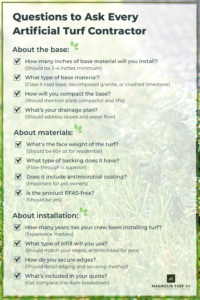
Ask every contractor the same specific questions:
About the base:
- How many inches of base material will you install? (Should be three to four inches minimum)
- What type of base material? (Class II road base, decomposed granite, or crushed limestone)
- How will you compact the base? (Should mention plate compactor and lifts)
- What’s your drainage plan? (Should address slopes and water flow)
About materials:
- What’s the face weight of the turf? (Should be 60+ oz for residential)
- What type of backing does it have? (Flow-through is superior)
- Does it include antimicrobial coating? (Important for pet owners)
- Is the product PFAS-free? (Should be yes)
About installation:
- How many years has your crew been installing turf? (Experience matters)
- What type of infill will you use? (Should match your needs; antimicrobial for pets)
- How do you secure edges? (Should detail edging and securing method)
- What’s included in your quote? (Get complete line-item breakdown)
Red Flags That Indicate Shortcuts
Vague answers about base work: If they won’t specify depth and compaction process, they’re probably skipping proper base.
No mention of weed barrier: It’s inexpensive and essential. Skipping it suggests other shortcuts.
Pressure to sign immediately: Quality installers don’t need pressure tactics. They let their work speak for itself.
Unusually low pricing: If a quote comes in 30–40% below others, they’ve eliminated the base work or downgraded to budget materials.
No insurance or licensing information provided: Professional contractors provide this upfront without being asked.
Generic product descriptions: “Standard artificial grass” or “premium turf” without specific specs means they’re not committed to particular quality.
No written warranty: Or warranty terms that are vague about coverage and duration.
Quality Indicators
- Detailed line-item quote: Shows exactly where your money goes
- Specific product specifications: Face weight, pile height, backing type, manufacturer
- Clear warranty terms: In writing, specifying coverage and requirements
- Professional references: Names and contacts of recent customers willing to share experiences
- Proof of insurance: Certificates from the insurance company, not copies
- Portfolio of completed projects: Photos showing similar installations to yours
- Transparent about limitations: Honest about challenges your specific site presents
Real Quote Comparison Example
Quote A: $9,000 for 1,000 sq ft ($9/sq ft)
- “Standard installation with basic turf”
- No base depth specified
- No product specifications listed
- No warranty mentioned
- Payment due upfront
Quote B: $14,000 for 1,000 sq ft ($14/sq ft)
- Line-item breakdown showing materials, labor, base work
- 4 inches of Class II road base with compaction details
- 75 oz polyethylene turf with flow-through backing
- Antimicrobial infill, weed barrier, edging all specified
- 15-year product warranty, 2-year installation warranty
- Standard payment schedule with final payment at completion
The $5,000 difference isn’t profit padding. It’s proper base preparation, high-quality materials, professional installation, and warranty backing.
Quote A will likely create a $15,000 repair need within three to five years. You’ll see wrinkles and bubbling from improper base settling, standing water that leaves your yard unusable after rain, seams that separate and curl up creating tripping hazards, and discolored patches where poor drainage has damaged the backing. Quote B is the real cost of high-quality installation done right.
Choose the installer you’d call back in three years when you have a question or concern. That matters more than saving money upfront.
Frequently Asked Questions
Do I need a permit for artificial turf installation?
Most residential installations don’t require permits, but requirements vary by city and HOA. Projects over 1,000 sq ft sometimes trigger permit requirements. Check with your local building department. Your installer should know local regulations. Permit costs typically range from $0–150 where required.
Will artificial turf increase my property value?
In drought-prone markets and areas where outdoor living spaces drive buyer interest, high-quality artificial turf can increase property value by 2–5%. The improvement comes from enhanced curb appeal, reduced maintenance concerns for buyers, and water conservation benefits. Properties with professionally installed turf typically show faster selling times.
Is artificial turf safe for pets?
Yes, when installed properly with the right features. Pet-safe turf requires flow-through backing for drainage, antimicrobial infill to prevent odors, and PFAS-free materials. Standard residential turf without these features will develop persistent odors, bacterial growth, drainage problems that leave puddles after your dog urinates, and premature matting in high-traffic areas. We’ve installed pet turf for hundreds of dog owners. Proper systems remain clean and odor-free with basic maintenance.
How long does artificial turf last?
High-quality materials with professional installation last 12–20 years, depending on use and maintenance. Polyethylene turf typically lasts 12–16 years. Nylon lasts 15–20 years. Budget materials may only last 8–12 years. Proper base work and installation matter as much as material quality for longevity.
What maintenance does artificial turf require?
Far less than natural grass. Basic maintenance includes:
- Regular brushing to keep fibers upright (monthly)
- Occasional rinsing to remove debris (as needed)
- Infill top-up every three to five years
- Pet area enzyme treatment if you have dogs
Total annual cost: $150–400. Time investment: 5–10 hours per year vs. 200+ hours for natural grass maintenance.
How hot does artificial turf get in Texas heat?
Turf does get warm in direct sun, though premium materials stay cooler than cheaper options. Nylon and polyethylene heat less than polypropylene. Light colors stay cooler than dark. Most homeowners find heat is only an issue during peak afternoon sun in summer. Shaded areas remain comfortable. Simple solution: Rinse your turf with water to cool it instantly for immediate use.
Does Florida humidity affect artificial turf?
Not with proper drainage. Flow-through backing that drains 900 inches per hour handles Florida rain without problems. Humidity doesn’t affect the turf material itself. Antimicrobial coating prevents moisture-related bacteria and mold growth. Thousands of Florida installations perform perfectly in high-humidity conditions.
Can I install artificial turf myself to save money?
Small areas under 200 sq ft can work for experienced DIYers. Larger installations require moving 9–12 tons of soil and base material, proper equipment (compactors, turf cutters), and technical precision (grading, seaming, securing). Common DIY mistakes cost $2,000–8,000 to repair. For primary lawn installations, professional installation protects your investment and often costs less than fixing DIY mistakes.
What happens if I need to access utilities under the turf?
High-quality installation allows for removal and reinstallation if utility access is needed. Proper edge securing and seaming make this possible without permanent damage. Note the location of sprinkler lines, electrical, and plumbing before installation. Your installer should identify and mark these.
Get Your Free Estimate: Expert Installation From Magnolia Turf
We’ve installed over 10,000 artificial turf projects across Texas and Florida. Every one starts with proper base work. No shortcuts. No exceptions.
What makes our installations different:
Proper sub-base every time: Three to four inches of decomposed granite or crushed limestone, properly compacted. This foundation keeps your turf looking great for 15 years, not five.
Premium materials that matter: Flow-through backing draining 900 inches per hour. Microban antimicrobial coating. PFAS-free products. Reinforced blade technology. Face weights of 60–90 oz, depending on your needs.
Owner accountability: David Turner personally oversees high-quality standards. We’re not a franchise. We’re locally owned, and our reputation depends on your satisfaction.
Transparent pricing: You’ll get a detailed line-item breakdown showing exactly where your investment goes without surprise fees or pressure tactics.
A 15-year warranty backing: We stand behind our materials and installation because we know they’ll last.
We serve these Texas and Florida markets:
- Dallas
- Houston
- Austin
- San Antonio
- Tampa
- Sarasota
What to expect from your free estimate:
- We’ll discuss your project goals and any specific concerns.
- We’ll measure your space and evaluate site conditions.
- You’ll get detailed pricing with material specifications.
- We’ll explain any site challenges that affect installation.
- You’ll receive a written quote with warranty information.
You’ll receive straightforward information to help you make the right decision without obligation or pressure.
High-quality artificial turf installation costs more upfront than cutting corners. It costs far less than replacing failing turf in five years or maintaining natural grass for 15 years.
Our approach pays for itself in 2.5–4 years and lasts 15+ years. Let us show you exactly what high-quality installation looks like and what it costs for your specific project.
Related Resources
- Installation process guide: Complete installation process breakdown
- Pet turf solutions: Specialized features for dog owners
- Cost calculator: Calculate your cost and 15-year savings
- Frequently asked questions: Get answers to common questions
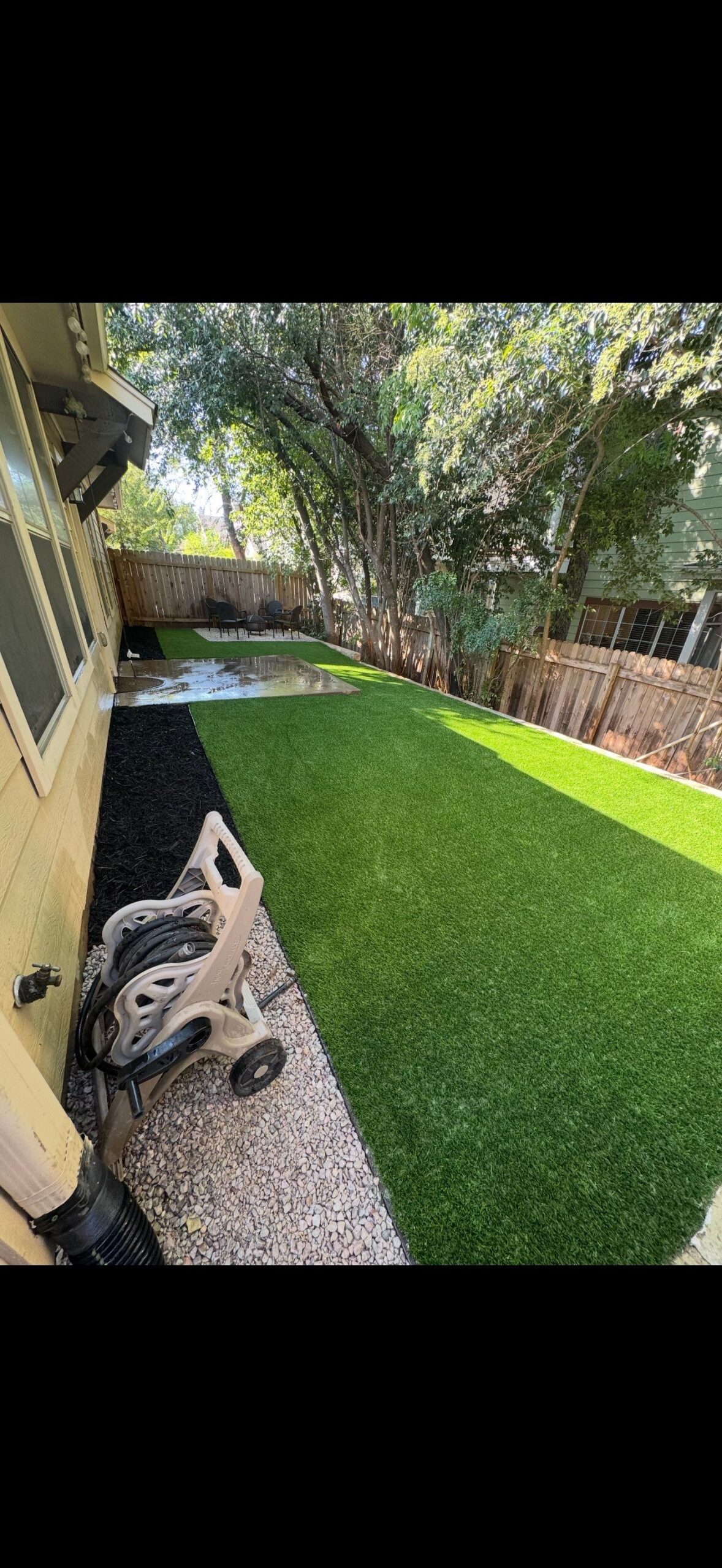
Magnolia Turf serves homeowners and contractors throughout Dallas, Houston, Austin, San Antonio, Tampa, and Sarasota with professional artificial turf installation backed by 10,000+ successful projects and a 15-year warranty. Contact us today for a free estimate and transparent pricing for your outdoor space transformation.