Artificial turf costs $7–$12 per square foot installed and lasts 15+ years with zero watering or mowing. Natural grass costs $0.10–$0.40 per square foot to install, but requires 100+ hours of annual maintenance and 40,000+ gallons of water.
Most Texas and Florida homeowners break even within five to seven years, thanks to savings on water and maintenance costs.
Quick Answer: Turf vs. Grass
If you’re tired of brown patches, dead zones from your dog, or spending every weekend mowing in 95°F heat, artificial turf is your solution. You’ll pay more upfront, but you’ll save time, water, and money over the years.
Natural grass looks great if you have time and water to spare. Most homeowners in Texas and Florida don’t.
Turf vs. Grass: What’s the Real Difference?
The real difference isn’t looks. Modern artificial turf doesn’t have that plastic, shiny look it did 10 years ago. We use delustered blades that look natural.
The difference is what happens after installation.
With natural grass, you’re signing up for fertilizing, weekly mowing, constant watering, and dealing with dead spots. In Texas or Florida, that means fighting extreme heat, drought restrictions, or heavy rainfall that turns your yard into a mud pit.
With artificial turf, you install it once and you’re done. No mowing. No watering. No dead grass from your dog’s urine. The surface stays consistent year-round.
Ready to see what artificial turf will cost for your yard? Get a free estimate.
Artificial Grass vs. Real Grass: The Real Cost
Here’s what your wallet will feel over time.
Artificial Turf
- Initial cost is $10,000–$20,000 for a typical 1,500 sq. ft. yard.
- Annual maintenance costs $100–$200 (occasional rinsing and brushing).
- Water savings add up to $600–$1,200 per year in Texas and Florida.
- Break even within five to seven years.
Natural Grass
- Initial cost is $150–$600 for sod installation.
- Annual maintenance runs $1,500–$3,000 (water, fertilizer, mowing, repairs).
- Time investment requires 100–150 hours per year.
- Long-term replanting is needed every 5–10 years in harsh climates.
We’ve installed over 10,000 yards in Texas and Florida. The customers who switch from natural grass save an average of $800 per year on water bills alone. Add in the time you’re not spending mowing and fertilizing, and the numbers make sense.
Does Artificial Turf Get Too Hot?
Yes, artificial turf gets hotter than natural grass in direct sun. In Florida and Texas, turf can reach 120–140°F on a 100°F day. Natural grass stays closer to the air temperature.
But most homeowners use their yards in the morning, evening, or under shade structures (pergolas, trees, covered patios, etc.). If you have to use your yard in the afternoon, our turf’s flow-through backing, which drains 30+ inches of water per hour, makes it possible. A quick rinse with the hose drops the surface temp by 30–40°F instantly. Plus, our zeolite infill reduces heat by 20–30% compared to standard infill.
If you’re barefoot at 2 p.m. in August on exposed turf, yes, you’ll be uncomfortable. But most homeowners don’t use their yard that way. Natural grass in Texas turns brown and dead during the summer anyway. Hot and dead isn’t better than just hot.
Turf vs. Grass Maintenance: What You’re Signing Up For
Natural Grass:
- Mowing every five to seven days takes two to three hours per week.
- Watering three to four times per week is required in Texas and Florida heat.
- Fertilizing happens four to six times per year.
- Dealing with weeds, pests, and brown patches never ends.
- Replanting dead zones from pets, heavy use, or drought is constant.
- Total time adds up to 100–150 hours per year.
Artificial Turf:
- Rinsing with a hose happens occasionally (monthly in most cases).
- Brushing infill takes 15 minutes every few months if it compacts.
- Removing leaves and debris happens as needed.
- Total maintenance time is only 5–10 hours per year.
But don’t take it from us. Take it from one of our customers in Houston, who has three dogs and told us he used to spend every Saturday morning dealing with dead grass and mud. Now he spends that time with his kids.
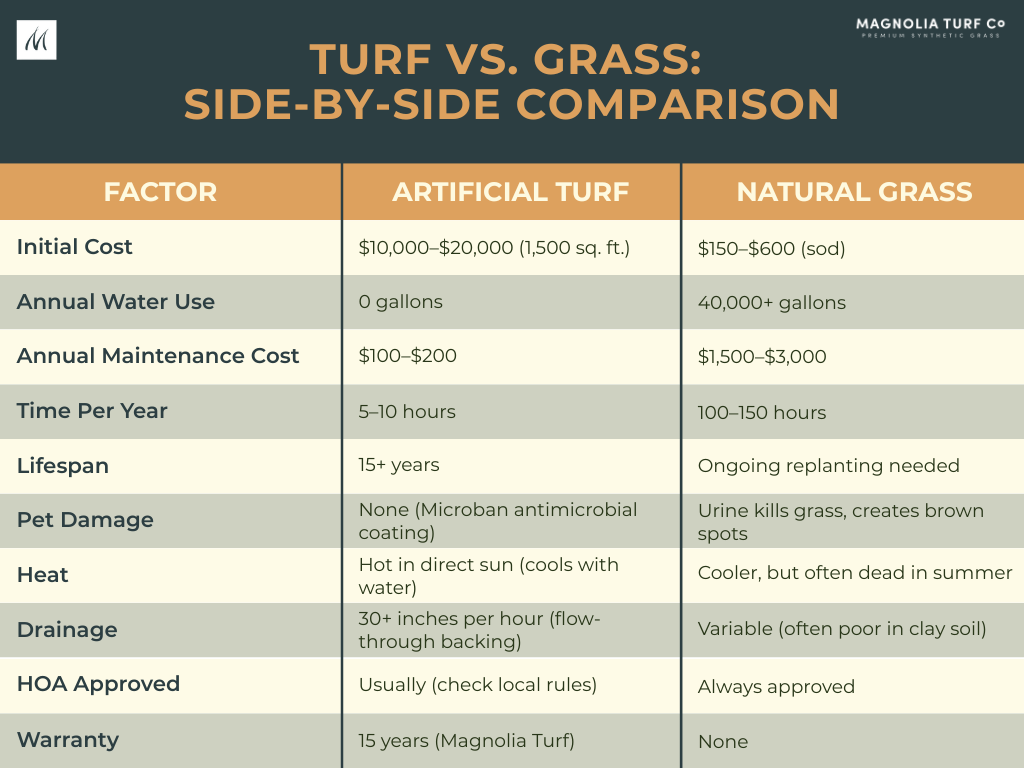
Turf vs. Grass: Side-by-Side Comparison
Artificial Turf vs. Natural Grass for Pets and Kids
Artificial turf is the clear choice for families, especially families with pets.
For Dogs:
- Microban antimicrobial coating reduces urine-induced bacteria by 99%.
- No more dead grass patches or mud tracked into your house.
- Flow-through backing prevents puddles and keeps the surface dry.
- Easy cleanup happens with just a hose rinse.
Learn more about pet turf options.
For Kids:
- Soft, consistent surface is ideal for playing (no holes or uneven ground).
- PFAS-free and 100% lead-free materials ensure safety.
- No pesticides or fertilizers that kids roll around in.
- Stays clean and usable year-round.
A couple in San Antonio with two kids and a golden retriever told us switching to artificial turf was “the best decision we made for our backyard.” They don’t have to deal with muddy paw prints or brown patches anymore.
Why Texas and Florida Homeowners Choose Turf Over Grass
Texas Challenges:
- Extreme heat kills natural grass (100°F+ summers).
- Drought and water restrictions limit watering.
- High water bills run $600–$1,200 per year just for grass.
- Clay soil with poor drainage creates mud problems.
Florida Challenges:
- Heavy rainfall and humidity create fungus, disease, and mud.
- Hurricane damage tears up natural grass.
- Year-round growing season means constant maintenance.
- Sandy soil drains too quickly or clay soil holds water too long.
In both states, natural grass fights against the climate, while artificial turf works with it. We’ve installed over 10,000 yards in Dallas, Houston, Austin, San Antonio, Tampa, and Sarasota. We know what works in these conditions.
Thinking about switching? Contact us for a free estimate.
Frequently Asked Questions About Turf vs. Grass
Will artificial turf look fake?
Not if it’s high-quality turf. We use delustered blades with varied colors and heights. Our installations look natural because we don’t cut corners on materials.
Can I install it myself?
We don’t recommend it. Proper installation requires a four-inch gravel base, precise grading for drainage, and professional seaming. We’ve fixed plenty of DIY jobs that failed within a year. It’s worth doing right the first time.
I have dogs. Will artificial turf smell?
Not with proper infill and drainage. Our flow-through backing and Microban coating prevent odor. Occasional rinsing keeps it fresh.
Will my HOA allow it?
Most do, but check first. HOAs in Texas and Florida have gotten more flexible about artificial turf as water conservation becomes increasingly important.
How long does installation take?
Most residential yards take two to four days, depending on size and site conditions.
What happens in heavy rain?
Our flow-through backing drains at 30+ inches per hour. Florida customers tell us it drains better than their old grass, which turned into a swamp during storms.
Is it environmentally friendly?
You’re saving 40,000+ gallons of water per year and eliminating the use of pesticides and fertilizers. The turf itself is PFAS-free and recyclable at the end of its life. It’s a trade-off, but water conservation wins in drought-prone areas.
Can I finance it?
Yes. Many homeowners finance installation. The monthly payment is often less than what you’re currently spending on water and lawn service.
Why Magnolia Turf?
Our owner, David Turner, oversees every installation. We’ve done this 10,000+ times across Texas and Florida, so we know what works in extreme heat, heavy rain, and everything in between.
Our turf comes with flow-through backing that drains 30+ inches of water per hour, Microban antimicrobial coating for pet areas, PFAS-free and lead-free materials, a 15-year warranty, and professional installation with proper base prep.
We don’t cut corners because we know what happens when you do: The turf fails, customers are unhappy, and we have to come back and fix it. We’d rather do it right the first time.
Ready to upgrade your yard? Get your free estimate today.