Table of Contents
- What Makes Artificial Grass Look Realistic?
- Choosing Realistic Turf for Texas and Florida Climates
- Most Realistic Artificial Grass Brands Compared
- How Professional Installation Makes or Breaks Turf Realism
- Safety and Health: PFAS-Free Turf, Microban, and Certifications That Matter
- Cost Guide: What Premium Realistic Turf Actually Costs
- Keeping Your Turf Looking Real for Years
- Frequently Asked Questions
- Get Your Free Estimate From Magnolia Turf
- Related Resources
- References and Additional Reading
What Makes Artificial Grass Look Realistic? The Technology Behind Modern Turf
Most homeowners worry that artificial grass will look obviously fake. That fear isn’t unfounded. Cheap turf installed poorly looks exactly like what it is: plastic carpet stapled to dirt.
But the gap between low-end turf and premium products has widened in a big way. The best artificial grass for landscapes in 2026 uses blade engineering, color science, and material technology that can fool your neighbors. We say that after installing over 10,000 projects across Texas and Florida, so we’ve seen which products hold up in your climate and which ones don’t.
Here’s what separates the most realistic artificial grass from the stuff that screams “fake” from the street.
Quick Answer: The most realistic artificial grass brands use multi-tone color blending, W-shape or S-shape blade technology, curly brown thatch layers, and face weights of 60–90 oz per square yard. Paired with professional installation and the right infill, premium turf is nearly indistinguishable from a natural lawn.
Who Is This Guide For?
This guide is built for homeowners in Texas and Florida who want turf that looks like a real lawn, not a green carpet. If any of these apply to you, keep reading:
- Curb appeal matters to you. You want a front yard that blends with your neighbors’ lawns, not one that announces “artificial” from the driveway.
- You have kids or pets (or both). You need turf that holds up under daily use and stays safe and clean.
- You’re comparing brands and products. You’ve seen the options online and want to know which ones actually deliver realistic results in Texas and Florida heat.
- You’re weighing DIY vs. professional installation. You want to understand how installation affects how your turf looks and lasts.
- Health and safety are priorities. You care about PFAS-free materials, antimicrobial protection, and third-party safety certifications.
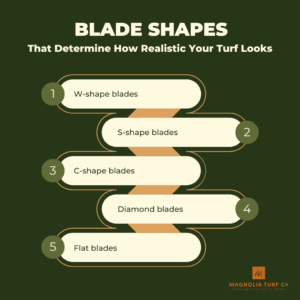
Blade Shape Technology
The cross-section of each grass blade changes how light hits the surface, how the turf feels underfoot, and how long it holds up under traffic.
- W-shape blades scatter light across multiple bends, eliminating the flat, mirror-like glare that makes cheap turf look plastic. The reinforced spine resists matting under heavy foot traffic, so your lawn keeps its realistic look year after year.
- S-shape blades feature a curved profile that cuts surface reflection and gives a softer, more natural crush underfoot. Many include LusterGuard technology, which adds microscopic ribs to diffuse sunlight and kill the shiny “plastic” look.
- C-shape blades act like a spring, bouncing back from compression and footprints faster than flat blades. Your yard recovers its shape quickly after kids play or the dog runs laps. They’re a great fit for playground and play areas and dog yards.
- Diamond blades combine a wider mid-section with tapered edges for a plush, soft feel. They look natural and work well for residential landscapes where curb appeal is the top priority, giving your front yard the lush look of a well-maintained lawn.
- Flat blades are the cheapest to produce. They reflect more light, mat quickly in high-traffic zones, and run hotter in Texas and Florida sun. After minimal use, flat blades bend and look like matted confetti.
Color, Thatch, and Density
A single shade of green looks fake from 50 feet away. Premium turf blends three distinct tones (field green, apple green, olive) to replicate a real lawn’s visual complexity.
A curly brown and tan thatch layer near the base mimics the dead grass found in natural lawns. This thatch supports the face blades and holds infill in place, keeping your lawn looking full and upright longer.
Face weight, measured in ounces per square yard, determines density. For the most realistic artificial grass, aim for 60–90 oz. Lower face weights look sparse, show rows, and read “fake” faster, especially in angled sunlight.
Pile Height and Infill
The best visual realism comes from a pile height between 1.5 and two inches. Shorter than 1.5 inches looks like carpet. Taller than two inches becomes hard to maintain and tends to lie flat.
Infill stabilizes blades so they stand upright, adds cushioning, and affects how the turf sounds and feels when you walk on it.
- Silica sand provides drainage and ballast at low cost but can trap odors in pet areas.
- Envirofill is a round, acrylic-coated sand infused with Microban antimicrobial protection. It doesn’t absorb pet urine and prevents odor buildup.
- OptiFILL+ is a natural mineral infill that absorbs and neutralizes ammonia from urine. It’s non-toxic, safe for pets, and effective at odor control.
- Crumb rubber offers bounce for sports fields but absorbs heat, tracks black dust, and isn’t ideal for residential yards.
- Cooling infills store and evaporate water to lower surface temperatures, making them a smart choice for pool decks and play areas in Texas and Florida heat.
Learn more about artificial grass infill options and which type works best for your yard.
Choosing Realistic Turf for Texas and Florida Climates
Premium turf that looks great in Oregon might fail in Dallas. Climate dictates which technologies matter and which products maintain their realism over time.
Texas Heat Performance
All artificial turf gets hotter than natural grass in direct sun; that’s physics. But it doesn’t retain heat like concrete. A one-minute rinse with a hose cools the surface for several hours.
Here’s what separates premium products in Texas heat:
- UV stabilizers blended into the yarn during extrusion prevent fading, brittleness, and color degradation for 15+ years, even in high-UV markets like Dallas and Austin. That means your most realistic artificial grass stays looking fresh instead of chalky and washed out.
- LusterGuard technology on S-shape and similar blades eliminates the shiny, whitish look that develops when sun softens cheaper fibers. Your turf won’t develop that telltale sheen that makes neighbors do a double-take.
- Nylon turf like Nylon 50 (or the Nylon 65 option) withstands extreme heat from Low-E glass window reflection that can melt standard polyethylene products. If your home has energy-efficient windows, nylon prevents you from replacing melted turf sections near the glass.
Without these features, you’ll see chalking, fading toward yellow, and permanent matting within a few years. With them, color stays stable through a 15-year warranty period.
Florida’s Unique Challenges
Tampa and Sarasota get 60+ inches of annual rainfall with intense afternoon deluges. Humidity creates mold and bacteria risk. UV exposure is relentless year-round.
Flow-through backing is non-negotiable in Florida. Standard hole-punched backing drains slowly. Flow-through backing is 100% permeable and drains at over 900 inches per hour. No pooling. No flooding. Your yard is usable minutes after a downpour.
Microban antimicrobial technology is coated onto turf blades and backing during manufacturing. It inhibits bacteria, mold, and mildew growth 24/7, keeping the surface hygienic and odor-free in humid conditions.
See how flow-through backing handles storms in Texas and Florida.
Matching Your Neighbors’ Lawns
The most realistic artificial grass blends with the surrounding landscape when it mimics the grass species your neighbors are growing.

Most Realistic Artificial Grass Brands Compared
We’ve installed turf from every leading manufacturer. Here’s what we’ve learned about realism across the brands available through professional installers.
What to Compare Across Brands
When evaluating the most realistic artificial grass brands, focus on these factors:

Application-Specific Recommendations
Different areas of your property demand different products.
Front lawns need the highest realism since they’re always visible. Look for multi-tone color blending, dense thatch layers, and face weight above 70 oz. S-shape or diamond blades with LusterGuard technology create the most convincing curb appeal. Our Magnolia Supreme 75 turf is built for front lawns, with a 75 oz face weight and multi-tone blending that matches the look of a professionally maintained natural yard.
Backyards and family areas prioritize durability alongside appearance. W-shape and C-shape blades handle heavy foot traffic from kids and pets and maintain their upright appearance. Pair with antimicrobial infill if you have dogs to keep your yard smelling fresh between cleanings.
Pet areas require flow-through backing (900+ inches per hour drainage), Microban antimicrobial coating, and durable blade shapes that resist the wear patterns dogs create. Our Pet Turf 60 uses a 1.75-inch pile height with reinforced blade design, paired with OptiFILL+ or zeolite infill for odor control. The result: a yard that drains pet waste in seconds, stays odor-free between cleanings, and holds up to daily wear for 15+ years.
Pool surrounds need UV-stabilized fibers, superior drainage to handle splash zones, and a comfortable barefoot feel. Cooling infill reduces surface temperature on hot days, so you can walk barefoot from the pool to the house without burning your feet.
Read our complete guide to pet turf for more on choosing and maintaining turf for dogs.
Professional-Grade vs. Consumer-Grade Products
Big-box retailers and online sellers offer turf at lower price points. The products look similar in photos and spec sheets.
The difference shows up after installation. Consumer-grade turf typically uses flat or simple blade shapes, thinner backing with hole-punch drainage, lower face weights (under 60 oz), and fewer UV stabilizers. Within two to three years in Texas or Florida sun, you’ll notice fading, matting, and the backing showing through.
Professional-grade brands available through certified installers use engineered blade shapes, flow-through backing, built-in antimicrobial protection, and higher face weights designed for 15+ year performance. The turf costs more per square foot, but it looks realistic for three times as long.
See why our competitive advantage starts with materials.
How Professional Installation Makes or Breaks Turf Realism
We’ve repaired hundreds of failing installations. The turf itself was fine in most cases. The installation made it look fake.
The same premium product can look either convincingly real or obviously artificial based entirely on how it’s put in the ground.
The Techniques That Make or Break Realism
Base preparation determines everything. Excavate three to four inches and install a sub-base of crushed limestone or decomposed granite. Compact it using a plate compactor to prevent sinkholes, dips, and wrinkles over time.
Skip this step, and your turf develops waves and soft spots within a year. Learn what goes under artificial turf and why it matters.
Seam placement separates amateurs from professionals. Edges get trimmed at a 45-degree angle to prevent bunching. High-tensile seaming tape and non-galvanized U-nails (which rust and swell to lock the turf into the earth) make seams invisible.
Grain direction matters more than most people realize. All turf sections get laid with fibers pointing in the exact same direction. Mismatched grain makes panels obvious, like a patchwork quilt instead of a lawn.
Infill application and brushing complete the look. A drop spreader distributes infill evenly, then a power broom works it deep into the base and lifts fibers so they stand upright. The result looks like freshly mowed, healthy grass.
DIY vs. Professional: The Realism Gap
DIY installation saves money upfront but rarely produces realistic results. The most common problems we see in DIY jobs: visible seams running across the lawn, wrinkles from inadequate base compaction, edges pulling away from borders, and mismatched grain direction between panels.
Professional installation costs more for good reason: It includes proper equipment, experienced crews, and the technical precision that makes turf look real. We’ve done this 10,000 times, and that experience means invisible seams, flat surfaces, and a lawn that looks right from the curb on day one.
See our step-by-step installation process to understand how we get these results.
Safety and Health: PFAS-Free Turf, Microban, and Certifications That Matter
Realistic turf matters. Safe turf is non-negotiable.
PFAS: What You Need to Know
PFAS (per- and polyfluoroalkyl substances) are man-made chemicals used for water and stain repellency. They’re called “forever chemicals” for a reason: They persist in your body and the environment indefinitely.
Some older turf products contain PFAS. Research has linked PFAS exposure to cancer, immune dysfunction, thyroid disease, and developmental issues.
We only install 100% PFAS-free, 100% lead-free products. Your family’s health isn’t a place to cut costs.
Microban Antimicrobial Protection
Microban agents are added to blade resin and backing during manufacturing. They inhibit bacteria, mold, and mildew growth on the turf surface around the clock.
For families with kids and pets playing on turf in warm climates, Microban keeps the surface cleaner between washings and reduces odors. The protection is embedded and won’t wash off, so you’ll never need to reapply it or worry about it wearing down.
Microban isn’t a substitute for routine rinsing. It’s a built-in layer of protection that supports hygiene and keeps your turf fresher between cleanings.
Certifications to Ask About
When evaluating the most realistic artificial grass brands, look for these safety benchmarks:
- ASTM standards for impact attenuation (F1292) on play surfaces and flammability (E648, D2859)
- CPSC FF 1-70 flammability compliance
- PFAS-free verification through independent third-party testing
- REACH compliance (EU chemicals regulation) for products tested against substances of high concern
Ask your installer for data sheets and proof of claimed testing. Any reputable company provides this documentation without hesitation.
Cost Guide: What Premium Realistic Turf Actually Costs in Texas and Florida
The most realistic artificial grass costs more than the products you’ll find at a hardware store. Here’s what drives the pricing and why the investment makes sense long-term.
Use our turf price calculator for a quick estimate.
Cost Breakdown
Premium realistic turf installation includes materials, base preparation, labor, and infill. In DFW, turnkey pricing for quality landscape turf (including tear-out, haul-off, sub-base, turf, installation, and infill) runs $8–$10+ per square foot, depending on product selection and project size.
Smaller projects under 400 square feet run higher per square foot. Larger projects over 2,500 square feet benefit from economies of scale.
Florida markets trend slightly higher at $11–$17 per square foot for drainage requirements and humidity considerations.
The price difference between tiers comes from face weight (a 75 oz turf costs more than a 60 oz), blade technology (S-shapes vs. flat), backing type (flow-through vs. hole-punch), and infill choice (antimicrobial OptiFILL+ vs. standard silica).
Why the Cheapest Quote Costs More Long-Term
Companies quoting $5–$6 per square foot are cutting the base work, downgrading materials, or both. Two years later, you’re looking at wrinkles, failed seams, standing water, and turf that’s matted flat.
We’ve repaired enough of these installations to know the math. Quality costs more upfront. Shortcuts cost more in the long run.
ROI vs. Natural Grass
For a typical 1,200-square-foot lawn, natural grass maintenance runs approximately $2,268 annually in Texas for water, fertilizer, chemicals, and mowing. Artificial turf maintenance runs $150–$400 per year for occasional brushing, rinsing, and infill top-ups.
Artificial turf typically pays for itself in 2.5 to four years compared to natural grass maintenance costs. Over a 15-year period, natural grass maintenance totals $34,000–$61,000.
Artificial turf ownership (initial investment plus maintenance) runs $18,500–$23,500. See the full turf vs. grass cost comparison for details.
Get the complete cost breakdown guide with market-specific pricing.
Ready to See What Premium Turf Costs for Your Yard?
Every project is different. Square footage, site conditions, product selection, and infill choice all affect your final price.
Request a free estimate and we’ll walk through the specifics for your property. No pressure, no obligation.
Keeping Your Turf Looking Real for Years: Maintenance and Longevity
Premium turf stays realistic with minimal care, but “minimal” doesn’t mean “zero.” Check out our complete turf maintenance guide for detailed seasonal schedules.
Seasonal Maintenance for Texas and Florida
Spring: Power-broom or stiff-rake high-traffic areas to stand blades upright. Top off infill where backing shows. Inspect seams and edges.
Summer: Rinse dust and pollen periodically. Hose down high-heat areas (a one-minute rinse cools the surface for hours). Clean pet waste promptly. In Florida, keep leaves and debris cleared so drainage stays open.
Fall/Winter: Leaf-blow debris, check drainage performance after heavy rains, and re-broom any flattened paths or play areas.
Preventing Premature Aging
Matting happens from heavy traffic on low-quality flat blades or from failing to maintain proper infill levels (two to three lbs per square foot). Power-brooming every three to five years restores compacted turf.
Fading happens fast in cheap products without UV stabilizers. Premium turf with built-in UV inhibitors maintains color for 15+ years. That’s why choosing the most realistic artificial grass brands upfront saves you from a full replacement down the road.
Infill displacement results from high-pressure washers, vacuums with beater bars, or pets running the same track repeatedly. Periodic inspection and spot top-ups fix this easily.
Weed intrusion is preventable with proper weed barrier installation during the initial setup. Quality installers include this as standard, so you won’t pay extra or deal with weeds poking through your turf down the road.
Premium vs. Budget: The Longevity Difference
Budget turf in Texas or Florida sun shows visible aging within three to five years. Colors wash out, blades mat permanently, and the backing deteriorates.
Premium turf with UV stabilizers, reinforced blade shapes, and flow-through backing maintains its realistic appearance for 15+ years with basic maintenance. The gap between budget and premium grows wider every year you own the product.
Frequently Asked Questions
How long does realistic artificial grass last?
Premium artificial grass with proper installation lasts 15–20 years. Budget products may show aging within five to eight years, especially in high-UV climates like Texas and Florida.
Polyethylene turf typically lasts 12–16 years. Nylon lasts 15–20 years. Proper base work and installation matter as much as material quality for longevity.
Does artificial grass get too hot to walk on?
Turf does get warm in direct sun during peak hours (12 p.m. to 4 p.m.), though premium materials stay cooler than cheaper options.
Nylon and polyethylene heat less than polypropylene. Light colors stay cooler than dark. A quick hose rinse cools the surface instantly for immediate use.
Can neighbors tell the difference between artificial and natural grass?
With premium products and professional installation, most neighbors can’t distinguish artificial turf from natural grass. Multi-tone color blending, thatch layers, and proper grain direction create a convincing appearance.
The biggest giveaways of fake-looking turf are visible seams, mismatched grain, and low face weight.
How does artificial grass hold up with dogs?
Dogs are hard on any lawn surface. Quality pet turf with flow-through backing (900+ inches per hour drainage), Microban antimicrobial coating, and reinforced blade shapes handles daily pet use for 15+ years.
Pair with antimicrobial infill like OptiFILL+ or Envirofill to prevent odor buildup. Weekly rinsing keeps pet areas fresh.
Does artificial turf affect home value?
Artificial turf can increase property value by 2–5% in markets where water conservation and low-maintenance outdoor living drive buyer interest. In drought-prone areas of Texas and Florida, the improved curb appeal and reduced maintenance concerns make properties more attractive to buyers.
How do I know if a brand’s turf is safe?
Ask for third-party testing documentation. Verify the product is PFAS-free and lead-free through independent testing.
Look for ASTM compliance, CPSC standards, and Microban antimicrobial certification. Reputable manufacturers and installers provide this documentation without hesitation.
Is artificial turf worth the investment over natural grass?
For most Texas and Florida homeowners, yes. Natural grass costs $2,268+ annually in water, chemicals, and maintenance. Artificial turf reduces that to $150–$400 per year.
The investment typically pays for itself in 2.5 to four years and saves $15,000–$42,000 over 15 years compared to natural grass. Add in 200+ hours of annual time savings from eliminating mowing and lawn care, and the value becomes clear.
Get Your Free Estimate From Magnolia Turf
We’ve installed over 10,000 artificial turf projects across Texas and Florida. That volume means we’ve handled every soil type, drainage challenge, and tricky property layout your project might throw at us.
Every one starts with proper base work. No shortcuts, no exceptions.
What makes our installations different:
Proper sub-base every time. Three to four inches of decomposed granite or crushed limestone, properly compacted. This base work keeps your turf looking great for 15 years, not five.
Premium materials that matter. Flow-through backing draining 900 inches per hour. Microban antimicrobial coating. PFAS-free products. Reinforced blade technology. Face weights of 60–90 oz, depending on your needs.
For you, that means a yard that drains instantly after storms, stays clean and odor-free with pets, and looks realistic for the full warranty period.
Owner accountability. David Turner personally oversees quality standards. You’re not handing your project to an unsupervised crew: If something isn’t right, the owner knows about it and fixes it.
We’re not a franchise. We’re locally owned, and our reputation depends on your satisfaction.
Fifteen-year warranty backing. We stand behind our materials and installation. If anything goes wrong with materials or workmanship, we cover it at no extra cost to you.
We Serve These Texas and Florida Markets:
- Dallas
- Houston
- Austin
- San Antonio
- Tampa
- Sarasota
What to Expect From Your Free Estimate:
- We’ll discuss your project goals and any specific concerns.
- We’ll measure your space and evaluate site conditions.
- You’ll get detailed pricing with material specifications.
- We’ll explain any site challenges that affect installation.
- You’ll receive a written quote with warranty information.
We offer free sample boxes so you can see and feel our most realistic artificial grass products before committing. Straightforward information to help you make the right decision, with no pressure.
Get a free estimate or schedule a consultation today.
Related Resources and Internal Links
- Pet Turf and Artificial Grass for Dogs
- How Magnolia Turf Installs Artificial Grass: Step by Step
- Artificial Turf Maintenance: Complete Care Guide
- Artificial Grass Installation Costs: The Complete Guide to Investment, ROI, and What You Really Pay
- Artificial Grass Drainage Systems Explained
- Types of Artificial Turf: Which One Is Right for You?
- Artificial Grass Infill Solutions
- Turf vs. Grass: Complete Comparison for Texas and Florida
- Browse Our Completed Projects
References, Standards, and Additional Reading
- ASTM F1292: Standard specification for impact attenuation of surfacing materials within the use zone of playground equipment
- ASTM E648: Standard test method for critical radiant flux of floor-covering systems using a radiant heat energy source
- ASTM D2859: Standard test method for ignition characteristics of finished textile floor covering materials
- U.S. Consumer Product Safety Commission: Flammable Fabrics Act guidance, including CPSC FF 1-70 surface flammability standard for carpets and rugs
- EU REACH Regulation (ECHA): Candidate list of substances of very high concern (SVHC), including PFAS and heavy metals
- Microban International: Built-in antimicrobial technology specifications for synthetic turf
- Texas A&M AgriLife Extension: Regional turfgrass species identification for Texas (Bermuda, St. Augustine, Zoysia)
- University of Florida IFAS Extension: Warm-season turfgrass selection and management for Florida landscapes
- Mount Sinai Institute for Exposomic Research: Position statement on artificial turf surfaces and PFAS