Most artificial turf doesn’t fail on its own. It fails when the work underneath it isn’t done right.
We’ve seen turf hold up for 15 years with dogs, kids, and Texas heat. We’ve ripped out competitor installs that looked terrible after three or four years.
We’ve installed over 10,000 artificial turf projects across Texas and Florida, so we’ve seen what lasts and what doesn’t. Homeowners always ask us the same question: How long does turf last?
How Long Does Turf Last? Quick Answer
Premium artificial turf with professional installation lasts 15 years minimum, with the potential for 20 or more years with proper care.
Low-quality products or shortcut installations give you eight to 12 years if you’re lucky. The difference comes down to product quality, installation technique, and maintenance.
Here’s what determines how long your artificial turf will last.
How Long Does Artificial Turf Really Last? The Range Explained
The industry throws around all kinds of numbers: eight-year warranties, 15-year warranties, 20-year warranties. We’ve seen them all.
At Magnolia Turf, we put a 15-year warranty on our products, which means if anything goes wrong with the turf itself, you’re covered. We’ve watched our installs hold up under real conditions, so we know what that warranty means in practice.
The turf at my parents’ house went in about 11 years ago. They have a dog, and grandkids and nieces and nephews are always running on it. The blades still stand upright, with no matting, and it still looks good.
We’ve seen plenty of installs from other companies fall apart in three to five years. The difference comes down to three factors: product quality, installation technique, and maintenance. Get all three right, and your turf will outlast most natural grass lawns by a decade or more.
Why Blade Engineering Determines How Long Your Turf Lasts
Every turf product has a blade. The shape of that blade determines whether your turf looks great in year 10 or mats down in year three.
Flat blades are the most common in lower-cost products. Step on them, and they fold over. Over time, they stay down, and the yard starts looking like flattened confetti instead of grass.
Shaped blades, like the W and S profiles we use at Magnolia, have a structural spine built into each fiber. That spine gives the blade memory, so it bounces back after foot traffic, furniture, and dogs tearing across the yard. Your lawn looks freshly installed years later, not flattened and worn.
We don’t guess about this. We test it. Lisport testing uses a machine to simulate heavy foot traffic over an extended period, measuring how well blades hold up under repeated stress.
That data tells us how long the product will perform before it starts to wear. For you, that means you’re not gambling on whether your turf will hold up; we’ve already proven it will before it goes in your yard.
The backing matters, too. Traditional turf uses hole-punched backing with drainage holes spaced every three inches. Our turf uses flow-through backing with tiny open holes across every millimeter of the surface.
The result: 900 inches of drainage per hour, roughly 2,900% faster than standard turf. Liquids move through instantly rather than pooling on the surface, which prevents mold, bacterial buildup, and the kind of backing deterioration that kills turf early.
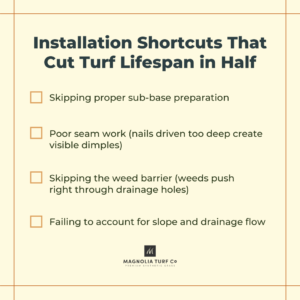
The Installation Shortcuts That Cut Turf Lifespan in Half
Quality turf on a bad installation won’t last. The material itself is only half the equation.
The biggest shortcut installers take is skipping proper sub-base preparation. Magnolia installs three to four inches of compacted decomposed granite or crushed limestone on every project. That base keeps your yard flat, draining properly, and looking good for the full 15-year life of the install.
Without enough base, or without proper compaction, the ground shifts over time. Dips form, and sinkholes develop. The surface becomes uneven, and no amount of maintenance fixes a settling problem.
You don’t want a yard full of wrinkles and low spots after spending this kind of money.
Other common shortcuts include poor seam work (nails driven too deep create visible dimples), skipping the weed barrier (weeds push right through drainage holes), and failing to account for slope and drainage flow. Each one shaves years off the installation’s life.
The installation technique matters as much as the turf itself. We’ve seen enough five-year failures from other companies to know the pattern. It almost always traces back to the base.
Texas Heat and Florida Sun: How Climate Affects Turf Longevity
Texas and Florida both deliver intense UV exposure. That sun will break down a low-quality product faster than foot traffic will.
We’ve seen products built for California climates that won’t hold up in Texas or Florida. The sun beats down harder here, speeding up blade matting and causing fraying at the fiber tips. How long turf lasts in this kind of heat depends on the product: A turf rated for 15 years in San Diego might give you eight in Dallas.
Every product we install is UV-tested for performance under prolonged sunlight exposure, so you know it won’t break down in the conditions your yard actually faces. Our turf uses LusterGuard technology, which engineers microscopic ribs into the yarn to diffuse sunlight and prevent fading. These ribs eliminate weak points in the fiber, giving each blade better split resistance under heavy traffic, so you get the full 15-year lifespan even in our Texas and Florida heat.
For Florida’s humidity, Microban antimicrobial coating works around the clock to stop mold and mildew from growing on the surface, keeping the turf hygienic without any extra work on your part. Paired with flow-through drainage, moisture doesn’t sit long enough to cause problems.
We select every product for the climate it’s going into, so your turf performs the same in year 10 as it did on install day. That’s why we stand behind the 15-year warranty in markets where the heat and UV are as intense as anywhere in the country.
How Long Does Turf Last With Simple Maintenance?
Premium turf doesn’t need much upkeep, but a little maintenance goes a long way toward reaching that full 15-to-20-year lifespan.
The biggest maintenance task is brooming. Add infill sand across the surface and broom it into the turf. The sand fortifies the blades, helping them stand upright and resist matting.
If your blades start to lean, sand and a stiff broom bring them right back. You can do this yourself, or we offer a maintenance program with our own crew, so you don’t have to think about upkeep at all.
For pet owners, rinse the turf one to two times per week with a garden hose to flush urine through the drainage system. Use a leaf blower or plastic rake weekly to clear leaves and debris before they break down and clog drainage holes. Once or twice a year, apply an enzyme cleaner to break down any odor-causing bacteria.
Avoid harsh chemicals, alcohol-based cleaners, and power washers. These damage fibers and displace infill. Keep grills and fire pits off the surface, since hot embers melt plastic fibers.
The Real Cost: Why Turf Lifespan Affects Your Bottom Line
For a 1,200-square-foot lawn in Texas, natural grass costs roughly $1,068 per year when you factor in water, fertilizer, chemicals, and irrigation maintenance. Over 15 years, that’s about $16,020, and that doesn’t count your own time mowing and weeding.
A premium turf installation for that same 1,200 square feet runs roughly $10,000 to $11,200 upfront, with no ongoing annual costs. At that rate, turf pays for itself in about nine to 10 years. Every year after that is money back in your pocket.
The longer your turf lasts, the better the return. That circles back to product quality and installation.
Invest in both upfront, and the savings compound for 15 to 20 years. Check our full cost breakdown for pricing by project size.
Your Turf Lifespan Questions Answered
Does artificial grass fade over time?
High-quality turf with UV stabilization holds its color for 15-plus years, even under Texas and Florida sun. Products without UV protection can fade within three to five years. Look for LusterGuard or comparable UV inhibitor technology.
How long does artificial turf last with dogs?
With pet-friendly turf (Microban coating, flow-through drainage) and weekly rinsing, expect 15 to 20 years even with multiple large dogs. Product quality matters more than how many pets you have.
What’s the biggest mistake that shortens turf lifespan?
Skipping or skimping on the sub-base. Three to four inches of compacted crushed granite or limestone is non-negotiable for a long-lasting installation. This is where most low-cost installers cut corners.
How do I know if my turf is failing prematurely?
Matting, fading, lifting edges, or drainage problems within the first five years point to a quality or installation problem. Premium turf with proper installation won’t show those signs for a decade or more. Don’t accept premature failure as normal wear.
Get Turf Built to Last
How long turf lasts comes down to two things: who installs it and what they install. Get both right, and you’re looking at 15-plus years of low-maintenance outdoor space, with the potential for 20 or more.
David Turner personally oversees every Magnolia Turf project, so you’re working with the person accountable for the result, not a subcontracted crew. We’ve done this over 10,000 times across Texas and Florida, and that experience means we’ve already solved the problems other installers are still learning from.
Get Your Free Estimate | See Our Installations
Serving Dallas, Houston, Austin, San Antonio, Tampa, and Sarasota.