Artificial grass works in Texas in ways natural lawns can’t. It handles 100°F+ summers without browning, drains 900+ inches of liquid per hour during storms, and skips watering bans entirely.
Most Texas homeowners pay $7–$10 per square foot installed and recoup the investment in five to seven years.
Quick Answer About Artificial Grass in Texas
The Texas climate destroys natural grass. Drought, watering restrictions, brutal summers, and clay soil that pools water all work against you. Artificial grass solves these problems with one installation.
Our turf carries a 15-year warranty that protects your investment for the full payback period and beyond. Most installs last 15–20 years and save the average Texas homeowner $600–$1,200 a year on water alone.
Get a free estimate today for a custom quote on your yard.
Why Artificial Grass Makes Sense in Texas
Texas summers regularly hit 100°F for weeks at a time. The four largest metros (Dallas, Houston, Austin, San Antonio) impose watering restrictions every year. Natural lawns can’t survive without daily watering, and even then, they brown out by August.
Artificial grass doesn’t care about any of that. It stays green from January through December with no irrigation, so your water bill drops to zero on the lawn line. That savings matters when DFW homeowners commonly pay $600–$1,200 a year just to keep grass alive.
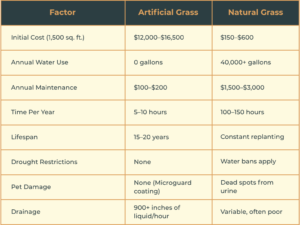
Drought isn’t the only problem. Texas storms drop two to four inches of rain per hour, which floods clay-heavy yards. Our Triflow Backing drains 900+ inches of liquid per hour, so water moves through our artificial grass drainage system instead of pooling in your yard.
Artificial Grass Cost in Texas
Installed pricing runs $7–$10 per square foot for residential turf. A typical 1,500-square-foot backyard runs $12,000–$16,500 fully installed. That number includes tear-out, sub-base prep, the turf itself, infill, and installation labor, so there are no surprise add-ons after you sign.
Pricing depends on three factors: yard size (larger jobs cost less per square foot), product line (pet-rated and play-rated turf costs slightly more), and any extras such as OptiFILL+ infill or steel edging. Larger projects above 5,000 square feet drop to $7–$9 per square foot, making whole-yard installs more cost-effective per square foot than small patio sections.
Most Texas homeowners hit break-even in five to seven years. After that, every year that grass would’ve cost you in water, mowing, fertilizer, and patching becomes pure savings.
See our complete cost breakdown or run the numbers on your yard with the turf price calculator.
Artificial Grass and Texas Heat
Artificial grass surface temperatures hit 120–140°F on a 100°F Texas day. That’s hotter than natural grass, which stays close to air temperature when it’s actually alive. By August, most Texas natural lawns are dead anyway, so the comparison gets less flattering for grass.
Two things make heat manageable. Light-colored turf runs 20–40°F cooler than dark options, so you have a real choice in how the yard feels barefoot. A quick rinse with the hose drops surface temperature by 30–40°F instantly, and our Triflow Backing drains the water in seconds with no soggy aftermath.
Most homeowners use their yards in the morning, evening, or under shade structures anyway. Pergolas, mature trees, and covered patios make midday use comfortable even in July. We help you pick the right turf color and infill for your specific use case so the yard performs the way you actually live in it.
Artificial Grass for Texas Pet Owners
Texas dogs destroy real lawns through traffic, digging, and urine that creates dead patches. Artificial grass eliminates all of that, so your yard stays green no matter how hard your dog runs on it.
Our Microguard antimicrobial coating reduces bacteria by 99% on the turf surface, which keeps the yard sanitary for kids and pets sharing the same space. Combined with Triflow Backing that drains 900+ inches of liquid per hour, urine moves through the turf instead of sitting on top. That’s the difference between a yard that smells fine and one that doesn’t.
For heavy pet use, we recommend our pet turf line with OptiFILL+ infill. OptiFILL+ adds another layer of odor control on top of the Microguard coating. It costs $0.40 more per square foot than standard infill and pays off the first time it rains and your yard doesn’t smell like a kennel.
Artificial Grass Installation in Your Texas City
We install across the state: Dallas and Fort Worth, the greater Houston area, Austin and surrounding cities, and San Antonio neighborhoods. Each region has its own quirks, and we adjust the installation to match so your yard performs in your specific climate.
DFW gets clay soil that holds water and freezes occasionally. Houston deals with humidity, hurricanes, and serious rainfall. Austin’s hill country has rocky soil that needs careful sub-base work, and San Antonio sees some of the worst drought conditions in the state.
Our proven installation process is the same in every market: four-inch crushed granite sub-base for long-term stability, professionally installed seams that stay invisible for the life of the product, and infill chosen for your specific use. The 15-year warranty travels with the install, so the coverage matches no matter which city you’re in.
Artificial Grass vs. Natural Grass in Texas
For a deeper side-by-side, see our full turf vs. grass comparison for Texas and Florida homeowners.
During Texas summers, skip the lawn-care nightmare. Request your free estimate.
Frequently Asked Questions About Artificial Grass in Texas
Does artificial grass work in Texas heat?
Yes. Surface temperatures get hot in direct sun (120–140°F on a 100°F day), but light-colored turf and a quick rinse drop temps fast. Most homeowners use yards in the morning, evening, or in shaded areas anyway.
Will my HOA allow artificial grass in Texas?
Most Texas HOAs allow artificial grass, especially as drought-tolerant landscaping protections have expanded in recent years. Always check your specific HOA rules first to confirm what’s permitted on your lot.
How long does artificial grass last in Texas?
High-quality artificial grass lasts 15–20 years in Texas with proper installation. Our turf includes UV stabilization to prevent fading from constant sun exposure. We back every residential install with a 15-year warranty, which means you’re covered for the entire payback period and most of the product’s useful life.
Is artificial grass safe for kids and pets?
Yes. Our turf is PFAS-free, 100% lead-free, and non-toxic, so children and pets can use the yard without exposure to harmful chemicals. The Microguard coating reduces bacteria by 99%, and the antimicrobial protection lasts the full life of the product.
How much can artificial grass save on Texas water bills?
The average Texas homeowner saves $600–$1,200 per year on water by switching to artificial grass. In drought years with watering restrictions, the savings climb higher. That’s how break-even hits in five to seven years.
Does artificial grass drain well in Texas storms?
Our Triflow Backing drains 900+ inches of liquid per hour, which handles the two-to-four-inch storm rainfall rates Texas regularly sees. Combined with a four-inch crushed granite sub-base, water moves through the turf instead of pooling in your yard.
What’s the difference between artificial grass and artificial turf?
There isn’t one. The terms are interchangeable. We use both depending on context, but it’s the same product.
Ready to Switch to Artificial Grass in Texas?
We’ve completed 10,000+ installations across Texas, which means we’ve already solved every common yard, soil, and climate challenge the state can throw at us. David Turner, our owner, personally oversees every project to make sure the sub-base is right, the seams are clean, and the install lasts the full warranty.
Get a free, no-pressure estimate for your yard, or call your nearest Magnolia Turf location:
- Dallas: (469) 940-7737
- Houston: (832) 346-5927
- Austin: (512) 595-0978
- San Antonio: (210) 972-7146
We’ll measure your yard, walk you through the product options, and give you a detailed quote.