Table of Contents
- Quick Answer About Artificial Grass Installation
- What to Expect From a Professional Artificial Grass Installation
- The Complete Artificial Grass Installation Process: From First Call to Final Walkthrough
- Pre-Install Homework for Your Artificial Grass Installation
- Day-by-Day Artificial Grass Installation Timeline
- Texas and Florida Climate Considerations for Artificial Grass Installation
- Anatomy of an Artificial Grass Installation Quote
- DIY vs. Big-Box vs. Local Specialist for Artificial Grass Installation
- Common Artificial Grass Installation Failures and How to Verify Quality
- Frequently Asked Questions About Artificial Grass Installation
- Get Your Free Artificial Grass Installation Estimate
- Related Resources
Search “artificial grass installation” online and you’ll find dozens of step-by-step DIY guides written for retailers and turf wholesalers. That isn’t what most homeowners need.
If you’re hiring a pro, your real question isn’t how to install turf yourself. It’s what hiring a pro looks like, what gets included, and how to tell the difference between a high-quality install and one that’ll fail in five years.
We’ve completed over 10,000 artificial turf projects across Texas and Florida, which means we’ve solved every install challenge that expansive clay, sandy soils, and Gulf storm patterns can throw at a residential yard.
This guide walks you through every step of a professional artificial grass installation, from the first phone call through the final walkthrough. You’ll learn what a good installer does, what a complete quote looks like, what climate-specific work Texas clay and Florida sandy soils demand, and what red flags to watch for.
By the end, you’ll know exactly what to expect and what to ask for.
Quick Answer About Artificial Grass Installation
Professional artificial grass installation includes site assessment, demolition, base preparation, drainage planning, turf placement, seaming, infill application, and a final walkthrough, all backed by a warranty. Most residential projects take one to three days, and turn-key pricing in DFW runs $7.60 to $10.30 per square foot depending on product and project size.
The single biggest predictor of a 15-year install (versus a five-year failure) is what’s underneath the turf. You want three to four inches of compacted decomposed granite or crushed limestone, graded for proper drainage, with Triflow Backing turf and Microguard-infused infill on top. Get those layers right and the surface holds up for 15 years instead of needing replacement in five.
What to Expect From a Professional Artificial Grass Installation
A professional artificial grass installation isn’t laying down a roll of turf. It’s a complete site rebuild: site assessment, demolition, base preparation, drainage planning, turf placement, seaming, infill application, and final detail work, all backed by a warranty.
The scope difference between professional and DIY is wide. A pro install includes:
- Removal of existing grass, sod, or hardscape
- Three to four inches of compacted decomposed granite or crushed limestone sub-base
- Proper grading for water flow
- Premium turf with Triflow Backing that drains 900+ inches of liquid per hour
- Antimicrobial-treated infill
- Secured perimeters and clean seams
- Walkthrough and warranty registration
This guide is written for homeowners hiring a contractor for a residential install. The same standards apply to contractors hiring an installation partner for client work. Magnolia Turf serves both, with about 60% homeowner installs and 40% contractor partnerships.
A high-quality artificial grass installation delivers even base depth across the entire footprint, no visible seams, and crisp edges locked against perimeters. Water clears within minutes of a downpour, the surface feels firm underfoot, and the finished look holds up for 15 years instead of five. That’s the floor for professional installation, and less than that means corners got cut somewhere.
The Complete Artificial Grass Installation Process: From First Call to Final Walkthrough
A professional artificial grass installation follows a predictable sequence. Knowing the sequence helps you spot installers who skip steps and helps you plan around your own life.
Stage 1: Initial Inquiry and Site Visit
You call or submit a free estimate request. A salesperson schedules a site visit, usually within a few days. During the visit, they measure your space, ask how you’ll use it (pets, kids, entertaining, putting practice), show turf samples, walk through product options, and discuss design choices like edging, transitions, and drainage.
A good site visit takes 45 to 90 minutes. If someone tries to sell you turf without seeing your yard, that’s a red flag.
Stage 2: Quote Review
Expect a written artificial grass installation quote within a few days. A complete quote includes line items for materials, labor, base prep, infill, edging, and any extras like sprinkler relocation or drainage upgrades. We’ll cover exactly what to expect on a quote further down.
Take your time. Ask questions. High-quality installers expect this and never pressure you to sign.
Stage 3: Scheduling and Materials
Once you sign, your project goes on the install calendar. In peak season (spring and fall in Texas, fall and winter in Florida), expect to book seven to 21 days out. Materials get ordered and staged for delivery the day before or morning of your install.
Stage 4: Installation
Most residential installs take one to three days. Larger or more complex projects can take three to five. The crew arrives early, stages equipment and materials, and works through demolition, base prep, turf placement, and infill in sequence.
Stage 5: Final Walkthrough
Before the crew leaves, you walk the project together. They show you what was done, point out edges and seams, explain maintenance, and confirm warranty coverage. You don’t pay the final balance until you’re satisfied.
Stage 6: Post-Install Follow-Up
Reputable installers check back during the first 30 to 90 days for any settling or seam issues. If issues come up, they come back.
Magnolia Turf backs every install with a 15-year product warranty covering fading, manufacturing defects, and balding, plus installation support if settling, wrinkles, or lifted edges occur. That means if a material fails, you don’t pay twice to replace it.
Pre-Install Homework for Your Artificial Grass Installation
The crew handles the install. Some prep work is yours to handle before they arrive.
HOA Approval
Most Texas and Florida HOAs require architectural review before exterior changes. Submit your application early. A good installer provides the documentation you’ll need: turf specs (color, pile height, face weight, backing type), an edge treatment plan, and a drainage plan.
Florida’s recent statute changes have made HOA approval easier for compliant residential synthetic turf, and Texas has statutory limits on outright HOA turf bans. You still need approval before work starts, so build that timeline into your project schedule.
Utility Locations and Sprinklers
Call 811 before any digging. It’s free, it’s required, and it prevents costly hits on gas, water, and electrical lines. Your installer typically initiates this, but confirm it’s been done.
If you have an irrigation system, decide what stays and what goes. Most homeowners cap and abandon sprinkler heads in the turf footprint. Some keep zones running for plant beds at the perimeter.
Talk through this during your site visit so it lands on the quote.
Identifying Problem Zones
Walk your yard with the salesperson. Point out spots that hold water after rain, areas where dogs have killed the grass, sections that get standing water, and slopes where erosion has cut channels. These zones often need extra base depth, modified grading, or perimeter drainage work.
Logistics During the Install Window
Plan ahead for the days your artificial grass installation crew is on site:
- Pets: Boarding, indoor confinement, or a temporary outdoor space. Wet adhesives and active machinery aren’t safe for dogs.
- Kids: Same logic. Loud equipment, exposed nails, and excavation make the yard off-limits during work hours.
- Vehicle access: Crews need driveway space for a dump trailer, materials, and tools.
- Neighbor coordination: Give a heads-up about noise. Most installs wrap by 4 or 5 p.m. each day.
- Plants: Plants and items inside the work zone need to be moved before day one. Don’t wait for the crew to do this.
A little prep on the front end keeps the install on schedule and avoids last-minute scrambles.
Day-by-Day Artificial Grass Installation Timeline
Every yard is different, but most residential installs follow the same rhythm. Here’s what to expect by project size.
Small Projects (Under 500 sq ft)
- Crew size: Two to three installers
- Duration: One day
- What happens: Sod removal in the morning, base prep and compaction by midday, turf placement and seaming in the afternoon, and infill and finish work to close.
You’ll hear light noise and see some dust during demo, and the yard is usable the next day.
Medium Projects (500 to 1,500 sq ft)
- Crew size: Three to four installers
- Duration: Two to three days
- What happens: Day one is full demo, excavation, and grading. Day two brings base materials, compaction, and turf layout. Day three handles seaming, infill, and walkthrough.
Heavier equipment runs on site for the first eight to 12 hours. The yard is typically usable for foot traffic by day three.
Large Projects (1,500 to 3,000 sq ft)
- Crew size: Four to six installers
- Duration: Three to five days
- What happens: Larger artificial grass installation projects require a multi-zone layout, more complex edges, multiple seams, integrated drainage runs, and possible sprinkler reroutes. Each phase takes longer.
Expect more equipment, more material deliveries, and longer days. The yard stays off-limits until the final walkthrough.
Extra Large Projects (3,000+ sq ft)
- Crew size: Four to six+ installers
- Duration: Four to seven days
- What happens: Multiple zones, deep drainage work, sometimes retaining or terracing, five or more seams, and detailed infill spreads.
These installs benefit from staging across two crews if scheduling allows.
What to Expect Each Day
- Demolition and excavation: The loudest day. Skid steers, sod cutters, and dump trailers haul off removed material the same day.
- Base preparation and compaction: Material delivery, spreading, and plate compactor work. Steady noise but less disruptive than demo.
- Turf placement and seaming: A quiet day with precise cutting, seam adhesive, and U-nail securing.
- Infill and grooming: Power broom and spreader work. Some dust as silica sand or OptiFILL+ gets brushed into the fibers.
- Final walkthrough: The crew chief walks every edge, every seam, and every transition with you.
If you spot a problem, that’s the time to flag it.
Texas and Florida Climate Considerations for Artificial Grass Installation
Most national turf content treats installation as one-size-fits-all. It isn’t. Texas and Florida soils, weather patterns, and storm risk demand specific adaptations that crews unfamiliar with these markets often miss.
Texas Clay Soils
DFW, Austin, Houston, and San Antonio sit on expansive clay that holds water near the surface and shifts with seasonal moisture changes. Installations on clay need:
- Thicker base material. Three to four inches of crushed limestone or decomposed granite is the floor. Some sites need more, which keeps the surface flat through years of clay shrink-swell cycles.
- Aggressive grading. A 1 to 2% slope away from structures keeps water moving toward designated drains instead of pooling under the turf.
- Heavier compaction. Plate compactor passes over the final lifts of the base to lock the entire base in place against the clay’s tendency to shift, so you don’t see ripples or low spots within a couple of seasons.
Skip any of this and you’ll see settling, ripples, and standing water within a couple of seasons.
Florida Sandy Soils and High Water Tables
Florida artificial grass installation looks different from Texas because Tampa and Sarasota sit on sandy soils with shallow water tables. The base requirements shift to match.
Material thickness is similar, but drainage planning matters even more. Perimeter trenching or French drains may be needed where water doesn’t move freely off-site.
The key product feature for Florida installs is permeable backing. Magnolia Turf’s Triflow Backing drains 900+ inches of liquid per hour, so during tropical downpours and afternoon storms, water moves through the turf and into the base instead of sitting on the surface.
Hurricane and High-Wind Anchoring
Florida coastal installs need extra perimeter security. Standard practice across both states is five-inch ungalvanized nails placed every six inches along the perimeter.
Ungalvanized is intentional. The nails rust slightly in the soil, expand, and create a permanent anchor that holds the turf flat even in high winds. Galvanized spikes or nails set too far apart are common shortcut markers, and they lift, rust unevenly, and let edges peel up over time.
Summer Heat and Install Scheduling
Texas summers and Florida’s humid season both push surface temperatures and crew safety to the limit. Adhesives also cure differently in extreme heat. Most high-quality installers schedule heavy work for cooler months (September through April) when possible, or start crews at sunrise during peak summer to avoid afternoon heat.
If a contractor wants to install at 2 p.m. in August with no schedule flexibility, that’s a sign they’re rushing.
Anatomy of an Artificial Grass Installation Quote
A professional quote tells you exactly where your money goes. A vague quote hides shortcuts. Here’s what every line covers.
Standard Line Items
- Turf material: Specific product name, face weight, backing type, and warranty
- Base materials: Decomposed granite, crushed limestone, or Class II road base, with depth specified
- Infill: Silica sand, OptiFILL+, T°Cool, or specialty options
- Demolition and haul off: Removal of existing grass, hardscape, or debris
- Labor: Excavation, grading, compaction, cutting, seaming, infill distribution
- Edging: Steel edge, poly board, or treated nail board where needed
- Drainage modifications: French drains or perimeter trenching where required
- Warranty: Product and installation coverage clearly stated
A typical professional quote splits roughly 50% materials and 50% labor.
DFW Pricing Reference (2025)
Magnolia Turf’s DFW turn-key pricing covers tear out, haul off, sub-base, turf, installation, infill, and minor irrigation work. By project size:
| Product | 200 to 400 sq ft | 1,000 to 1,500 sq ft | 5,000 to 7,500 sq ft |
| Select 60 | $9.30/sq ft | $8.30/sq ft | $7.60/sq ft |
| Olive 72 | $9.60/sq ft | $8.60/sq ft | $7.90/sq ft |
| Spring Supreme 75 | $10.30/sq ft | $9.30/sq ft | $8.60/sq ft |
| Kid Play | $10.00/sq ft | $9.00/sq ft | $8.30/sq ft |
Standard add-ons:
- OptiFILL+: +$0.40 per sq ft (Microguard-infused, recommended for pet areas to kill odor-causing bacteria)
- Steel edge: $6 per linear foot
- Poly board or treated nail board: $6 per linear foot
- 1.1″ underpad: $3.40 per sq ft (playground and high-impact areas)
- Nylon 50 upgrade: +$0.70 per sq ft over Spring Supreme 75
- Minimum project: $1,800
Florida pricing follows similar logic with adjustments for regional labor and material delivery. Specifics come during your site visit.
What Drives Cost Up or Down
Artificial grass installation pricing shifts based on a handful of factors:
- Project size: Larger jobs see meaningful per-square-foot reductions.
- Slope and access: Steep yards or tight side gates require more labor.
- Sprinkler relocation: Each capped or moved zone adds time.
- Product selection: Pet-grade turf and putting greens cost more than landscape turf.
- Drainage complexity: French drains or grading work add line items.
What’s Included vs. Excluded
Standard inclusions: tear out, haul off, sub-base prep, turf, install labor, basic infill, and minor irrigation. Standard exclusions: deep landscape design, retaining walls, hardscape work, electrical, and major irrigation rebuilds.
Financing
Magnolia Turf offers financing through Wisetack and Acorns, which lets you spread the investment across the same 2.5- to 4-year window when the turf pays itself back through eliminated water and lawn care bills. Approval and rates depend on your personal financials.
ROI Math
For a 1,200-sq-ft yard:
- Natural grass: Roughly $6,000 to install with irrigation. Annual maintenance (water, fertilizer, chemicals, repairs) runs approximately $2,268 to $4,068. Over 15 years: $34,020 to $61,020.
- Artificial turf: $10,800 to $16,920 installed depending on product selection. Annual maintenance $150 to $400, covering occasional brushing, debris rinsing, and infill top-ups every three to five years.
- Payback: 2.5 to 4 years through eliminated water bills, mowing, and lawn care.
That math is why most Magnolia customers tell us they wish they’d done it sooner.
DIY vs. Big-Box vs. Local Specialist for Artificial Grass Installation
Three paths exist for getting artificial grass installed. Each has trade-offs.
DIY
- Cost: Materials only, roughly $3 to $7 per sq ft
- Time: Several weekends for a small to medium yard
- Warranty: None (or manufacturer-only on the turf itself)
- Risk: High. Common DIY failures (poor base prep, visible seams, drainage issues, perimeter lifting) are expensive to fix.
DIY makes sense for small decorative areas under 200 sq ft if you have the equipment and time. For primary lawns, the math rarely works out.
Big-Box Retailer (Subcontracted Install)
- Cost: Mid-range, often comparable to local specialists
- Time: Scheduling depends on the subcontractor pool
- Warranty: Product warranty only, often 30 to 90 days or capped at one to two years on labor
- Accountability: Layered. The store sells, an independent crew installs, and claims bounce between them.
Big-box buyers often find out after the fact that the install crew isn’t an employee of the store. Service calls go through the store, then to the contractor, then sometimes back to the manufacturer. Resolving issues takes longer.
Local Owner-Operated Specialist
- Cost: Comparable to or slightly above big-box, with more value built in
- Time: Booking timelines are usually faster, especially in peak season
- Warranty: 15-year product warranty plus one- to five-year installation labor coverage
- Accountability: Single point of contact. The owner cares about the work because their name is on it.
Magnolia Turf is owner-operated by David Turner. Every install gets owner-level oversight, which means there’s a single name attached to your project and a single number to call if a problem comes up, instead of getting bounced between a store, a subcontractor, and a manufacturer. Service calls go directly to the crew that did the work.
Which Path Fits Your Project
- Small decorative DIY (under 200 sq ft): DIY can work.
- Mid-sized projects with budget constraints: Big-box subcontractor is acceptable if warranty terms are clearly understood.
- Primary lawn, pet-heavy use, or any project over 500 sq ft: Local specialist almost always wins on long-term value.
If you’re going to spend $10,000 or more on a yard, the warranty and accountability layer matter a lot.
Common Artificial Grass Installation Failures and How to Verify Quality
Bad installs share predictable patterns. Knowing what to look for protects your investment during and after the job.
What Failure Looks Like
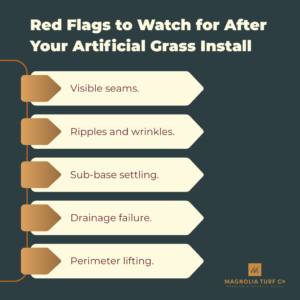
- Visible seams. Edges separating, lifting, or showing dark lines where turf strips meet. Caused by poor seam prep, wrong-angle cuts, or skipping high-quality seam tape and adhesive.
- Ripples and wrinkles. A surface that looks wavy or bunched. Caused by an uneven base, failure to stretch turf properly during placement, or skipping the infill step.
- Sub-base settling. Sinkholes or low spots months after install. Caused by less than three inches of base material or skipping plate compaction.
- Drainage failure. Standing water after rain. Caused by laying turf directly on soil, failing to grade the base for slope, or using non-permeable backing in wet climates.
- Perimeter lifting. Edges peeling up over time. Caused by nails too far apart (more than six inches) or galvanized nails that don’t grip soil properly.
Quality-Control Checklist
During your artificial grass installation, watch for:
- Base material applied in lifts and compacted between each pass
- Plate compactor used (not just hand tamping)
- Slight slope away from structures
- Turf seams placed with grain running the same direction
- Seam tape and adhesive applied consistently
- Ungalvanized five-inch nails every six inches along perimeters
- Infill brushed in evenly, not piled in spots
After the install, test:
- Base firmness. Walk the entire surface. No spongy spots and no sinking.
- Seam visibility. Crouch down and look across each seam. Quality joins are nearly invisible.
- Perimeter security. Try lifting the edges. They won’t budge on a properly anchored install.
- Infill distribution. Brush your hand across the surface. Texture feels uniform from edge to edge.
- Drainage. Run a hose for two to three minutes on a low spot. Water clears within minutes on a properly graded base.
- Walkthrough completeness. The crew chief walks every transition with you and confirms warranty coverage in writing.
What Proper Materials and Methods Prevent
Quality starts with specs. You want three to four inches of base material, 85% to 95% compaction (which locks the base in place so you don’t see low spots months later), 60+ oz face weight (denser fibers that resist matting in high-traffic zones), Triflow Backing, antimicrobial infill, ungalvanized perimeter nails, and properly seamed joins.
Get all of that right and the install lasts 15 years. Skip any of it and you’re paying twice.
Frequently Asked Questions About Artificial Grass Installation
How long does a typical professional install take?
Most residential artificial grass installation projects take one to three days, depending on size and complexity. Be skeptical of companies advertising “one-day installs” for any project size. A 2,000-sq-ft yard with proper base prep, compaction, and seaming takes longer than a single day to do right.
Can artificial grass be installed over existing grass, concrete, or pavers?
Existing grass and sod must be removed first. Concrete and pavers can sometimes serve as the base, but only with proper drainage modifications and an underpad. A glue-on concrete install is sometimes possible at a $1 per sq ft discount when prep work isn’t required.
Is artificial grass safe for pets?
Yes, when it’s installed with the right features. Pet-grade installs include Triflow Backing for drainage, Microguard antimicrobial coating that kills odor-causing bacteria from pet urine before it develops into a smell you can’t get rid of, and OptiFILL+ or zeolite infill for added odor control. Without these features, urine pools, bacteria grow, and odors develop fast.
How hot does artificial grass get in Texas summer?
Turf gets warmer than natural grass during peak afternoon sun (noon to 4 p.m. in June through August), but premium materials with LusterGuard technology stay cooler than budget products by diffusing sun rays. A one-minute rinse with a hose drops surface temperature for several hours. For areas near reflective Low-E windows, nylon turf is required because polyethylene can melt under concentrated reflection.
How does drainage work during heavy rain?
Properly installed turf with Triflow Backing and a three- to four-inch graded base clears water within minutes of even heavy rain. Magnolia Turf’s Triflow Backing drains 900+ inches of liquid per hour, which is faster than any storm Texas or Florida produces.
How long does artificial grass last and what does the warranty cover?
High-quality artificial grass with proper installation lasts 15 to 20 years. Magnolia Turf provides a 15-year product warranty covering fading, manufacturing defects, and balding, so if the materials fail prematurely, you’re not paying again to replace them. Installation issues like settling, wrinkles, or lifted edges get addressed by return service from the original crew.
What happens if a problem comes up after install?
Reputable installers respond to service calls within 24 to 72 hours. Magnolia Turf customers call directly and we send a crew. Our customers skip the layered subcontractor mesh and the manufacturer back-and-forth.
Do I need a permit or HOA approval?
Most residential installations under 1,000 sq ft don’t require city permits, though verify with your specific municipality. HOA approval is required in most Texas and Florida communities, so submit your application early with turf specs, edge treatment, and a drainage plan. Florida’s recent statute changes have streamlined HOA review for compliant residential installs.
Are the materials safe?
Premium artificial turf is independently tested as 100% PFAS-free and 100% lead-free, so kids and pets aren’t tracking forever chemicals or heavy metals into the house.
Nylon products meet Federal Flammability Standard CPSC FF 1-70 and pass ASTM flammability and ignition testing. The turf won’t ignite from a stray cigarette ash or a misfired sparkler.
Playground padding is ASTM-certified for fall heights from five to eight feet or more depending on density. A child can fall from up to eight feet without serious injury.
Get Your Free Artificial Grass Installation Estimate
We’ve installed over 10,000 artificial turf projects across Texas and Florida. Every one starts with proper base work, with no shortcuts and no exceptions.
What makes our artificial grass installation different:
Proper sub-base on every job. Three to four inches of decomposed granite or crushed limestone, properly compacted. That’s the base that keeps turf looking great for 15 years instead of settling into ripples within a couple of seasons.
Premium materials that matter. Triflow Backing that drains 900+ inches of liquid per hour, so the surface clears within minutes of a downpour. Microguard antimicrobial coating that kills odor-causing bacteria from pet urine. PFAS-free products so kids and pets aren’t tracking forever chemicals into the house. Reinforced blade technology and face weights of 60 to 90 oz for denser, longer-lasting fibers.
Owner accountability. David Turner personally backs the high-quality standards on every project. We’re not a franchise. We’re locally owned, which means there’s a single name attached to your install and a single number to call if a problem comes up.
Transparent pricing. Detailed line-item quotes showing exactly where your investment goes. No surprise fees and no pressure tactics.
A 15-year warranty. We stand behind our materials and installation because we know they’ll last, and if a material fails, you’re not paying again to replace it.
We Serve These Markets
What to Expect From Your Free Estimate
- We’ll discuss your project goals and any specific concerns.
- We’ll measure your space and evaluate site conditions.
- You’ll get detailed pricing with material specifications.
- We’ll explain any site challenges that affect the install.
- You’ll receive a written quote with warranty information.
High-quality artificial grass installation costs more upfront than cutting corners. It costs far less than replacing failing turf in five years. Our installations pay for themselves in 2.5 to 4 years and last 15+.
Related Resources
- Artificial Grass Installation Costs: The Complete Guide to Investment, ROI, and What You Really Pay: Full cost breakdown by region, product, and project size
- Installation Process: Step-by-step look at how Magnolia Turf installs every project
- What Goes Under Artificial Turf?: Sub-base materials and depth specifications
- Artificial Grass Drainage: How Triflow Backing handles Texas storms and Florida tropical rain
- Artificial Grass Infill Solutions: Comparing silica sand, OptiFILL+, and specialty infills
- Pet Turf and Artificial Grass for Dogs: Specialized features for pet-heavy installs
- Artificial Turf Maintenance: Complete Care Guide: What annual upkeep looks like
- Frequently Asked Questions: Answers to common questions across every project type
Magnolia Turf serves homeowners and contractors throughout Dallas, Houston, Austin, San Antonio, Tampa, and Sarasota with professional artificial grass installation backed by 10,000+ successful projects and a 15-year warranty. Contact us today for a free estimate and transparent pricing on your next outdoor project.