Table of Contents
- Why Artificial Grass Maintenance Matters
- Tools and Equipment for Maintaining Artificial Grass
- Weekly and Monthly Artificial Grass Cleaning Routines
- Artificial Grass Stain Removal Guide by Type
- Pet Waste Management and Odor Control for Artificial Turf
- Seasonal Artificial Grass Care for Texas Climates
- Artificial Grass Maintenance by Application Type
- Troubleshooting Common Artificial Grass Problems
- Frequently Asked Questions About Maintaining Artificial Grass
- Get Expert Help With Your Turf
- Related Resources
Introduction
Artificial grass isn’t maintenance-free. Anyone who tells you otherwise is setting you up for disappointment.
Quality turf requires far less work than a natural lawn. No mowing. No watering. No fertilizing. But “less work” isn’t “no work.”
We’ve installed over 10,000 artificial turf projects across Texas and Florida. We’ve seen what happens when homeowners assume their turf will take care of itself: matted fibers, drainage problems, and odor issues that shouldn’t exist. Most of these problems are preventable with basic upkeep.
This guide covers everything you need for maintaining artificial grass properly: the right tools, effective cleaning methods, seasonal schedules for Texas weather, and troubleshooting when problems arise. Whether you have a backyard lawn, a dedicated pet area, or a putting green, you’ll find specific guidance for your situation.
The difference between turf that looks great at year 15 and turf that fails at year five often comes down to simple, consistent maintenance.
Learn how to get 15 years of use out of your artificial grass.
Why Artificial Grass Maintenance Matters
Maintenance isn’t about appearance alone. It affects how long your turf lasts and whether your warranty remains valid.
Longevity and Performance
Quality artificial turf is built to last 15–20 years with proper care. Without maintenance, that lifespan can drop to 7–10 years or less.
Regular brushing keeps fibers upright and resilient. Keeping drainage clear prevents water damage to the backing. Removing organic debris stops it from decomposing and creating problems underneath the surface.
The Installation Connection
Most maintenance guides skip this part: Your ongoing maintenance needs depend heavily on how your turf was installed.
Proper sub-base preparation creates natural drainage that makes artificial grass maintenance easier. Three to four inches of crushed granite or limestone, compacted correctly, allows water to move through the base properly. You won’t fight standing puddles or deal with moisture trapped against the backing.
Triflow backing that handles 900 inches per hour means pet urine flushes away instead of sitting on the surface. That’s the difference between turf that stays fresh with basic rinsing and turf that develops permanent odor problems.
Turf installed without proper base work creates maintenance headaches that never go away. Water pools. Infill washes into low spots. The backing stays damp. No amount of cleaning fixes a drainage problem caused by poor installation.
Health and Safety
Antimicrobial coatings like Microguard work continuously to inhibit bacteria and mold growth on turf surfaces. But they work best when you’re doing your part: removing organic matter, rinsing pet areas, and keeping the surface clean.
All Magnolia Turf products are PFAS-free, eliminating exposure to harmful “forever chemicals” that persist in the environment. Combined with antimicrobial protection, your family and pets have a safer outdoor surface.
Regular cleaning reduces allergens, too. Unlike natural grass that produces pollen and harbors dust mites, well-maintained artificial turf provides a cleaner outdoor surface for allergy sufferers.
Warranty Protection
Most artificial turf warranties require reasonable maintenance. Our 15-year warranty, like most quality manufacturer warranties, expects you to perform basic upkeep: periodic rinsing, debris removal, and appropriate cleaning. Neglect isn’t covered.
Learn why homeowners choose our warranty-backed products.
Tools and Equipment for Maintaining Artificial Grass
The right tools make maintenance faster and prevent damage to your turf. The wrong tools can tear fibers, displace infill, or void your warranty.
Turf Rakes and Brushes
What to look for:
- Plastic or nylon tines only. Metal tines cut fibers and can pull seams apart. This is non-negotiable.
- Curved or fan-style heads work better than straight, stiff designs. They lift blades without snagging.
- Lightweight handles (aluminum or fiberglass) reduce fatigue during larger jobs.
Recommended tool: The Grandi Groom Turf Rake is a professional-grade option with an 18-inch-wide head, synthetic brush fibers, and a 53-inch handle. It’s designed to work between blades, lift fibers upright, and redistribute infill without damage.
Manual vs. Power Brushes

Power brushes are recommended for deep cleaning every three to five years or for restoring heavily matted high-traffic areas. Manual brushes handle routine maintenance well for most homeowners.
Leaf Blowers
Leaf blowers are a must for removing leaves, twigs, and organic debris before it decomposes on your turf.
CFM recommendations by yard size:
- Small patios/balconies: 150–300 CFM
- Typical residential lawns: 300–500 CFM
- Large or heavily wooded yards: 500–700+ CFM (use lower speed settings over turf to avoid displacing infill)
Use enough power to move debris without blasting infill out of place. Variable speed settings give you more control.
Infill Management Tools
Measuring infill depth: Use a marked screwdriver or depth gauge pushed between fibers to measure from backing to top of infill. Compare it to your original specification (typically 0.5–1.5 inches depending on product and application).
Top-up schedule:
- Light residential use: Inspect annually, typically top up every 3–5 years.
- Pets, sports, or heavy traffic: Inspect every 6–12 months; top up when backing starts showing or matting increases.
Cleaning Products to Use and Avoid
Safe products:
- Mild dish soap (non-bleach, non-abrasive)
- White distilled vinegar (5%, diluted with water)
- Turf-specific enzyme cleaners (biodegradable, non-foaming)
- PE-51 enzyme cleaner for pet areas
Products to avoid:
- Bleach
- Ammonia (except 3% solution for specific grease stains)
- Harsh solvents and petroleum-based cleaners
- High-alcohol formulas
- Pressurized water settings that displace infill
Learn more about artificial grass maintenance.
Weekly and Monthly Cleaning Routines
Consistent, simple maintenance prevents most turf problems. A practical schedule keeps your turf in top condition without consuming your weekends.
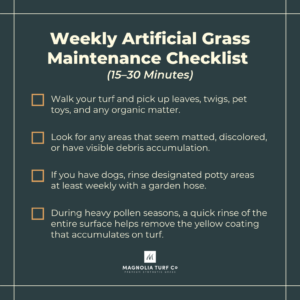
Weekly Routine (15–30 minutes)
Debris removal: Walk your turf and pick up leaves, twigs, pet toys, and any organic matter. Use a leaf blower for larger areas. Organic debris left on turf decomposes, creates a seedbed for weeds, and can block drainage.
Spot check: Look for any areas that seem matted, discolored, or have visible debris accumulation. Address problem spots before they become larger issues.
Rinse pet areas: If you have dogs, rinse designated potty areas at least weekly with a garden hose. This flushes urine through the backing and prevents odor buildup. One to two minutes of rinsing is typically sufficient for average pet use.
Texas dust and pollen: During heavy pollen seasons, a quick rinse of the entire surface helps remove the yellow coating that accumulates on turf. This is especially important in spring when oak and grass pollen are at their peak.
Monthly Deep Maintenance (1–2 hours)
Cross-brushing: Brush your turf against the grain (opposite the direction fibers naturally lean) using a turf rake or stiff-bristled broom. This lifts blades upright, prevents permanent matting, and redistributes infill evenly.
Brushing frequency by use level:
- Light use: Monthly
- Moderate use (kids, occasional gatherings, one dog): Every two to four weeks
- Heavy use (multiple pets, play areas, frequent entertaining): Weekly to every two weeks
Infill inspection: Check infill levels in high-traffic areas. If backing is visible or blades aren’t standing upright, you may need to add infill.
Learn about our artificial grass infill options.
Drainage verification: After rain, observe how quickly water clears from the surface. Pooling that lasts more than a few minutes indicates a potential drainage issue that needs attention.
Learn more about our artificial grass drainage technology.
Stain Removal Guide by Type
Most stains come off artificial turf easily with the right approach. Address them promptly and use appropriate cleaning methods.
Food and Beverages
Coffee, soda, condiments, and similar spills are common and easy to handle.
Process:
- Blot up excess liquid immediately (don’t rub).
- Rinse the area with a garden hose.
- For sticky residue, apply mild soap solution and scrub gently with a soft brush.
- Rinse thoroughly until water runs clear.
Remove sugary substances completely to prevent ant attraction.
Oil and Grease
Motor oil, cooking grease, and similar substances require a bit more attention.
Process:
- Scrape off solid residue gently.
- Apply a small amount of mild degreasing dish soap to the stain.
- Agitate with a soft brush.
- Rinse thoroughly with water.
Avoid solvent-type degreasers, which can damage turf fibers.
Tree Sap and Gum
These sticky substances are best handled when firm, not soft.
Process:
- Let the substance firm up (or apply ice to harden it).
- Carefully chip away with a plastic scraper.
- For remaining residue, continue with ice and gentle mechanical removal.
- Avoid strong solvents that can melt fibers.
Biological Stains
Leaves left too long, bird droppings, and similar organic matter can leave marks.
Process:
- Remove solid material.
- Rinse the area.
- Apply a 1:1 vinegar-water solution or enzyme cleaner.
- Let sit for 10 minutes, then rinse.
For stubborn organic stains, repeat the enzyme treatment.
Pet Waste Management and Odor Control
Pet owners make up a large portion of artificial turf installations. Dogs are hard on lawns, and turf solves most of those problems, but only with proper maintenance.
Solid Waste Removal
Process:
- Allow waste to dry slightly (easier removal, less smearing).
- Scoop and dispose of solids.
- Rinse the spot with water.
- For any remaining residue, clean with a mild soap solution.
Timing: Remove solids daily if possible, at minimum every two to three days. Prompt removal prevents material from being ground into fibers.
Urine Management
This is where proper installation pays off. Triflow backing that drains 900 inches per hour means urine passes through the surface instead of pooling. But you still need to rinse.
Rinsing protocol:
- Rinse pet areas at least weekly with a garden hose.
- During hot weather, rinse more frequently (heat intensifies odors).
- Run sprinklers for one to two minutes periodically if available.
Enzyme cleaners: Products like PE-51 break down organic compounds in urine rather than masking odors. They’re the most effective solution for persistent pet odor.
For stubborn odors: Sprinkle 15 lbs of baking soda on the affected area, then spray with a 90% white vinegar/10% dish soap solution using a hose-end sprayer. Let it work, then rinse thoroughly.
Antimicrobial Infill
Standard silica sand infill absorbs odors over time. For pet areas, Envirofill is the better choice: a round, acrylic-coated sand infused with Microguard antimicrobial protection. It reduces fluid absorption, improves drainage, and actively prevents odor development.

Multi-Pet Households
With multiple dogs, maintenance demands increase proportionally.
Strategies:
- Designate specific potty areas to concentrate maintenance.
- Increase rinsing frequency (multiple times weekly).
- Consider professional maintenance service for deep cleaning.
- Use antimicrobial infill from installation.
Need help with pet turf maintenance? Our crews offer professional enzyme treatments and deep cleaning for pet areas. Contact us to schedule a maintenance visit.
Learn more about our pet turf installations.
Seasonal Care for Texas Climates
Texas weather creates specific maintenance challenges. Knowing the seasonal rhythm helps you stay ahead of problems when maintaining artificial grass.
Spring Maintenance
Pollen season: Texas pollen hits in waves. Cedar fever runs from late December through February (Central Texas especially). Oak and other trees follow from February through May, creating that yellow coating on every outdoor surface, including your turf. Grass pollen continues from March through September.
Spring tasks:
- Rinse turf regularly to remove pollen accumulation.
- Inspect for any winter damage or settling.
- Cross-brush to lift fibers after winter dormancy.
- Check infill levels and drainage before heavy spring rains.
Summer Care
Texas summers are brutal on all outdoor surfaces. Artificial turf handles heat better than you might expect, but it needs attention.
Heat management: Turf surfaces can get hot during peak afternoon hours (roughly noon to 4 p.m., June through August). Surface temperatures can reach 150°F+ in direct sun. Unlike concrete, turf doesn’t retain heat for extended periods.
Cooling strategy: A one- to two-minute rinse with the hose can drop surface temperature for several hours. Do this before kids or pets use the area during hot weather.
UV protection: Quality turf includes UV stabilizers that prevent fading and fiber degradation. Our products feature LusterGuard technology and Microguard coating that continues working through summer heat. Avoid placing reflective objects (glass, mirrors, shiny metal) near turf. Concentrated sunlight can cause localized damage.
Water restriction compliance: Artificial turf dramatically reduces water needs compared to natural grass, which helps during Texas water restrictions. Focus your water use on spot-rinsing pet areas, occasional cool-downs before heavy use, and post-storm debris cleanup.
Fall Maintenance
Leaf removal: Don’t let leaves accumulate. They trap moisture, block drainage, and decompose into organic matter that creates weed-friendly conditions. Regular blowing or raking is a must.
Pre-winter tasks:
- Deep cross-brush to lift fibers.
- Check and top up infill levels.
- Clear drainage paths and perimeter channels.
- Inspect edges and seams for any lifting.
Winter Considerations
Texas winters are mild but can surprise you.
Frost: Artificial turf handles frost fine. Let it melt naturally. Don’t try to scrape ice off the surface.
Rare freeze events: After hard freezes, inspect for any seam separation or edge lifting caused by ground movement.
Reduced maintenance: Winter requires less frequent maintenance. Monthly brushing and debris removal are typically sufficient when the turf isn’t in heavy use.
Learn more about climate considerations for Texas homeowners.
Maintenance by Application Type
Different turf applications have different maintenance requirements. Focus on what matters for your specific installation.
Landscape Turf (Residential Lawns)
Standard residential installations are the most straightforward to maintain.
Key focus areas:
- Weekly debris removal
- Monthly cross-brushing
- Seasonal rinsing for pollen and dust
- Annual infill inspection
Most homeowners spend 30 minutes weekly on maintenance, with occasional deeper sessions seasonally.
Pet Turf and Dog Runs
Pet areas require the most consistent attention for waste management.
Key focus areas:
- Daily or every-other-day solid waste removal
- Weekly (minimum) rinsing of the entire pet area
- Enzyme cleaner application as needed for odor
- More frequent infill inspection (every three to six months)
- Antimicrobial infill strongly recommended
Putting Greens
Putting greens require precision maintenance to preserve playing characteristics.
Key focus areas:
- Regular brushing to maintain fiber direction and ball roll consistency
- Keep surface clear of debris that affects ball movement
- Monitor infill levels closely (uneven infill creates inconsistent roll)
- Avoid heavy objects that create permanent impressions
Pool Surrounds
Pool areas face unique challenges from chemical splash and constant moisture exposure.
Key focus areas:
- Rinse regularly to dilute pool chemical residue
- Keep drainage paths clear
- Brush fibers upright (pool traffic tends to mat fibers in one direction)
- Inspect for any chemical discoloration
Playground Turf
Safety is the priority for playground surfaces.
Key focus areas:
- Regular inspection for any loose edges, exposed backing, or trip hazards
- Keep drainage clear to prevent slip hazards
- Check infill depth to maintain fall protection ratings
- Remove any debris that could cause injury
- Document maintenance for liability purposes
Troubleshooting Common Problems
Even well-maintained turf occasionally develops issues. Here’s how to diagnose and address common problems.
Matting and Flattening
Symptoms: Fibers lay flat instead of standing upright; turf looks worn in traffic patterns.
Causes: Heavy foot traffic, furniture pressure, insufficient infill, lack of regular brushing.
Solutions:
- Remove any furniture or objects compressing the area.
- Cross-brush vigorously with a turf rake (against the grain).
- For stubborn matting, moisten the turf slightly before brushing.
- Add infill where levels are low.
- For severe cases, power brooming may be needed.
Prevention: Regular cross-brushing and rotating furniture placement.
Drainage Issues
Symptoms: Water pools on the surface after rain; turf feels squishy underfoot; slow drying.
Causes: Clogged drainage paths, debris accumulation, compacted sub-base, insufficient slope.
Solutions:
- Clear surface debris that may be blocking drainage.
- Check and clear nearby drains, weep holes, or perimeter channels.
- Inspect for any low spots where water collects.
- If pooling persists, professional evaluation may be needed.
Triflow backing dramatically reduces drainage problems compared to hole-punched systems. If you’re experiencing chronic drainage issues with properly installed Triflow backing, the problem is usually in the sub-base or perimeter drainage, not the turf itself.
Weed Growth
Symptoms: Weeds appearing through turf surface or at edges.
Causes: Seeds blown onto surface and germinating in decomposed organic matter; weeds intruding at edges where barrier is incomplete.
Solutions:
- Pull visible weeds by hand.
- Apply turf-safe, water-based herbicide carefully (avoid saturating backing).
- Keep edges clear of soil and mulch that act as seedbeds.
- Remove organic debris promptly to prevent seedbed formation.
Prevention: Proper weed barrier installation, edge maintenance, and regular debris removal.
Seam Problems
Symptoms: Visible seam lines, edges lifting or separating, fibers pulling apart at seams.
Causes: Original seaming issues, heavy stress, ground movement, age.
Light DIY repair: For small separations, carefully lift fibers, apply turf adhesive and seaming tape under backing, press together, weight until cured, then brush fibers to hide the line.
When to call a professional: Long seam runs, high-traffic areas, or seams over poor base conditions need professional repair to avoid repeat failures.
Persistent Odor
Symptoms: Smell that doesn’t improve with regular rinsing.
Causes: Urine residue in infill, organic matter decomposition, inadequate drainage.
Solutions:
- Deep rinse the affected area.
- Apply enzyme cleaner and allow proper dwell time.
- Consider the baking soda and vinegar treatment for stubborn odors.
- For chronic issues, infill replacement with antimicrobial product may be necessary.
- Evaluate whether drainage is functioning properly.
Quality turf with proper drainage and regular maintenance shouldn’t develop persistent odor. If it does, drainage is likely inadequate.
Frequently Asked Questions
How often should I clean my artificial grass?
Basic debris removal and spot-checking work best on a weekly schedule. Cross-brushing for most residential lawns fits well monthly. Pet areas need weekly rinsing at a minimum. Adjust frequency based on use: heavier traffic means more frequent maintenance.
Can I use a pressure washer on artificial turf?
Use caution. If you do pressure wash, stay under 1,500 PSI, use a 25–40-degree fan nozzle, keep the wand moving, and maintain at least a 12-inch distance. Avoid pressure washing heavily infilled areas, near seams, or on aging turf. For most situations, a regular garden hose works better and carries no risk.
Is bleach safe for artificial grass?
No. Bleach can discolor fibers and damage backing. Use mild dish soap, diluted vinegar, or turf-specific enzyme cleaners instead.
How do I keep my artificial grass cool in summer?
A quick rinse with the hose drops surface temperature for several hours. Plan outdoor activities for morning or evening during peak summer. Consider shade structures for frequently used areas. Quality turf with proper UV stabilizers handles heat better than budget products.
What maintenance is required to keep my warranty valid?
Most warranties expect reasonable upkeep: periodic rinsing, debris removal, appropriate cleaning products, and protecting the turf from obvious damage sources. Our 15-year warranty covers manufacturing defects when turf is properly maintained. Keep documentation of any professional maintenance services.
Should I hire a professional for turf maintenance?
DIY works well for routine maintenance on most residential installations. Consider professional service for deep cleaning (power brooming), infill replenishment, seam repairs, or if you lack the equipment or time. Pet owners with multiple dogs often find professional maintenance valuable for periodic deep cleaning.
How do I know when my infill needs replacing?
Check infill depth with a marked tool. If backing is visible in traffic areas, blades won’t stand upright, or drainage has slowed, you likely need infill top up. Most residential turf needs infill replenishment every three to five years for light use, and more frequently for heavy use or pet areas.
Get Expert Help With Your Turf
Maintaining artificial grass doesn’t have to be complicated. Basic weekly attention and seasonal deep maintenance keep your turf looking great and performing properly for years.
But sometimes you need professional help: deep cleaning with power equipment, infill replenishment done right, seam repairs that actually hold, or odor problems that won’t quit no matter what you try.
We offer maintenance services across our Texas and Florida markets. Our crews know turf; they’ve installed over 10,000 projects. We use the right equipment, the right products, and the techniques that actually work.
Our maintenance services include:
- Power brooming and fiber restoration
- Infill inspection and replenishment
- Enzyme treatment for pet areas
- Seam and edge repairs
- Full system inspection
Whether you need a one-time deep clean or want to set up a regular maintenance schedule, we’re here to help protect your investment.
Quality costs more upfront. Shortcuts cost more in the long run. That applies to maintenance just like it applies to installation.
Contact us today for a free maintenance consultation or turf inspection.
We serve:
Related Resources
From Magnolia Turf:
- Our Complete Installation Process
- Pet-Friendly Turf Solutions
- Custom Putting Green Installation
- Artificial Grass Installation Costs
- Our Competitive Advantage
Industry Standards and References: