Table of Contents
- Quick Answer About Artificial Grass for Dogs
- What Is Pet-Friendly Artificial Grass?
- Pros and Cons of Artificial Grass for Dogs
- Anatomy of Artificial Grass for Dogs: What Actually Matters
- How Artificial Grass for Dogs Performs in Texas and Florida Heat
- Will My Dog Actually Use Artificial Grass?
- Real Cost Ranges for Artificial Grass for Dogs
- Installing Artificial Grass for Dogs: Why Sub-Base Quality Decides the 15-Year Outcome
- Maintenance Calendar for Artificial Grass for Dogs
- Artificial Grass for Dogs: Common Mistakes, Pro Tips, and Outcomes
- Frequently Asked Questions
- Get Your Free Magnolia Turf Quote
- References, Standards, and Further Reading
Most pet owners researching artificial grass for dogs run into the same problem. The internet is full of marketing pages that don’t tell you what actually matters in a real dog yard. They skip the hard questions about heat, drainage, urine, durability, and what proper installation costs.
We’ve installed artificial grass for pets for hundreds of dog households across Dallas, Houston, Austin, San Antonio, Tampa, and Sarasota, which means we know your local soil profile, your city’s permitting quirks, and the seasonal patterns that wreck a poorly built dog yard, so the install plan we hand you is tuned to your zip code instead of pulled from a generic template.
Over 10,000 total installations in the past decade means when we walk your yard for the first time, we already know where the drainage pinch-points hide, how a multi-dog traffic pattern wears down a base, and which sun-exposure traps will bake a paw at noon. You get that pattern recognition baked into the bid and the build.
Pet yards behave differently from regular lawns, and what works in California doesn’t hold up in Texas heat or Florida humidity. That’s why this guide treats artificial grass for dogs as its own category, not a footnote to standard landscape turf.
This guide gives you a complete decision framework: safety, climate performance, real installed costs, honest tradeoffs, and the maintenance routine your dog yard actually needs.
We’ve cut the fluff and the sales pitch. You’re reading what we’ve learned from doing this work right for the past ten years.
Quick Answer About Artificial Grass for Dogs
Pet-rated artificial grass for dogs is synthetic turf built with three pet-specific upgrades: Triflow Backing that drains 900+ inches of liquid per hour so urine never pools, Microguard antimicrobial treatment that inhibits odor-causing bacteria continuously so your yard never develops the ammonia stink that ruins natural-grass dog yards, and reinforced blades that bounce back after every paw strike so the surface still looks freshly cut in year five.
Properly installed artificial grass for dogs in Texas and Florida runs $8 to $10 per square foot for premium products and lasts 12 to 20 years with a basic maintenance routine, which means the upfront premium pays itself back inside three to four years, and you stop spending on water, fertilizer, mowing, and reseeding for the rest of the decade. The right product specs, a properly compacted sub-base, and professional installation are what separate a dog yard that performs for a decade-plus from one that fails in five years.
What Is Pet-Friendly Artificial Grass?
Pet-friendly artificial grass is built for the demands a dog puts on a yard. The key differences from standard landscape turf show up in the backing, the infill, and the antimicrobial treatment, and those three components are what make artificial grass for dogs perform where general landscape turf fails.
Standard landscape turf usually has hole-punched backing, which drains water through perforations spaced every few inches. That’s fine for rain.
It’s not fine for dog urine, which lingers between holes and breeds odor-causing bacteria. Pet turf uses Triflow Backing, which drains across the entire surface so liquid moves away from the surface immediately. Triflow Backing drains 900+ inches of liquid per hour, which means a multi-dog household never deals with puddles, ammonia smell, or saturated patches.
This guide covers several audiences: single-dog homeowners trying to break the mud-and-bare-patch cycle, multi-dog households where natural grass never had a chance, and breeders and dog daycare operators who need surfaces that withstand constant heavy use.
The fundamentals stay the same across all of them. Only the product specs and installation details have to match the load.
We’ll cover what to look for, what to avoid, what it actually costs, and how to keep it performing for the long haul. For a broader look at fiber options across applications, see our overview of types of artificial turf.
Pros and Cons of Artificial Grass for Dogs
The honest answer: Artificial grass for dogs solves real problems for pet owners, but it isn’t perfect. Here’s the full picture.
The Real Benefits of Artificial Grass for Dogs
Durability natural grass can’t match. Properly installed pet turf handles two or three large dogs without bare patches, ruts, or seasonal die-off. The reinforced blades bounce back after every paw strike, which means the yard still looks freshly mowed at year five instead of resembling a worn-down dog run.
The base stays stable, which means you stop reseeding bare spots every spring.
Drainage that actually works. Triflow Backing drains 900+ inches of liquid per hour, so urine passes through immediately and rain clears fast. You get no pooling, no muddy spots, and no waiting for the yard to dry out before the dogs go back outside.
Cleaner house, cleaner dog. No mud means no muddy paws tracking through the kitchen. A quick rinse keeps the surface fresh.
You’ll see the difference on your floors within the first week.
Year-round usability. Texas summers kill cool-season grass. Florida’s rainy season turns yards into mud pits.
Artificial grass for dogs gives your dog consistent footing in both extremes, which keeps your routine on schedule and your dog out of the house.
Chemical-free yard. You skip the fertilizer, the pesticides, and the herbicides. Your dog isn’t rolling in lawn chemicals or licking them off paws.
The Honest Drawbacks
Heat is real in summer. Synthetic turf gets hot under direct Texas and Florida sun, especially from noon to four. We’ll cover specific solutions in the climate section below.
Higher upfront cost. High-quality pet turf installation runs more than sodding a natural lawn. The math shifts when you factor in long-term maintenance, but the day-one number is bigger.
Determined chewers can damage edges. Most dogs don’t try to chew or dig up properly installed turf. The aggressive few sometimes do.
Edge securing matters.
Not all “pet turf” is pet turf. The product label means little. Specifications matter.
Cheap products with hole-punched backing fail in dog yards within a year or two.
Safety Standards for Artificial Grass for Dogs
PFAS-free is non-negotiable. Lead-free matters just as much. Ask for documentation, not marketing language, because what you put down is what your dog sleeps on, eats from, and licks off paws.
High-quality pet turf is independently tested to be 100% PFAS- and lead-free and meets ASTM flammability and reliability standards. That means your dog isn’t absorbing forever chemicals through paw pads or licking lead-tainted fibers off after a roll, and the surface won’t flash-ignite from a dropped grill ember or a stray cigarette. If a salesperson can’t produce the testing, that’s your answer.
This is part of the Magnolia Turf difference and a key reason we don’t compete on price. The cheapest turf on the market gets cheap by skipping the testing budget; we don’t.
Anatomy of Artificial Grass for Dogs: What Actually Matters
You’ll see a lot of turf marketing copy. Most of it skips what matters and emphasizes what doesn’t. When customers ask us what to look for in artificial grass for dogs, here’s what we tell them.
Yarn, Blades, and Face Weight
High-quality pet turf uses W-shaped, S-shaped, or C-shaped blades with a reinforced spine. These shapes bounce back after compression, which means your turf still looks new in year five. Flat monofilament blades mat down permanently under heavy dog traffic and never recover.
Face weight measures how much yarn is packed into a square yard. For pet applications, look for 60 ounces per square yard at a minimum, which means the blades won’t mat down flat under heavy paw traffic in year two and your yard still reads like grass instead of a green carpet.
Pile height between 1.5 and 2 inches drains best and cleans easiest, which keeps your weekly hose-down to minutes instead of an afternoon. Taller isn’t better for dogs; it traps debris and slows your hose-down routine.
Drainage Backing for Pet Turf: The Spec That Decides Odor Outcomes
This is where artificial grass for dogs separates from landscape turf. The two main backing types perform differently in a dog yard.
| Backing Type | Drainage Rate | What It Means for Dogs |
| Hole-punched | 30 to 60 inches per hour | Urine pools between holes. Odors develop. Bacteria multiply. |
| Triflow Backing (fully permeable) | 900+ inches of liquid per hour | Urine drains edge-to-edge instantly. No pooling. No trapped odor. |
Triflow Backing is the difference between a yard that smells fine in August and one that doesn’t. We install Triflow Backing on every pet project because hole-punched backing fails the dog-yard test every time.
Antimicrobial Technology in Pet Turf
Microguard antimicrobial coating gets built into the turf and the OptiFILL+ infill. It works continuously to inhibit bacteria, mold, and mildew growth, which means the ammonia odor associated with dog urine never gets a foothold even in heavily marked zones.
Other manufacturers use different antimicrobial systems, including silver-ion technologies and surface treatments. Most published performance data comes from the manufacturers themselves, so independent comparison is limited.
The practical question to ask any installer is whether the antimicrobial treatment is built into the product or applied as a topical spray that washes off. Built-in treatment holds up over the life of the turf; topical sprays don’t.
Our Magnolia Pet Turf 60 carries Microguard antimicrobial treatment, Triflow Backing that drains 900+ inches of liquid per hour, and a reinforced blade design built for heavy dog traffic, so odor stays manageable, urine never pools, and the surface holds up to active dogs without matting.
How Artificial Grass for Dogs Performs in Texas and Florida Heat
This is where most pet turf guides go quiet. We won’t, because USDA zones 8 through 10 demand straight talk about heat.
Surface Temperatures and Paw Safety on Artificial Turf
In direct Texas or Florida summer sun, artificial turf surfaces run 20 to 50 degrees hotter than the surrounding air. Peak heat hits between noon and four, June through August. Surface temperatures can reach 120 to 150°F when it’s 100°F outside, well above what’s comfortable for dog paws.
That doesn’t make artificial grass for dogs unworkable. It makes timing and management important.
Concrete and asphalt run even hotter, and they don’t cool down with a hose. Turf does, and that’s the practical advantage that gives you a real summer fix.
The fastest-cooling fix is to run your hose or sprinkler over the surface for one minute. The water absorbs and dissipates heat across the whole yard, and the cooling effect lasts for hours. Try that on your driveway and see what happens.
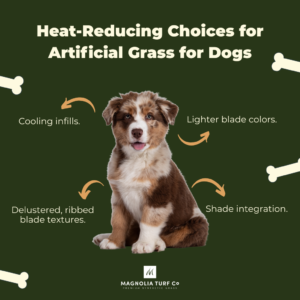
Heat-Reducing Choices for Artificial Grass for Dogs
A few specific choices reduce heat retention:
- Cooling infills. Products like T°Cool use evaporative cooling to drop surface temperatures during hot stretches, which extends the safe-paw window into the early afternoon.
- Lighter blade colors. Lighter greens reflect more solar radiation than dark greens, so the surface absorbs less heat to begin with.
- Delustered, ribbed blade textures. Coatings like LusterGuard diffuse direct sunlight rather than absorbing it as glare, which keeps the surface cooler and easier on dog eyes.
- Shade integration. Even partial shade from a tree, pergola, or patio cover knocks surface temps down by 20 to 30 degrees, which can be the difference between safe and unsafe at midday.
Regional Drainage and Sub-Base Realities
Texas clay soils don’t drain well on their own. Florida sandy soils drain too fast and move under load. Both demand a properly engineered sub-base, and both call for crushed limestone or decomposed granite at three to four inches, which gives the turf a stable surface that won’t settle, dish, or pool urine after the first wet season.
Limestone is our preference for pet yards. Its porosity speeds urine drainage through the base, and it compacts to a stable surface that doesn’t move under dogs, which means your turf stays flat and your seams stay tight for the long haul.
Sandy Florida soil installations sometimes need extra sub-base depth or supplemental drainage. Heavy clay sites in DFW need precise grading to move water away from the house.
Hot-Weather Pet Safety Practices
A few practical habits keep dogs safe and comfortable through Texas and Florida summers:
- Schedule outdoor time before 10 a.m. and after 6 p.m. during peak summer.
- Rinse the surface with the hose for one minute before midday use.
- Provide shade across at least 30% to 50% of the yard.
- Keep fresh water available outdoors during any extended use.
Heat is manageable with planning. We’ve installed thousands of dog yards across Texas and Florida that work year-round, including Houston turf installation projects where summer heat is at its most punishing, which means the cooling-infill, blade-color, and shade-planning recommendations you get from us aren’t theoretical. They come from yards we still service today, so you skip the trial-and-error every cooler-climate installer puts their first hot-zone customers through.
Will My Dog Actually Use Artificial Grass?
This question gets less attention than it deserves. The short answer is yes; almost every dog adapts to artificial grass for dogs. The longer answer involves a few specifics worth knowing.
Transitioning Dogs From Natural Grass to Artificial Turf
Dogs raised on natural grass typically transition within a few days to a couple of weeks. The visual and tactile cues are similar enough that most dogs treat artificial grass for dogs the same way they treated their old lawn. A few tips that speed adoption:
- Take your dog out on a normal schedule and reinforce the right behavior with praise or treats.
- For dogs who hesitate, place a small amount of urine-scented material on the new turf to provide a familiar marker.
- Stay consistent with your routine. Dogs learn fast on a steady schedule.
For more details on the training process, see our guide on training dogs to use turf.
Marking, Potty Zones, and Multi-Dog Homes
Marking behavior on artificial grass for dogs works the same as on natural grass, with one big advantage: the urine drains through immediately rather than pooling. With Microguard treatment and Triflow Backing, odor stays manageable even in heavily marked zones.
Multi-dog households benefit from designating a potty zone within the larger yard. The zone gets the heaviest hose-down attention and the periodic enzyme treatment. The rest of the yard stays cleaner because traffic concentrates in one area.
Puppies, Diggers, and Chewers
Puppies adapt easily and learn their potty routine on turf the same way they would on natural grass. Properly installed pet turf with reinforced blades and tight tuft bind resists most digging behavior. The surface doesn’t loosen up the way dirt does, which removes the trigger that drives a lot of digging.
For dogs with serious digging instincts, secure edges and adequate infill weight matter most. We use six-inch nails every six to eight inches around the perimeter, with extra attention at high-traffic spots where determined dogs test the edges, which keeps the perimeter locked even when a digger goes hard at a corner. You don’t come outside to a peeled-back edge.
Real Cost Ranges for Artificial Grass for Dogs
Artificial grass for dogs costs more than standard landscape turf, and pet yards in Texas and Florida usually fall into a wider range depending on what the project actually requires. Here’s the breakdown.
What You’ll Actually Pay for Artificial Grass for Dogs
High-quality artificial grass for dogs installation in DFW typically runs $8 to $10 per square foot, installed turn-key.
That covers the premium pet-specific specifications (Triflow Backing, Microguard antimicrobial coating, reinforced blades, and the proper sub-base depth that makes the rest last), and the practical translation is a yard that doesn’t smell, doesn’t pool urine, doesn’t mat down, and doesn’t settle out from under you in five years. Pricing in our other Texas and Florida markets falls in a similar range.
Cheaper quotes do exist. They usually skip the base work, swap to hole-punched backing, or use general landscape turf instead of pet-rated products. The savings disappear fast when the yard starts smelling or the surface settles.
In DFW, our minimum project is $1,800. OptiFILL+ antimicrobial infill and steel edging are common upgrades on pet projects, and they add to the base cost. OptiFILL+ gives you continuous antimicrobial action through the surface, which keeps odor in check long-term, and steel edging holds the perimeter rock-solid against determined diggers, so neither upgrade is fluff: they target the two failure points most pet yards run into.
Project size, site complexity, and add-ons drive where you land in that $8 to $10 range.
What Drives the Variance
The biggest cost drivers in a dog yard:
- Yard size. Larger projects spread fixed costs across more square footage and run lower per square foot.
- Site complexity. Tear-out of old turf, slope challenges, irrigation rerouting, and access difficulty all add cost.
- Drainage upgrades. Heavy clay sites or sites with existing drainage problems may need supplemental drainage work.
- Product tier. Pet-rated turf with Microguard runs more than basic landscape turf, and pet-rated is what you want, because landscape turf in a dog yard starts to ammonia-stink within a year and mats out within two.
- Cooling infill upgrades. T°Cool and similar cooling infills add cost where summer heat is a real concern, and what you get back is a yard your dog can use at one in the afternoon in August instead of a yard you have to ration around the sun.
Long-Term ROI of Artificial Grass for Dogs Versus Natural Grass
A natural grass lawn for a dog household in Texas or Florida runs roughly $1,500 to $2,500 per year in water, fertilizer, mowing, irrigation repair, and reseeding bare patches. Some households spend more. Artificial grass for dogs eliminates almost all of that, with annual maintenance averaging around $150 to $300 for enzyme cleaner and supplies.
For most dog households, the math works out to a payback period of 2.5 to 4 years. After that, you’re banking the savings for the next decade-plus.
For more detail on how much pet turf costs, see our complete pet turf cost breakdown.
Want a real number for your yard? Every artificial grass for dogs project is different. Yard size, soil type, drainage conditions, and product choice all move the price. Schedule a free on-site consultation and we’ll measure your space, walk you through your options, and give you a transparent written proposal.
Installing Artificial Grass for Dogs: Why Sub-Base Quality Decides the 15-Year Outcome
Most failed turf installations fail at the base. Almost every repair we respond to traces back to sub-base shortcuts the original installer took. Here’s what proper installation of artificial grass for dogs looks like and what gets cut when it isn’t.
The Installation Process That Actually Lasts
Start with full removal of existing grass and topsoil to the proper depth. Grade for drainage away from the house, then install three to four inches of crushed limestone or decomposed granite, compacted in lifts to a firm, stable surface. Fine-grade to final elevation.
That base is what separates a pet yard that looks great in year 15 from one that’s wrinkled, sunken, and pulling up at the edges by year five. It’s labor-intensive and expensive, which is exactly why the corner-cutters skip it.
Edge Securing, Seams, and Infill
Edges hold the whole installation in place. We use six-inch landscape nails every six to eight inches around the perimeter. Combined with proper sub-base prep, that’s what keeps edges from lifting, curling, or pulling away over time.
Installers join seams with seaming tape and adhesive, then drive nails every four to six inches along the seam to hold it in place as the adhesive cures. A properly seamed pet turf installation has the seam disappear within days as the blades blend together. Bad seams show forever, and they’re the first place a dog finds to pull up.
Infill goes down at one to three pounds per square foot. We use OptiFILL+ with Microguard antimicrobial coating for pet applications because the antimicrobial action runs continuously through the surface. The infill weight holds the turf in place, supports the blades upright, and prevents matting, which means your yard still looks fresh in year 10.
What Cut-Rate or DIY Shortcuts Look Like
The shortcuts we see most often in repair calls:
- Two inches of base instead of four, with no proper compaction.
- Hole-punched backing on a pet yard.
- Edge nails spaced too far apart, leaving lift-prone perimeters.
- Cheap silica infill instead of antimicrobial OptiFILL+.
- Skipped seam tape with edges butted together.
Each shortcut saves money on day one. Each one shows up as a problem within two to five years. Walk through our turf installation process for a complete breakdown of what we do differently.
Maintenance Calendar for Artificial Grass for Dogs
Artificial grass for dogs isn’t maintenance-free. It’s much lower maintenance than a natural lawn, but a dog yard needs a routine. Here’s the calendar that keeps things fresh and odor-free.
Daily
- Pick up solid waste right away. Same as natural grass, but the surface doesn’t hold residue the way dirt does.
- Quick spot-rinse on heavy-use areas if needed.
Weekly
- Hose down the entire surface, focusing extra time on potty zones. Two or three times a week for high-traffic dog yards.
- Run your sprinkler system for one minute as an alternative to hosing.
- Lightly brush against the grain with a stiff push broom to lift fibers in high-traffic spots.
- Remove leaves and yard debris with a blower or rake.
Monthly
- Apply an enzyme-based cleaner like PE-51 to potty zones. PE-51 is non-toxic, salmonella-free, and digests odor-causing bacteria at the source, which means your dog can run on the surface within minutes of treatment without you worrying about residue on paws or tongue.
- Brush the entire surface to lift matted areas.
- Check infill levels in high-traffic zones.
Quarterly and Annual
- Inspect infill depth across the yard. Replenish where it’s thinned out, typically every three to five years across the full yard and sooner in heavy-use spots.
- Deep clean once or twice a year. For stubborn odors in trouble spots, a baking-soda and vinegar treatment works well: 15 pounds of baking soda spread per 1,000 square feet, followed by a hose-end sprayer mix of 90% white vinegar and 10% dish soap.
- Inspect seams, edges, and high-traffic areas for any wear that needs attention.
Avoid bleach, harsh chemicals, and pressure washers. They damage backing and aren’t necessary. For step-by-step technique, see our complete guide to how to clean pet turf.
Artificial Grass for Dogs: Common Mistakes, Pro Tips, and Outcomes
A decade of installing artificial grass for dogs makes patterns clear. Here’s what we see go wrong, what works, and what good outcomes look like.
The Most Common Pet-Owner Mistakes
- Buying on price alone. The cheapest quote almost always skips base work or downgrades the product. The savings vanish in repair costs.
- Skipping antimicrobial features. Pet turf without antimicrobial backing or infill develops odor problems no amount of rinsing fixes.
- Underestimating drainage needs. Multi-dog households on hole-punched backing run into trouble fast.
- Choosing landscape turf for a pet application. General landscape turf isn’t built for urine load.
- Skipping the consultation. Sites have different drainage, slope, and soil conditions. A good installer walks the site before quoting.
Pro Tips for Dog Yards
A few details that make a noticeable difference in any artificial grass for dogs installation:
- Designate a potty zone in the corner that’s easiest to hose down. Concentrate maintenance there and the rest of the yard stays cleaner.
- Add transition strips where the turf meets concrete or pavers. They protect the seam and create a cleaner finish.
- Plan for shade. Even a small pergola or shade sail across part of the yard makes summer heat much more manageable.
- Specify OptiFILL+ with Microguard from day one. Adding it later means lifting and reseating the turf, which doubles the cost.
What Real Yard Outcomes Look Like
The patterns we see across hundreds of artificial grass for dogs installations come down to a few common results. Multi-dog households gain back a usable yard within a week of installation. Active-breed homes stop dealing with bare patches and erosion.
DFW yards with clay soil finally drain properly after the right base goes in. Tampa yards handle the rainy season without standing water for the first time in years.
The common thread is straightforward. Proper base, the right product specs for pet use, professional installation, and a basic maintenance routine.
That combination is what produces a yard that looks great and works hard for the long haul. Browse our completed turf project gallery to see real outcomes.
Frequently Asked Questions
Is artificial grass safe for dogs?
Yes, when you choose the right product. High-quality artificial grass for dogs is non-toxic, PFAS-free, and lead-free, with Microguard antimicrobial treatment built into the backing and infill, which means your dog isn’t picking up forever-chemicals through paws or licking lead off blades, and the antimicrobial action keeps bacterial growth in check at the source rather than just masking odor. The key is buying pet-rated turf with documented testing, not generic landscape turf with unknown materials.
How do you keep artificial grass from smelling with dogs?
Drainage and Microguard treatment do most of the work. Triflow Backing drains 900+ inches of liquid per hour, so urine clears immediately, and Microguard-treated OptiFILL+ inhibits bacterial growth continuously. Daily solid waste removal, weekly rinsing, and monthly enzyme cleaner treatment keep things fresh.
How long does artificial grass for dogs last in Texas and Florida heat?
High-quality artificial grass for dogs installed properly lasts 12 to 20 years in our climate. UV-stabilized fibers, reinforced backing, and proper sub-base preparation all matter for longevity, which is why our installations carry a 15-year warranty that protects you against fading, fiber failure, and seam separation. Cheaper installations with hole-punched backing and minimal base work often need replacement in five to seven years.
Can dogs dig through artificial turf?
Properly installed pet turf with reinforced blades and tight tuft bind resists digging in most dogs because the surface doesn’t loosen up the way dirt does. For determined diggers, six-inch nails every six to eight inches around the perimeter plus adequate infill weight handle the rest, which means even an aggressive digger can’t peel back an edge or open a seam. We’ve installed turf for dogs that destroyed natural lawns and the turf held up.
Does artificial grass get too hot for dog paws in summer?
In direct sun during peak summer heat, surfaces can reach 120 to 150°F when ambient is 100°F. The fix is timing and management: schedule outdoor time before 10 a.m. and after 6 p.m. during the hottest stretches, rinse the surface for one minute before midday use, and provide shade across part of the yard. Concrete and asphalt run hotter and don’t cool with a hose, but turf does.
What does artificial grass for dogs cost in DFW or Houston?
High-quality artificial grass for dogs installation in DFW typically runs $8 to $10 per square foot, installed turn-key, for premium pet-specific products with Triflow Backing and Microguard antimicrobial treatment. That’s what buys you a yard that performs for 12 to 20 years instead of failing in five. Smaller yards run higher per square foot, larger yards run lower, and the minimum project is $1,800. Houston pricing falls in a similar range, with cheaper quotes elsewhere usually meaning shortcuts somewhere.
How often do you have to clean artificial grass with dogs?
Daily solid waste pickup, weekly hose-down, and monthly enzyme cleaner application is the standard routine. Total time investment averages 30 to 40 minutes per week, roughly a 60% to 70% reduction compared to a natural lawn for a dog household. For more detail, see our pet turf installation maintenance guide.
Get Your Free Magnolia Turf Quote
A properly installed artificial grass for dogs yard solves the problems natural grass can’t: mud, bare patches, urine damage, constant reseeding. Done right, your artificial grass for dogs stays beautiful and functional for 15 years or more.
We’ve installed pet turf for hundreds of dog households across Dallas, Houston, Austin, San Antonio, Tampa, and Sarasota. Over 10,000 installations in the past decade means we already know how your soil drains, how your zone handles August sun, and how your breed mix wears down a yard before we ever set foot on the property.
Magnolia Turf is owner-operated, which means you’re not buying through a sales-quota structure where the rep moves on after the contract is signed. David Turner, our owner, personally oversees every installation, which means there’s a single name and a single phone number on the line if an issue ever comes up. You don’t get routed through a regional sales manager or a customer service queue, and the person quoting your job is the person standing behind it.
Here’s what you get with us:
- Free on-site consultation. The price you see is tied to your actual yard, not a square-footage calculator guess.
- Detailed proposal with transparent pricing. You know exactly what’s included and what isn’t before you sign the contract.
- Microguard antimicrobial coating and Triflow Backing. Triflow Backing drains 900+ inches of liquid per hour, which keeps your yard odor-free and puddle-free even with multiple dogs in heavy rotation.
- Three to four inches of properly compacted sub-base on every project. That layer prevents the settling, wrinkling, and edge lift that kill cheap installations in five years or less.
- 15-year warranty on every installation. Covers fading, fiber failure, and seam separation, so a problem in year nine doesn’t cost you a second installation.
We’re not the cheapest option for artificial grass for dogs. We’re the right one.
Schedule your free estimate and we’ll walk your property, discuss your dog’s needs, and give you straight talk about what will work for your situation. No pressure, no high-volume sales pitch, only honest expertise from a team that’s done this 10,000 times.
References, Standards, and Further Reading
Standards and certifications referenced throughout this guide include ASTM E6748 and ASTM D2589 (flammability and reliability), CPSC and ASTM F963 (lead content limits), and California PFAS-free thresholds for total organic fluorine. Pet turf specifications referenced reflect industry best practices for face weight (60+ ounces per square yard), backing drainage rates (Triflow Backing drains 900+ inches of liquid per hour for fully permeable systems), and antimicrobial treatment protocols.
For more details on specific topics covered above:
- Pet Turf and Artificial Grass for Dogs
- Magnolia Pet Turf 60
- How Much Does Pet Turf Cost?
- How Long Does a Pet Turf Last?
- How to Clean Turf for Pets: Complete Guide
- Artificial Turf Maintenance: Complete Care Guide
- Types of Artificial Turf: Which One Is Right for You?
- Artificial Grass Installation Process