Install artificial grass between pavers, and you’ll end up with a clean, low-maintenance yard that stays green year-round. The combination works well for walkways, patios, pool areas, and full backyard redesigns in Texas and Florida.
If turf and pavers are installed correctly, liquid drains fast, edges stay tight, and the surface lasts 15–20 years. But when installers cut corners, you end up with lifted edges, standing water, and turf that needs replacing in two to three years.
We’d love to show you what turf and pavers, installed the right way, would look like in your yard. Get a free estimate today.
Quick Answer
Turf and paver installations cost $7–$12 per square foot for residential projects. The turf fills the spaces between pavers, and the pavers create walkways, patios, or decorative patterns.
Proper base work and drainage are more important with pavers because water must flow through both materials without pooling.
Why Combine Artificial Grass With Pavers?
Natural grass around pavers creates constant maintenance problems. You have to edge carefully, trim close to stones, and deal with grass growing into cracks. In Texas and Florida, the grass dies in high-traffic areas and turns to mud when it rains.
Artificial grass between pavers solves these problems. The turf stays green without mowing or edging. Pavers provide stable walking surfaces. The combination gives you a yard that looks good with minimal upkeep.
Common uses include walkways from patios to pools, stepping stone paths through turf sections, patio borders, courtyard designs, and side yards where grass struggles to grow.
We’ve installed turf and paver combinations in and around Dallas, Houston, Austin, San Antonio, Tampa Bay, and Sarasota. The approach works in both Texas heat and Florida humidity when the base work is done right.
Turf and Pavers vs. Natural Grass and Pavers

Does Drainage Work With Turf and Pavers?
Drainage is the biggest challenge with turf and paver installations. Water has to move through both materials and into the ground without pooling at the edges where they meet.
Our flow-through backing drains at 30+ inches per hour. That handles heavy Texas thunderstorms and Florida’s 50+ inches of annual rainfall, but it only works if the sub-base is installed correctly.
For our turf and paver projects, we use a 4″ compacted gravel base that extends under both materials. We grade the base, so water flows away from the house. Without this continuous base, water collects at the paver edges, causing the turf’s edges to lift.
Some installers pour concrete footings for pavers and install a separate, thinner base for the turf. This approach creates a drainage barrier. Water pools where the surfaces meet, and turf edges lift over time.
What Makes Turf and Paver Installation Difficult?
The transitions between turf and pavers require a precise hand. Cut too close, and the turf bunches against the paver edge. Cut too far, and you get visible gaps that collect debris.
Professional installers cut turf at a 45-degree angle and leave a 1/8″ gap between turf and paver edges. This strategy allows the turf to expand without bunching and stay tight enough to look clean.
Base preparation takes longer with paver projects. The sub-base has to be level across both areas while maintaining an appropriate drainage slope. We use two to three pounds of infill per square foot on turf sections to keep blades upright and create a surface level with adjacent pavers.
Will Turf and Pavers Get Hot in Texas and Florida?
Both materials absorb heat in direct sunlight. Concrete pavers can reach 150–160°F in Dallas or Houston in July, while turf surfaces reach 120–140°F on a 100°F day.
The combination of turf and pavers helps manage heat. Pavers provide stable walking surfaces for the hottest parts of the day. You can cool turf with a quick hose rinse, dropping temperatures 30–40°F instantly. Our flow-through backing drains that water in seconds.
Light-colored pavers and turf with zeolite infill stay 20–40°F cooler than dark materials.
How Long Do Turf and Paver Installations Last?
High-quality turf, when installed correctly, lasts 15–20 years, even with pavers. The pavers themselves last for decades with minimal maintenance.
The failure point is usually the transition between materials. Poor edge work causes the turf to lift away from the pavers within two to three years. Inadequate base prep causes settling, which creates gaps and trip hazards.
Our installations include proper edge securing with professional-grade adhesive and mechanical fastening. The turf stays tight against paver edges for the product’s entire life. All our residential installations come with a 15-year warranty.
If you’re considering turf and pavers for your yard, contact us today to discuss your project.
What Pavers Work Best With Artificial Turf?
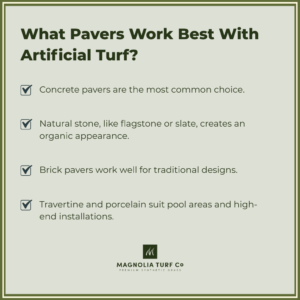
Most paver materials work well with artificial turf. The choice depends on your design goals and budget:
- Concrete pavers are the most common choice. They come in many colors, shapes, and textures. Square concrete pavers with turf filling the gaps create a modern, geometric look.
- Natural stone, like flagstone or slate, creates an organic appearance. Irregular edges require more precise turf cutting but look natural once installed.
- Brick pavers work well for traditional designs. The warm tones complement green turf and match many Texas and Florida home styles.
- Travertine and porcelain suit pool areas and high-end installations. These materials stay cooler than concrete and resist pool chemicals.
Paver thickness matters for installation. Thicker pavers require deeper excavation. We adjust your base depth so your turf and paver surfaces end up level.
Frequently Asked Questions About Artificial Grass Between Pavers
Can I install artificial grass between existing pavers?
Yes, but it’s difficult. The base underneath existing pavers may not extend to turf areas, creating drainage problems. Retrofitting artificial grass between pavers usually requires removing pavers and installing a continuous base.
How do you maintain turf and pavers?
Rinse the turf every month and brush high-traffic areas if the blades flatten. Sweep debris off pavers as needed. Total maintenance for turf and paver combinations is about 5–10 hours per year.
Does artificial grass between pavers drain well?
Yes, artificial grass between pavers drains well with proper installation. Our flow-through backing drains 30+ inches of liquid per hour.
How much do turf and paver installations cost?
Residential turf and paver projects run $7–$12 per square foot, depending on paver type, design complexity, and site conditions.
Will weeds grow between turf and pavers?
Properly installed turf includes weed barrier fabric. Weeds occasionally sprout in the gap between turf and paver edges, but they’re easy to remove and rare with tight edge work.
Get Turf and Pavers Installed Right
We’ve completed 10,000+ installations across Texas and Florida, including hundreds of turf and paver combinations. Our owner, David Turner, personally oversees every project to make sure it’s done right.
Get a free estimate for your turf and paver project today. We’ll assess your space, recommend the right materials, and show you what proper installation looks like.