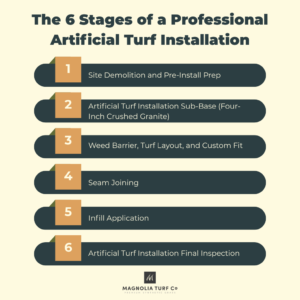
The artificial turf installation process has six stages: site demolition, sub-base construction, weed barrier and turf layout, custom trimming and edge securing, seam joining, and infill application.
A high-quality install takes two to four days for most residential yards in Texas and Florida and lasts 15 to 20 years. Cutting corners on the sub-base or drainage is what causes turf to fail in two to three years.
Quick Answer About the Artificial Turf Installation Process
A professional artificial turf install runs $8 to $11 per square foot all-in. A typical 1,500 sq. ft. yard runs $12,000 to $16,500 over two to four days. Base prep is the biggest factor in whether your turf lasts five years or 20.
Get a free estimate for your yard.
Why the Installation Process Matters
A bad artificial turf installation process looks fine for six months, then breaks down by year two or three: lifted seams, low spots, drainage failures, matted fibers. We’ve ripped out plenty of failed jobs across Texas and Florida, almost always from skimped base work or bad drainage.
Step One: Site Demolition and Pre-Install Prep
Our crew strips out grass, soil, weeds, and old hardscape down to the depth the new sub-base needs, then caps sprinkler heads and marks every irrigation, electrical, and utility line. Skip this step or leave organic matter behind, and you’ll see settling, weed growth, and uneven surfaces within a year.
Step Two: Artificial Turf Installation Sub-Base (Four-Inch Crushed Granite)
We lay four inches of crushed granite or limestone, compact it in lifts with a plate compactor, and grade it for proper drainage slope. Some companies cut this to two or three inches to save money. The result: low spots, pooling, and a loose surface.
The sub-base is the most important part of the installation. Learn more about sub-base requirements.
Step Three: Weed Barrier, Turf Layout, and Custom Fit
We roll out a geotextile weed barrier over the compacted base, then lay turf panels so the blade grain runs the same direction across every piece. An off-direction panel is one of the easiest tells of an amateur job.
We custom-trim each piece around obstacles and secure the edges with six-inch nails every six inches along the perimeter. Nails go in flush, not deep, to prevent visible dimples.
Step Four: Seam Joining
Where two pieces of turf meet, the seam has to disappear. We use seam tape and professional-grade adhesive, line up the blade rows, and weight the seam as it cures.
A clean seam disappears when you walk the yard. A bad one lifts within the first year.
Step Five: Infill Application
Infill is the granular material we brush down between the blades to add weight, hold the blades upright, and give the surface a grass-like feel. Our crews apply two to three pounds per square foot with a drop spreader and power broom.
Standard installs use kiln-dried silica sand. Pet areas get OptiFILL+, which is antimicrobial and handles urine drainage. Zeolite stays 20 to 30% cooler if heat reduction is your priority.
Step Six: Artificial Turf Installation Final Inspection
Before we leave, the crew runs water across the surface to confirm drainage works. Our Triflow® Backing drains 900+ inches of liquid per hour, which handles Texas storm bursts of two to four inches per hour and Florida’s 50+ inches of annual rainfall.
Microguard® antimicrobial protection keeps pet areas sanitary by inhibiting bacterial growth on the fibers, so urine smells don’t build up over time. The final walk-through covers seam workmanship, edge securing, infill coverage, and grade. More on our drainage system.
DIY vs. Professional Artificial Turf Installation
DIY works for small decorative patches under 100 square feet. For a full yard, the redo cost on a failed install runs higher than doing it right the first time.
| Factor | DIY Install | Professional Install |
| Up-front cost | Approximately $3–$6 per sq. ft. (materials only) | $8–$11 per sq. ft. (turn-key) |
| Sub-base depth | Often one to two inches | Full four-inch compacted base |
| Drainage | Whatever the backing allows | 900+ inches/hour Triflow Backing |
| Seam workmanship | Visible, lifts within a year | Hidden seams, stay flat |
| Time investment | 40 to 80 hours of labor | Two to four days, hands-off |
| Warranty | None | 15-year warranty |
| Typical lifespan | Two to three years | 15 to 20 years |
What Makes a Magnolia Installation Different
Every install gets four inches of compacted crushed granite, full Triflow Backing, two to three pounds of infill per square foot, and professional seam work. No exceptions.
Our turf is PFAS-free and 100% lead-free, so it’s safe for kids, pets, and barefoot use without exposing your family to forever chemicals or heavy metals. The 15-year warranty covers fading, seam separation, and backing failure, so you’re protected if a defect shows up before the turf has earned its keep.
David Turner, our owner, personally oversees every job, so you get the same standard whether it’s a 200-square-foot side yard or a 20,000-square-foot estate. After 10,000+ installs across Dallas, Houston, Austin, San Antonio, Tampa, and Sarasota, the team knows what works in extreme heat, heavy rain, and both clay and sandy soil.
Frequently Asked Questions About Artificial Turf Installation
How long does the artificial turf installation process take?
Most residential yards take two to four days. Smaller jobs can finish in a single day. Larger projects with custom drainage, slopes, or putting greens can run a week or more.
What’s the most important step in artificial turf installation?
The sub-base does more for longevity than any other step. Four inches of compacted crushed granite, properly graded, is the single biggest factor in whether your turf lasts 15 to 20 years or fails in two to three.
Can I install artificial turf myself?
Yes, but we don’t recommend it for full yards. DIY installs typically fail within two to three years from base prep and drainage shortcuts.
Does artificial turf need infill?
Yes, you need infill to keep the blades upright. We use two to three pounds per square foot. Silica sand is standard; OptiFILL+ works best for pets, and zeolite stays coolest in summer heat.
How much does professional artificial turf installation cost?
Professional installs run $8 to $11 per square foot all-in for residential projects in Texas and Florida. A typical 1,500-square-foot yard costs $12,000 to $16,500. See our full cost breakdown.
Can artificial turf be installed on a slope?
Yes, and slopes actually drain better than flat ground. We adjust base prep, anchoring, and infill to keep everything in place during heavy rain.
Get Your Yard Installed the Right Way
We’ll walk your property, talk through what your site needs, and give you a detailed line-item quote.
Request your free estimate today. A real artificial turf installation process leaves you with a yard that looks great 15 years later.