Table of Contents
- What Artificial Grass Drainage Is and Why It Matters for Your Investment
- How Drainage Performs in Texas and Florida Climates
- The True Cost of Drainage Failure
- Artificial Grass Drainage Backing Technologies Compared
- The Magnolia Turf Drainage Process: Step by Step
- Drainage for Pets, Pools, and Specialty Applications
- Long-Term Drainage Performance: Problems, Prevention, and Maintenance
- Common Artificial Grass Drainage Scenarios in Texas and Florida
- Frequently Asked Questions
- Get a Free Artificial Grass Drainage Assessment
- Related Resources and References
A typical Texas or Florida artificial grass drainage installation runs $15,000 to $50,000. The drainage system you can’t see decides whether that investment lasts 15 years or fails in five.
We’ve installed over 10,000 artificial turf projects across Texas and Florida, which means we’ve seen every soil type and storm pattern your property is likely to throw at a turf system. We’ve been called out to repair hundreds of failing installations from other companies. The pattern is almost always the same: the surface looked fine, but water had nowhere to go.
This guide explains what proper artificial grass drainage is, how it has to work in DFW clay or Tampa flood zones, and what drainage failure costs once you add up turf replacement, slab repair, and warranty loss. You’ll learn how the main backing technologies stack up, what’s underneath every Magnolia install, and how to evaluate whether any installer’s drainage plan is built for your soil and your climate.
This isn’t a generic overview of how artificial turf drains. It’s a Texas and Florida buyer’s guide to protecting a five-figure outdoor investment.
Quick Answer About Artificial Grass Drainage
Proper artificial grass drainage moves water from the turf surface through pores in the backing, into a permeable sub-base, and out into native soil or routed drains. In Texas and Florida, real-world performance depends on what’s underneath the turf, not the backing rate alone.
Magnolia’s Triflow Backing drains 900+ inches of liquid per hour over a four-inch decomposed granite sub-base graded one to two percent away from your home, which keeps the surface usable through tropical downpours and protects your install for the full 15-year warranty period.
What Artificial Grass Drainage Is and Why It Matters for Your Investment
Drainage is the path water takes from the surface of your turf to the soil below. Rain, hose water, pool splash, and pet urine hit the turf fibers, move through the infill layer, pass through the pores in the backing, travel through a permeable sub-base, and finally percolate into the native soil.
Every layer has to keep up with the layer above it. If your backing drains 900+ inches of liquid per hour but your sub-base is compacted clay, water pools and your install sits saturated. The system performs at the speed of its slowest layer.
Drainage isn’t a product feature. It’s the single biggest factor in whether your turf:
- Maintains warranty coverage for the full 15 years, so you’re protected from manufacturing defects for the life of the install
- Stays clean and odor-free under heavy pet use, so your yard is still pleasant to be in two years from now
- Avoids the wrinkles, soft spots, and seam failures that come from saturated sub-bases, which keeps the surface looking new
- Protects your slab, beds, and surrounding hardscape from runoff damage, sparing you repair bills that can easily exceed the cost of the turf itself
Manufacturer drainage rates printed on a turf spec sheet describe the backing in a lab. Real-world performance depends on what’s underneath. That’s the part most quotes never mention.
How Drainage Performs in Texas and Florida Climates
Artificial grass drainage performance in Texas and Florida hinges on regional soil and storm patterns that don’t show up on a national spec sheet. A drainage plan that works in San Diego will fail in Houston. Soil and rainfall in Texas and Florida demand specific engineering choices most national turf companies don’t make.
Texas Soil and Storm Realities
DFW black clay: Expansive clay swells when wet, contracts when dry, barely percolates, and moves under load. We use a four-inch sub-base of decomposed granite or crushed limestone, compacted in lifts, to create a stable, permeable buffer between the turf and the clay below. That buffer gives water somewhere to go even when the underlying clay can’t absorb another drop, which keeps your surface dry and your sub-base intact.
San Antonio Blackland Prairie and Hill Country caliche: Similar swelling-clay challenges in San Antonio, with hardpan caliche layers in some Hill Country sites that require deeper excavation to reach a base material that drains. Skipping that step traps water against the caliche and pushes it sideways into the turf seams.
Austin and Hill Country sites: Many Austin yards sit on a mix of Blackland clay and shallow limestone bedrock. We size the sub-base depth to the specific lot, often blending a thicker decomposed granite layer with surface drains in low spots so water has a clear exit route during a thunderstorm.
Houston Gulf Coast: Flat terrain, high water tables, and tropical storms that drop two to four inches in an afternoon. Slope grading away from the house isn’t optional. Neither is proper compaction that keeps drainage channels open through the sub-base instead of sealing them off, which is what protects your foundation when the next storm parks over the bayou.
See how we install in Houston.
Florida Soil and Storm Realities
Tampa and Sarasota sandy soils: Sand drains beautifully on its own. The challenge is stability. We typically run a three-inch decomposed granite base with extra compaction passes so the turf doesn’t move after a heavy storm, which keeps your install flat and seams tight after years of foot traffic.
High water tables and FEMA flood zones: Coastal Florida properties sit on saturated soil after even moderate rain. French drains, swales, or perforated drainpipe become part of the system, not optional add-ons. They route surge water off the property before it can saturate the sub-base and undermine the turf.
Hurricane rainfall: Storms like Helene and Milton dropped rainfall measured in feet, not inches. Properly installed permeable systems with a one to two percent slope shed surge water within minutes of the rain stopping. Skimped sub-bases scour and pool, which is what turns a $25,000 install into a $40,000 redo.
The True Cost of Drainage Failure
When artificial grass drainage fails, you don’t just replace turf. You inherit a chain of costs most homeowners never see coming until the first big storm.
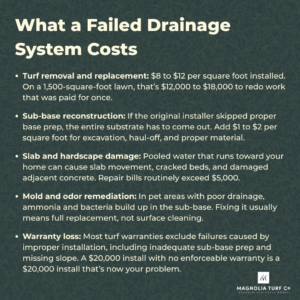
What a Failed Drainage System Costs
- Turf removal and replacement: $8 to $12 per square foot installed. On a 1,500-square-foot lawn, that’s $12,000 to $18,000 to redo work that was paid for once.
- Sub-base reconstruction: If the original installer skipped proper base prep, the entire substrate has to come out. Add $1 to $2 per square foot for excavation, haul-off, and proper material.
- Slab and hardscape damage: Pooled water that runs toward your home can cause slab movement, cracked beds, and damaged adjacent concrete. Repair bills routinely exceed $5,000.
- Mold and odor remediation: In pet areas with poor drainage, ammonia and bacteria build up in the sub-base. Fixing it usually means full replacement, not surface cleaning.
- Warranty loss: Most turf warranties exclude failures caused by improper installation, including inadequate sub-base prep and missing slope. A $20,000 install with no enforceable warranty is a $20,000 install that’s now your problem.
Why the Upfront Premium Pays for Itself
Proper drainage prep adds roughly $1.50 to $3 per square foot to the project cost. For a 1,500-square-foot install, that’s $2,250 to $4,500.
Skipping it saves money on day one. It costs $10,000 to $25,000 over the next three to five years.
Quality costs more upfront, and shortcuts cost more in the long run. That’s the math.
Artificial Grass Drainage Backing Technologies Compared
Every turf product has a backing. The backing’s job is to let water through without compromising strength. Here’s how the main categories stack up.
The Four Main Backing Categories
| Backing Type | Drainage Rate | Best Use Cases | Pricing Tier |
| Hole-punched urethane | 30 to 50 inches per hour | Standard low-traffic lawns in dry climates | Base |
| Triflow Backing (full-surface permeable) | 900+ inches of liquid per hour | Pet areas, Texas and Florida residential, heavy rain regions | Premium |
| Fully permeable polyurethane | 400 inches per hour and up | Sports surfaces, multi-pet households | Premium |
| Geocell drainage core | One-inch lateral void, 90+ percent air space | Rooftops, balconies, playgrounds, decks over concrete | Specialty |
What This Means in Practice
Hole-punched backings have spaced perforations every four to six inches. Water has to find a hole. In a Texas downpour, that’s not fast enough, and the spaces between holes become pooling points that ruin infill and rot organic debris into the sub-base.
Magnolia’s Triflow Backing system drains across the entire surface through tiny pores in every millimeter of the material. Triflow Backing drains 900+ inches of liquid per hour, which is roughly 29 times faster than hole-punched. That’s the standard we use on every Magnolia install since it works under Texas heat, Florida humidity, and heavy pet load without slowing down over time.
Geocell drainage cores are specialty solutions for installs where there’s no permeable soil underneath, like rooftop decks, balcony installs, or putting greens on concrete. We use a perforated drain mat with a dimpled core that drains 21 gallons per minute per foot of width (ASTM D-4716) under turf installed over hard surfaces. That capacity keeps rooftop and pool deck installs dry even during a sustained Florida thunderstorm.
A backing’s published drainage rate only matters if the layers underneath can keep up. That’s the part of the system most installers underbid.
The Magnolia Turf Drainage Process: Step by Step
Every Magnolia install follows the same artificial grass drainage workflow. We don’t take shortcuts, and we don’t make exceptions.
Step One: Site Assessment and Percolation Check
We walk the site, identify low spots, locate the slab and structures, and evaluate native soil. On clay-heavy lots, we test how fast water moves through the existing soil so we can size the sub-base accordingly. Owner David Turner reviews complex sites personally, which means drainage problems get caught and engineered around before crews arrive, not after.
Step Two: Excavation
We remove three to four inches of existing soil and turf, digging deeper in caliche or hardpan areas to reach a workable base. About one cubic yard of base material per 100 square feet of turf gets hauled in. That depth gives the new permeable layer enough volume to handle the kind of rainfall a Texas thunderstorm or a Tampa squall can deliver.
Step Three: Sub-Base Installation
We use decomposed granite or crushed limestone. Both have angular particles that lock together when compacted, creating a stable, level platform that still lets water through. That stability is what keeps your install flat 10 years later, when settled bases on cheaper jobs start showing soft spots and visible wrinkles.
The base goes in two-inch lifts and gets compacted between each lift. Slope grading runs one to two percent away from houses and structures so water moves where we want it to: away from your foundation and into the yard.
Step Four: Drainage System Integration
For sites with high water tables, flat grading, or known drainage issues, we add French drains, swales, or perforated drainpipe before the turf goes down. Florida coastal installs and Houston flood-prone yards almost always need this. The added drainage routes storm volume off the property before it can saturate the sub-base and undermine the turf.
Step Five: Turf and Infill
We install premium turf with Triflow Backing that drains 900+ inches of liquid per hour, and we glue and secure all seams so they hold under heavy traffic and storm runoff. Infill goes down at the manufacturer-specified rate. For pet turf installations done right, we use Microguard-treated OptiFILL+, an antimicrobial acrylic-coated sand that blocks the bacteria that turn pet urine into ammonia odor, keeping your yard fresh between rinses.
Learn about turf infill options.
Step Six: Post-Install Drainage Test
Before we sign off, we flood-test the surface to confirm water clears through the system without pooling. If it doesn’t, we fix it before we leave. That’s how we know the warranty stands and how you know the system performs before you write the final check.
See the full installation process.
Drainage for Pets, Pools, and Specialty Applications
Standard residential artificial grass drainage isn’t enough for every yard. Pet areas, pool surrounds, and specialty installs each have their own requirements.
Pet Area Drainage
Multi-dog households put a heavy, repeated load on the drainage system. Urine has to clear through the backing into the sub-base, not sit on the surface or pool between layers, which is what creates the smell that drives homeowners off their own patios.
Our pet turf installations use:
- Triflow Backing that drains 900+ inches of liquid per hour, which clears pet urine on contact instead of letting it pool
- Microguard-treated OptiFILL+ antimicrobial infill that blocks ammonia and bacteria buildup, keeping the surface odor-free
- Extra compaction at the sub-base that prevents settling under high-traffic pet zones, so your dog’s favorite spot doesn’t dish out into a low spot two years in
Recommended care includes solid waste pickup, rinsing two to three times per week, and an enzyme cleaner like PE-51 once or twice a year. With proper drainage and maintenance, pet turf stays clean and odor-free for the life of the install.
Read the pet turf installation guide.
Pool Deck Drainage
Splash, deck rinse, and chlorinated water hit turf around pools. The system needs to handle saturated conditions without breaking down or staining.
We integrate the turf with the pool deck so runoff sheds away from the coping, not toward it. Triflow Backing drains pool splash without pooling, and Magnolia’s UV-stabilized fibers handle direct sun and chlorine exposure without fading, so the green color stays true through years of Texas and Florida summers.
Putting Greens, Playgrounds, and Rooftops
Backyard putting green drainage planning needs precise grading so the surface drains evenly and stays true to roll speed. We use a putting green underpad and drain core for greens installed over concrete or where natural drainage is poor.
Playground turf drainage requirements include IPEMA-certified fall attenuation systems plus drainage. We install medium-density foam (for falls up to five feet) or high-density foam (for falls up to eight feet) beneath the turf, all atop a permeable sub-base. That combination protects kids from injury during the fall and keeps the surface playable within minutes of a rain event.
Rooftop and balcony installs (common in Florida high-rises) sit over concrete, so they get a perforated drain mat that creates a 0.40-inch dimpled void for lateral water flow. The void carries stormwater to the building’s existing scuppers, which keeps the install dry without adding load to the structure.
Long-Term Drainage Performance: Problems, Prevention, and Maintenance
Artificial grass drainage doesn’t fail on day one. It fails slowly, then suddenly. Knowing what to watch for keeps your install performing for the full warranty period.
Common Drainage Failure Modes
- Sub-base settling: Improper compaction creates voids. Voids fill with water, and water creates soft spots and turf wrinkles.
- Slope reversal: Settling near houses can flatten or reverse the original drainage slope, sending water toward the home instead of away from it.
- Plugged backing perforations: Hole-punched backings can clog with fines from infill or organic debris. Triflow Backing has so many drainage points that plugging is functionally impossible, which is one reason we standardized on it.
- Infill compaction: Heavy traffic and pet use compress infill, slowing percolation. Topping up infill every three to five years restores the layer and the drainage rate.
- Edge separation: Poor edge securing lets water pool at the perimeter and undermine the sub-base.
Drainage Myths Worth Killing
“All artificial turf drains.” True only if the entire system was built right. The turf might drain fine. The compacted clay underneath might not.
“Higher manufacturer drainage rate means better real-world drainage.” Backing rate is a ceiling, not a floor. Your sub-base sets the floor.
“You can fix drainage problems by adding more infill.” Adding infill won’t fix drainage problems. Drainage problems live in the sub-base, and infill changes can’t reach them.
Texas and Florida Maintenance Schedule
| Frequency | Task |
| Weekly (pet areas) | Rinse the surface and pick up solid waste |
| Monthly | Brush fibers upright and clear surface debris |
| Quarterly | Inspect slopes, edges, and seams for separation |
| After heavy storms | Check for pooling, scour, and debris in drains |
| Annually | Top up infill as needed; flush French drains and swales |
| Every three to five years | Full infill replenishment |
Total annual time: five to 10 hours. Annual cost for materials and consumables: $150 to $400. That’s a small price to keep a $25,000 install performing through the back half of its 15-year warranty period.
See the full maintenance guide.
Common Artificial Grass Drainage Scenarios in Texas and Florida
Across 10,000+ installs, the same regional artificial grass drainage challenges show up over and over. Here’s how we approach the most common ones.
DFW Backyard With Expansive Black Clay
The challenge: Compacted clay that swells when wet, contracts when dry, and percolates at single-digit inches per hour. Standard three-inch base prep fails on Dallas-Fort Worth lots.
Our approach: Four inches of decomposed granite or crushed limestone, compacted in lifts, with a one to two percent slope away from the house. Triflow Backing turf laid over a fully prepared sub-base. The clay still moves; the turf doesn’t.
Houston Yard in a Flood-Prone Subdivision
The challenge: Tropical storm rainfall, slow native drainage, and a yard that already pools during normal weather.
Our approach: Sub-base prep plus French drains routed to a code-compliant outlet. Slope grading verified by sight and water test. Triflow Backing handles the surface, and the drains handle the volume.
Tampa Pool Surround With Splash and Storm Surge
The challenge: Constant pool deck rinse, hurricane season rainfall, and proximity to coping where standing water destroys infill.
Our approach: Three-inch decomposed granite base with extra compaction passes for sand stability, sloped away from coping. Triflow Backing drains splash before it can pool. UV-stabilized turf handles sun and chlorine without fading.
Sarasota High-Rise Balcony Putting Green
The challenge: Concrete substrate, no native soil drainage, building-required slip resistance, and load limits.
Our approach: Perforated drain mat over the concrete, topped with putting green turf and a precision underpad. Drainage routes to the building’s existing balcony scupper system. Lightweight infill keeps load within tolerance.
Frequently Asked Questions
What drainage rate do I need for my yard?
For most Texas and Florida residential yards, Triflow Backing that drains 900+ inches of liquid per hour is more than enough, even for heavy pet use, pool areas, and flood-prone lots paired with French drains or swales. The bigger question is whether your sub-base can keep up. A 900+ inch backing over compacted clay drains at the speed of clay.
Will artificial turf drainage work over Texas clay soil?
Yes, with the right sub-base it works reliably. We excavate three to four inches of clay and replace it with decomposed granite or crushed limestone, compacted in lifts. That permeable layer becomes the actual drainage path, and the clay stays put underneath.
How do I vet an installer’s drainage plan?
Ask these three questions before signing a contract:
- What sub-base material are you using, and how deep?
- What slope are you grading to?
- Will you flood-test the system before sign-off?
If the installer can’t answer all three, the drainage is being underbid.
What voids my drainage warranty?
Most turf warranties exclude failures from improper installation, including inadequate sub-base depth, missing slope, no flood test, and undocumented drainage modifications. They exclude damage from acts of nature where the system wasn’t engineered for the conditions. Get the warranty in writing and read what’s excluded before you sign.
How much does it cost to fix drainage failure?
Artificial grass drainage repairs that involve sub-base replacement run $8 to $12 per square foot installed, similar to a new install. Add slab or hardscape repairs if water damaged adjacent structures. Total exposure on a 1,500-square-foot lawn typically runs $15,000 to $30,000.
What do I need to do after a hurricane or heavy storm?
Walk the perimeter and check for scour, exposed sub-base, or shifted infill. Clear debris from French drains and swales, and look for new low spots that may have settled. If water is pooling more than 24 hours after the storm, call us for an inspection.
Does Florida humidity cause drainage problems?
No, humidity doesn’t affect drainage rate. What it can do is encourage mold and mildew growth on debris that sits on the surface. Microguard-treated antimicrobial infill blocks that growth, keeping the surface fresh through Florida’s wettest months.
Can I install French drains under existing turf?
In some cases, yes, but it usually requires lifting and reseating sections of turf. If drainage problems are widespread, a full reinstall with proper drainage from day one is more cost-effective than spot-fixing.
Get a Free Artificial Grass Drainage Assessment
We’ve installed over 10,000 artificial grass drainage systems across Texas and Florida. Every one of them starts with proper drainage planning, no shortcuts and no exceptions.
Here’s what you get with a Magnolia drainage assessment:
On-site evaluation: We walk your property, identify drainage challenges, and check soil and slope conditions in person. That’s the only way to size a system to your specific lot instead of guessing from a satellite photo.
Specific drainage plan: Sub-base material and depth, slope grading, drain integration if needed, and the exact backing technology suited to your conditions. You see the spec before you sign a contract.
Transparent pricing: Line-item quote showing what drainage prep costs and why. No vague “site work” line items hiding margin or hiding shortcuts.
15-year warranty: Backed by 10,000+ successful installations and a written warranty that pays out, since the system is built to perform under Texas and Florida conditions from day one.
We serve Dallas, Houston, Austin, San Antonio, Tampa, and Sarasota. We’re not the cheapest option. We’re the right artificial grass drainage company when you’re protecting a five-figure outdoor investment that has to last 15 years.
Get your free drainage assessment.
Related Resources and References
Related Magnolia Turf Resources
- Artificial Grass Drainage Main Page
- What Goes Under Artificial Turf?
- Artificial Grass Installation Process
- Artificial Grass Installation Costs: The Complete Guide
- Pet Turf and Artificial Grass for Dogs
- Artificial Grass Putting Greens
- Artificial Grass Playscapes
- Artificial Grass Infill Solutions
- Artificial Turf Maintenance: Complete Care Guide
- Perforated Drain Mat Product Page
Industry Standards and External References
- ASTM F1551: Standard test methods for synthetic surfaces.
- ASTM D-4716: Standard test method for hydraulic transmissivity (used for drain mat performance).
- IPEMA: International Play Equipment Manufacturers Association certification standards for playground safety surfacing.
- FEMA Flood Map Service Center: Flood zone designations relevant to Florida coastal installs.
- Texas and Florida municipal stormwater codes vary by jurisdiction. Verify local requirements before any installation involving drainage modifications.
Magnolia Turf serves homeowners and contractors throughout Dallas, Houston, Austin, San Antonio, Tampa, and Sarasota with professional artificial turf installation backed by 10,000+ successful projects and a 15-year warranty. Contact us today for a free drainage assessment and transparent pricing for your outdoor space.