Yes, artificial grass gets hot. Hotter than natural grass. We can’t pretend otherwise: we’ve installed over 10,000 artificial turf projects across Texas and Florida.
But here’s what most blog posts won’t tell you: heat is a factor for about 12 weeks of the year, during a four-hour window each day, and only in direct sunlight. The rest of the time, it’s a non-issue. And when it does get hot, a 60-second spray with your garden hose cools it down instantly.
Let’s talk about what happens with artificial grass and heat in our markets, what affects it, and how to keep you comfortable year-round.
Quick Takeaways: Artificial Grass and Heat
- Artificial grass gets hotter than natural grass in direct sunlight. This is true and unavoidable.
- Heat is a factor June through mid-September, roughly noon to 4 p.m., in direct sun.
- Shade eliminates the heat concern entirely.
- A 60-second hose spray cools the surface instantly and lasts one to two hours.
- “Cooling technology” products offer minimal benefit (about five degrees).
- Flow-through backing and proper sub-base make the cooling rinse work better.
- Avoid crumb rubber infill in hot climates.
- For window reflection areas, use nylon turf products that resist melting.
What 10,000 Texas and Florida Installations Taught Us About Artificial Turf Heat
Artificial turf retains heat like concrete. When the sun beats down on it, the surface temperature rises. That’s physics, and no amount of marketing spin changes it.
We’ve tested every “cooling technology” product on the market. The T-cool products, the coolant-infused blades, all of it.
The honest truth is that high-end products run about five degrees cooler than lower-end options. That’s it. If someone tells you their turf stays 30 degrees cooler than the competition, that’s marketing, not reality.
Here’s what matters: direct sunlight. Your turf only gets hot when the sun hits it. The moment a cloud passes overhead, the surface cools instantly. If you have any shade from trees, a pergola, or your house, that shaded area stays comfortable even on the hottest days.
The timing matters, too. Peak heat happens from roughly noon to 4 p.m., June through mid-September. Outside that window, surface temperature isn’t a concern.
Morning coffee on your turf at 10 a.m. in July? Completely comfortable. Evening barbecue at 6 p.m.? No issues at all.
That leaves about 12 weeks of summer afternoons to manage. And even then, there’s a simple solution.
The 60-Second Fix That Works for Hot Artificial Grass
When you’re expecting guests for a pool party or the kids want to play barefoot, grab your garden hose. A quick rinse across the turf surface drops the temperature, and it stays cool for one to two hours.
You don’t need to soak it. A light spray does the job.
This works since artificial turf doesn’t retain heat the way concrete does. Concrete absorbs heat deep into the material and releases it slowly for hours. Turf surface temperature comes from solar radiation hitting the surface. Remove the heat source (or cool the surface), and the temperature drops immediately.
If you’re hosting an afternoon gathering in July, spray the turf before guests arrive. Do it again halfway through if needed. That’s all it takes.
Why Artificial Turf Installation Affects How Well Cooling Works
Here’s where installation quality comes into play. The hose trick works great for cooling hot artificial grass, but only if that water can drain properly.
Magnolia Turf installations start with three to four inches of crushed limestone or decomposed granite as a sub-base. This porous foundation lets water pass through efficiently. When you spray the turf to cool it down, the water doesn’t pool on the surface or create muddy conditions underneath. It drains through and away.
We use turf with flow-through backing that drains at over 900 inches of liquid per hour. That’s roughly 2,900% faster than traditional hole-punched backing found in lower-cost products.
This matters for two reasons: pet urine drains quickly instead of lingering and causing odors, and your cooling rinse disappears fast without leaving standing water.
Installers who skip proper base preparation create problems. Without adequate drainage, water sits on the surface or turns the ground beneath into a soggy mess. The cooling method still works, but the aftermath becomes inconvenient.
Premium Artificial Turf vs. Big-Box Products: What Differs in Hot Climates
Walk into Home Depot or Lowe’s and you’ll find artificial turf that looks similar to what professional installers use. The difference shows up in performance over time, and yes, in heat.
Lower-quality turf uses flat blades that mat down quickly under foot traffic. They end up looking like shiny green plastic within a few years.
Premium turf uses W-, S-, and C-shaped blades with a reinforced spine. These shapes bounce back after being stepped on and maintain a natural appearance for 15 years or more.
The backing matters, too. Flow-through backing (100% permeable) drains liquids instantly. Hole-punched backing relies on drainage points spaced every three inches, which slows water movement.
Does premium turf stay dramatically cooler? Not dramatically. Maybe five degrees.
But it performs better in every other way: drainage, durability, appearance, and longevity. The heat difference alone isn’t worth the upgrade. Everything else is.
One infill to avoid with artificial grass in hot climates: crumb rubber. Made from recycled tires, it’s dense and black. It absorbs heat and leaves black dust on skin, clothing, and pets as it degrades. We use silica sand or Envirofill (an acrylic-coated sand with antimicrobial protection) instead.
When Heat Becomes a Problem for Artificial Grass in Texas and Florida
Let’s talk about situations where artificial grass genuinely struggles with heat.
Window reflection is the big one. Low-E glass and other highly reflective windows can concentrate sunlight like a magnifying glass. This creates intense heat spots that can melt or deform standard polyethylene turf. We’ve seen it happen.
The solution isn’t anti-reflective window film (though that helps). For areas exposed to window reflection, we install nylon turf products instead. Nylon can withstand extreme heat without melting or warping. If your installation includes areas near reflective windows, tell your installer about it so they can plan accordingly.
Full-sun yards with no shade experience the most heat during summer afternoons. The turf will get hot enough to be uncomfortable barefoot. This doesn’t make artificial grass a bad choice for these yards. It means you’ll use the hose-spray method more often during June, July, and August.
Dark-colored turf absorbs more heat than lighter shades. If heat concerns you, consider a lighter green option. The difference isn’t huge, but it helps.
What Texas and Florida Homeowners Experience With Artificial Turf Heat
We talk to homeowners after installation. The pattern is consistent.
Most people worried about heat before installation find it’s a non-factor in practice. They aren’t spending peak summer afternoons barefoot in their backyards anyway. Mornings, evenings, and the other nine months of the year? The turf stays comfortable.
Pet owners tell us their dogs love the turf. Whether you’re in Houston or Tampa, dogs find comfortable spots. If the turf were unbearably hot, they wouldn’t choose to relax on it.
The families who do use their yards during hot afternoons learn the spray routine quickly. It takes less than a minute and keeps the surface comfortable for hours. Most say they wish they’d made the switch sooner.
Compare this to natural grass in a Texas or Florida summer. Drought restrictions limit watering. Grass goes brown and dormant.
Bare patches develop. And when it does rain, you get mud tracked through the house for days. Artificial turf stays green and usable year-round.
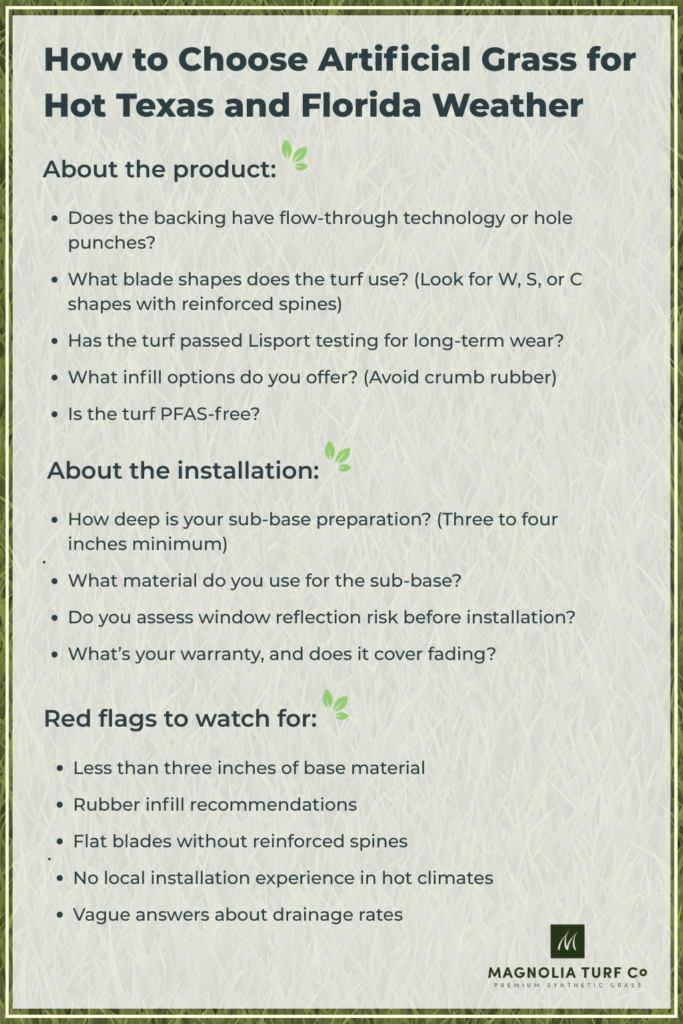
How to Choose Artificial Grass for Hot Texas and Florida Weather
If you’re evaluating artificial grass options in Texas or Florida, ask these questions:
About the product:
- Does the backing have flow-through technology or hole punches?
- What blade shapes does the turf use? (Look for W, S, or C shapes with reinforced spines.)
- Has the turf passed Lisport testing for long-term wear?
- What infill options do you offer? (Avoid crumb rubber.)
- Is the turf PFAS-free?
About the installation:
- How deep is your sub-base preparation? (Three to four inches minimum.)
- What material do you use for the sub-base?
- Do you assess window reflection risk before installation?
- What’s your warranty, and does it cover fading?
Red flags to watch for:
- Less than three inches of base material
- Rubber infill recommendations
- Flat blades without reinforced spines
- No local installation experience in hot climates
- Vague answers about drainage rates
Frequently Asked Questions
How hot does artificial grass get in Texas and Florida summers?
Surface temperatures can climb above 140°F in direct afternoon sun during peak summer months. This occurs during a narrow window (roughly noon to 4 p.m., June through September) and only in areas with no shade. A quick spray with water drops the temperature immediately.
Is artificial grass safe for pets in hot weather?
Yes, with basic awareness. Pets naturally seek comfortable spots and won’t lie on surfaces that are too hot.
Most pet owners find their dogs use the turf comfortably, especially in mornings and evenings. For midday summer use, the hose-spray method keeps the surface comfortable.
Does premium artificial grass stay cooler than cheap turf?
Slightly. Higher-quality products with advanced backing and blade technology run about five degrees cooler than basic options. The real advantages of premium turf are durability, drainage, and appearance over time, not dramatic heat reduction.
Can artificial grass melt?
Standard polyethylene turf can melt or deform under concentrated heat from reflective windows. Nylon turf products resist this damage. If your yard includes areas near Low-E glass or other reflective surfaces, have your installer address this with appropriate product selection.
How long does artificial grass stay cool after spraying with water?
Typically one to two hours, depending on sun intensity. The cooling effect is immediate. For afternoon gatherings, plan to spray once before guests arrive and once more midway through if needed.
Ready to See If Artificial Grass Works for Your Yard?
Heat is manageable. Product and installation quality determine whether you’ll love your turf for 15 years or replace it in five.
We’ve done this over 10,000 times across Texas and Florida. We know what works in our climate and what doesn’t. If you want straight answers about whether artificial grass makes sense for your specific situation, we’re happy to talk it through.
Get a free estimate for your project today.