Table of Contents
- What Is a Dog Run and Why Artificial Turf?
- Who Needs a Dog Run With Artificial Turf?
- Benefits and Drawbacks of Artificial Turf Dog Runs
- Choosing the Right Artificial Turf for Your Dog Run
- Step-By-Step Planning Process
- Installation Options: DIY vs. Professional
- Cost Breakdown and ROI Analysis
- Design Ideas and Essential Components
- Maintenance Requirements and Long-Term Care
- Common Pitfalls and Expert Tips
- Frequently Asked Questions
- Get Started With Your Dog Run Project
Introduction
Your dog needs exercise. Your yard needs to survive.
Most pet owners face this tension daily. Natural grass turns to mud. Dogs track dirt through the house. Bare patches multiply. You’re stuck choosing between a happy dog and a decent-looking yard.
Dog runs with artificial turf solve this problem. They give your pet a dedicated outdoor space that stays clean, drains properly, and lasts for years. You won’t deal with mud, dead grass, or constant reseeding.
We’ve installed artificial turf dog runs for hundreds of pet owners across Texas and Florida. Over 10,000 total installations in the past decade. We’ve seen what works, what fails, and why proper installation makes the difference between a dog run that lasts 15 years versus one that needs replacing in five.
This guide covers everything you need to know about planning, installing, and maintaining a dog run that actually lasts. Whether you’re considering DIY installation or professional help, you’ll learn how to make decisions that work for your dog, your property, and your budget.
The key comes down to doing it right from the start. Proper base preparation, premium materials that actually drain, and installation techniques that prevent problems make all the difference. We don’t cut corners.
What Is a Dog Run and Why Artificial Turf?
A dog run is a dedicated outdoor space where your dog can exercise, play, and relieve themselves safely. Think of it as a controlled yard-within-a-yard. You define the boundaries, choose the surface, and create an area that meets your dog’s needs without sacrificing your entire landscape.
Traditional dog runs used concrete, gravel, or wood chips. These surfaces work, but they have problems. Concrete gets scorching hot in summer and creates a harsh impact on joints. Gravel shifts and tracks into the house. Wood chips retain odors and need frequent replacement.
Artificial turf changed the equation. Premium pet turf with flow-through backing drains at 900 inches per hour. That’s what we install on every dog run. For perspective, that’s faster than natural grass and most other drainage solutions. Urine passes through immediately with no pooling and no lingering smells when installed correctly.
The durability matters, too. Quality pet turf handles heavy traffic, digging attempts, and constant use. The backing is reinforced. The blades bounce back. Natural grass can’t compete with that kind of abuse.
Dog runs aren’t the same as letting your dog use the entire yard. They’re purpose-built spaces with proper drainage, appropriate fencing, and ground cover designed specifically for pet use. Some homeowners install them alongside natural grass areas. Others convert problematic sections of their yard that never grew grass well anyway.
The key difference from other solutions: Artificial turf provides a permanent solution that requires minimal maintenance while providing a comfortable, safe surface your dog will actually use.
Learn more about artificial turf for pets.
Who Needs a Dog Run With Artificial Turf?
Multiple-dog households see the biggest impact. Two or three dogs create traffic patterns that destroy natural grass within months. A dedicated dog run concentrates that wear in one area while protecting the rest of your landscape.
Active breeds benefit most. High-energy dogs that need daily exercise tear up yards quickly. Breeds like Border Collies, German Shepherds, and Labs need space to move. A proper dog run gives them that outlet without turning your entire property into a dirt lot.
Dog runs make sense in these scenarios:
- You have limited yard space and want to maximize what you have.
- Your dog destroys grass faster than it can recover.
- You’re tired of muddy paw prints throughout the house.
- Your HOA requires maintained landscaping, but your dog has other ideas.
- You want a dedicated potty area separate from play spaces.
- You live in Texas or Florida, where summer heat kills natural grass anyway.
Small dogs need runs, too, but for different reasons. A contained space provides security. It keeps them visible and prevents escape attempts. The artificial turf stays cleaner than dirt or natural grass, which matters when you’re carrying a 10-pound dog inside.
Senior dogs appreciate the consistent, cushioned surface. They get even ground with no muddy patches and reliable footing that’s easier on aging joints.
Dog runs don’t substitute for walks or human interaction. They won’t magically eliminate all yard maintenance. They won’t fix behavior problems that stem from insufficient exercise or training.
But if your main problem is grass destruction, mud tracking, or maintaining a clean outdoor space for your dog, a properly installed dog run with artificial turf delivers.
If you’re in Dallas, Houston, Austin, San Antonio, Tampa, or Sarasota and wondering whether a dog run makes sense for your situation, we offer free consultations to walk your property and discuss options. We’ll give you straight talk about what will work, with no pressure.
Benefits and Drawbacks of Artificial Turf Dog Runs
Let’s talk about what artificial turf actually does versus what it doesn’t do.
The Real Benefits
Durability that natural grass can’t match. We’ve installed turf that’s handled three large dogs for 10+ years. The surface stays intact with no bare patches and no replanting. The backing is engineered to resist digging, and properly installed turf with adequate infill stays in place.
Drainage that works. Premium pet turf with flow-through backing drains at 900 inches per hour. That’s what we install. For context, that means even heavy rain clears fast. More importantly, dog urine passes through immediately. Combined with antimicrobial infill below the surface that neutralizes odors, this isn’t just better than natural grass: It’s engineered specifically for pet use. The difference between flow-through backing and basic perforated backing shows up in the first month when cheaper installations start pooling water.
Year-round usability. Texas summers kill grass. Florida’s rainy season creates mud. Artificial turf handles both extremes. Your dog has consistent footing regardless of season or weather.
Cleanliness. Dogs track less dirt inside. The turf fibers don’t hold mud the way natural grass does. A quick rinse keeps the surface fresh. You’ll notice the difference on your floors.
Water conservation. In Texas, we’re talking about thousands of gallons saved annually. You won’t need irrigation systems running constantly, and your water bills won’t spike during drought restrictions.
The Honest Limitations
Heat is real in summer. Artificial turf gets hot under direct sun during peak summer months (June through August, 12 pm to 4 pm). Surface temperatures can reach 120–150°F when it’s 100°F outside. The solution: Rinse with water before use, provide shade, or schedule outdoor time for morning and evening. Modern heat-resistant materials help, but they don’t eliminate the issue entirely.
Upfront cost is higher. Quality pet turf installation runs $13–17 per square foot professionally installed. Natural grass sod costs less initially. But factor in long-term maintenance, water bills, and replacement costs, and the math shifts. The break-even point typically occurs around 2.5 years.
Maintenance still exists. It’s minimal compared to natural grass, but you’ll still need to remove solid waste daily, rinse weekly, and use enzyme cleaner periodically. The difference is you’re spending 15 minutes weekly instead of hours mowing, fertilizing, and repairing.
Not every turf product works for pets. Some cheaper products don’t drain properly. Others use backing that dogs can damage. The specifications matter. This isn’t a place to buy the cheapest option and hope it works.
The Comparison

We’ve installed dog runs in Texas heat and Florida humidity. We know which turf specifications actually matter and which ones don’t. Schedule a free consultation to discuss your specific situation.
Choosing the Right Artificial Turf for Your Dog Run
Not all artificial turf works for dogs. The specifications that matter on a residential lawn matter even more when dogs are involved. You need to know what to look for and why it matters.
Drainage Rate: The Most Critical Specification
Flow-through backing versus perforated backing makes the difference between a dog run that works and one that fails.
Flow-through backing allows drainage across the entire surface. Water and urine pass through immediately at rates of 900+ inches per hour. The backing itself is porous.
Perforated backing has small holes punched through a solid backing material. Drainage happens only where the holes are. Urine can pool between perforations. Over time, organic matter clogs the holes. Performance degrades.
We’ve replaced enough perforated backing installations to know that flow-through backing is non-negotiable for pet applications. The initial cost difference is minimal. The performance difference is significant.
Rated drainage capacity matters. Look for turf rated at 900 inches per hour minimum. Some products claim “excellent drainage” without specifying rates.
Get the number. Anything below 500 inches per hour creates problems with multiple dogs or heavy use.
Backing Material and Construction
What we install: polyurethane backing with a drainage layer. The backing needs to be strong enough to resist digging and heavy traffic while remaining porous enough for proper drainage.
Quality pet turf uses multi-layer construction:
- Top layer: Turf fibers (the visible grass)
- Primary backing: Holds fibers in place
- Coating layer: Polyurethane that provides strength and flexibility
- Drainage layer: Flow-through material that allows liquid to pass
Cheaper products skip the drainage layer or use thin coatings that deteriorate. That’s why they cost less. It’s also why they fail.
Antimicrobial Properties
Microban coating inhibits bacterial growth. This isn’t marketing fluff. It’s chemistry that prevents odor-causing bacteria from multiplying in the turf fibers and backing.
Without antimicrobial treatment, organic matter builds up over time. Even with good drainage, turf can develop odors in high-use areas. Microban-treated turf stays fresher longer with basic maintenance.
PFAS-free matters. Per- and polyfluoroalkyl substances (PFAS) are synthetic chemicals linked to health concerns. Quality manufacturers now produce PFAS-free turf. Your dog spends time on this surface, so PFAS-free isn’t optional.
Pile Height and Blade Design
For dog runs, a pile height of 1.5–2 inches works best. Taller isn’t better for pet applications.
Shorter pile offers these advantages:
- Drains faster (less material for liquid to pass through)
- Easier to clean (solid waste sits on surface, doesn’t get tangled in long fibers)
- More durable under heavy traffic
- Resists matting from constant use
Blade shape matters for durability. Quality pet turf uses W-, S-, and C-shaped blades that bounce back after compression. Flat monofilament blades mat down permanently under heavy use.
The blade coating is important, too. UV-resistant coatings prevent degradation from sun exposure. In Texas and Florida, this extends turf life by years.
Infill Selection for Pet Applications
OptiFILL+ infill provides antimicrobial properties and odor control. The infill sits between the turf blades, providing:
- Weight to hold turf in place
- Cushioning for comfort
- Drainage channels between blades
- Antimicrobial action to neutralize odors
OptiFILL+ is a natural mineral that absorbs and neutralizes ammonia from urine. It’s non-toxic, safe for pets, and effective at odor control.
Infill depth should be one to two inches for pet applications. Too little infill and the turf shifts. Too much and drainage slows. The right amount provides stability and performance.
Learn more about our infill options.
What We Install: Magnolia’s Pet Turf 60
Our pet turf specifications include:
- Flow-through backing: 900 inches/hour drainage
- Polyurethane coating for durability
- Microban antimicrobial treatment
- 1.75-inch pile height with reinforced blade design
- PFAS-free materials
- UV-resistant coating rated for Texas and Florida sun
- Zeolite infill included
These specifications aren’t arbitrary. They’re based on 10,000+ installations and knowing what performs long-term in our markets.
The difference between adequate and excellent shows up over time. Adequate turf might last 7–10 years with proper maintenance. Excellent turf lasts 15–20 years and maintains appearance and performance throughout. The cost difference at installation is 15–20%. The performance difference over the turf’s lifetime is significant.
Step-By-Step Planning Process
Proper planning prevents problems. Follow this process to plan a dog run that works for your property and your dog.
Step 1: Determine Size and Location
Size requirements depend on your dog:
- Small dogs (under 25 lbs): 150–300 square feet minimum
- Medium dogs (25–60 lbs): 300–500 square feet minimum
- Large dogs (over 60 lbs): 500–800 square feet minimum
- Multiple dogs: Add 150–200 square feet per additional dog
These are minimums for dedicated potty/exercise areas. If the dog run is the primary outdoor space, go larger.
Location considerations include:
- Drainage: A natural slope away from structures is ideal.
- Access: Close enough to the house for convenience, but far enough to separate from main yard.
- Sun exposure: Some shade during peak heat hours extends usability.
- Visibility: A line of sight from the house lets you monitor dogs.
- Property lines: Check setback requirements and HOA rules.
Walk your property with these factors in mind. The best location balances practical considerations with your dog’s needs.
Step 2: Assess Drainage Conditions
Poor drainage causes the most problems. Address it during planning, not after installation.
Check the current drainage by observing your yard after heavy rain. Where does water pool? How long does standing water take to dissipate? Is the soil clay-heavy (Texas) or sandy (Florida)?
Solutions for poor drainage include:
- French drain installation along the low side of the dog run
- Extended base depth (six inches instead of three to four inches)
- Drainage pipe beneath base layer
- Grading to create a positive slope (minimum 1% grade)
Proper base preparation requirements cover this in detail, but the key point is simple: Don’t skip drainage assessment. Fix problems before installation, not after.
Step 3: Plan Fencing and Boundaries
Fencing serves multiple purposes: keeping dogs in the designated area, separating dog space from landscaped areas, and preventing escape and unauthorized access.
Fencing options include:
- Chain link: $15–30 per linear foot, durable, functional
- Wood privacy: $25–45 per linear foot, attractive, requires maintenance
- Vinyl: $30–50 per linear foot, low maintenance, clean appearance
- Welded wire panels: $20–35 per linear foot, industrial look, extremely durable
Height requirements vary by dog size:
- Small dogs: Four feet minimum
- Medium dogs: Five feet minimum
- Large/athletic dogs: Six feet minimum
- Climbers or jumpers: Six feet with coyote roller or lean-in top
Check local codes for fence height restrictions before purchasing materials.
Step 4: Consider Additional Features
Shade structures are critical for Texas and Florida summers. Options include:
- Shade sails: $200–600, covers 150–300 square feet
- Pergolas: $1,500–4,000, permanent structure
- Artificial shade trees: $300–800, portable option
- Natural trees: Free if already present, plan around them
Water access ensures dogs have water, especially in heat. Plan for:
- Outdoor water bowl location
- Hose bib proximity
- Automatic waterer consideration for convenience
Waste disposal needs convenient placement to increase compliance with daily cleanup:
- Designated waste container location
- Easy bag access
- Proximity to dog run entrance
Play features can be added if space allows:
- Agility equipment: Ramps, jumps, tunnels
- Digging pit: Designated area with sand or dirt (if your dog digs)
- Toy storage: Weather-resistant container near dog run
Step 5: Create a Detailed Plan
Draw it out. Even a rough sketch helps. Include:
- Dimensions (length × width)
- Fence line locations
- Gate placement and width
- Slope direction for drainage
- Shade structure locations
- Water and utility access points
Calculate materials needed:
- Turf square footage (add 5–10% for waste)
- Base material (cubic yards = length × width × depth ÷ 27)
- Fencing (linear feet of perimeter)
- Infill amount (typically 1.5–2 lbs per square foot)
Set a realistic timeline:
- DIY installation: Three to five days for a 400 sq ft dog run
- Professional installation: Two to four days typically
- Site preparation: Additional one to two days if excavation is significant
Budget accurately and include all components:
- Base materials
- Artificial turf and infill
- Fencing and gates
- Shade structures
- Tools or rental equipment (DIY)
- Labor (professional installation)
Planning thoroughly reduces surprises during installation. Measure twice, order once.
Installation Options: DIY vs. Professional
You have two paths: Do it yourself or hire professionals. Each has advantages and considerations.
DIY Installation
What makes DIY feasible:
- Small to medium size (under 500 square feet)
- Good existing drainage
- Level or minimal slope
- Access for equipment and materials
- Experience with landscape projects
- Time availability (three to five days)
Required skills:
- Basic excavation and site preparation
- Grading and compaction
- Measuring and cutting accurately
- Working with power tools
- Following detailed instructions
DIY advantages:
- Lower cost (save $5–8 per square foot on labor)
- Work at your own pace
- Satisfaction of completing the project yourself
DIY limitations:
- Physically demanding work (excavation, hauling materials)
- Equipment rental or purchase costs
- Longer timeline
- Risk of costly mistakes (improper drainage, poor compaction)
- No warranty on workmanship
Realistic cost expectations for DIY:
- 400 sq ft dog run: $4,800–6,400 in materials
- Tool rental: $200–400
- Delivery fees: $150–300
- Total: $5,150–7,100 versus $7,200–9,600 professionally installed
The DIY process overview:
Site preparation (six to eight hours)
- Mark perimeter with stakes and string
- Remove existing grass and vegetation
- Excavate three to four inches (more for poor drainage)
Base installation (four to six hours)
- Add three to four inches crushed granite or limestone
- Grade for drainage (minimum 1% slope)
- Compact thoroughly with plate compactor
Turf installation (six to eight hours)
- Roll out turf, trim to fit
- Seam pieces if needed (requires seaming tape and glue)
- Secure edges with six-inch nails every six to eight inches
- Add infill and brush in
Finishing (two to three hours)
- Install fencing if not already present
- Final brushing and grooming
- Clean up work area
Where DIY commonly fails:
- Inadequate base compaction (turf settles unevenly)
- Poor seaming (visible lines, separation over time)
- Insufficient drainage planning (pooling water)
- Wrong materials (choosing cheaper base that shifts)
If you’re confident in your abilities and have the time, DIY can work. But know that mistakes in base preparation create problems that aren’t easily fixed after turf installation.
Professional Installation
Professional installation costs more upfront. Expect $13–17 per square foot for complete installation with high-quality materials. You’re paying for proper execution that prevents problems.
What proper installation looks like:
Base preparation that matters is where most DIY installations and budget companies fail. We excavate three to four inches, install crushed granite or decomposed limestone, grade for drainage, and compact it correctly. This foundation work takes time and costs money. It’s also the difference between turf that lasts 15 years and turf that fails in five. We don’t skip this step ever.
Premium materials with specifications that matter include flow-through backing rated at 900 inches per hour of drainage, Microban antimicrobial coating for odor control, and PFAS-free products because your dog’s health isn’t negotiable. These features cost more than basic turf. They also perform better and last longer.
Experienced crews who know what they’re doing make a difference. We’ve installed over 10,000 artificial turf projects. Our teams have seen clay soil in Dallas, sandy conditions in Florida, and poor drainage everywhere. That experience shows up in problem-solving and execution.
Timeline: Professional installation typically completes in two to four days, depending on site preparation needs. You get a free consultation first, where we assess your space, discuss your dog’s needs, and provide transparent pricing.
Warranty backing: Our installations include a 15-year warranty. That’s confidence in materials and workmanship earned through a decade of proven results.
When professional installation makes sense: Sites with drainage issues, compacted soil, slopes, or challenging access benefit from professional expertise. Multiple dogs or large breeds that need bulletproof durability require proper installation. Homeowners who value their time and want it done right once should consider professional installation. Anyone who’s seen what happens when corners get cut on base preparation understands the value.
Professional installation process:
Free consultation
- Site assessment and measurements
- Discussion of your dog’s needs and habits
- Drainage evaluation
- Material recommendations
- Detailed proposal with transparent pricing
Site preparation
- Excavation to proper depth
- Drainage solutions if needed
- Base material installation (crushed granite/limestone)
- Precise grading for drainage
- Professional compaction
Turf installation
- Premium pet turf with flow-through backing
- Professional seaming (invisible joins)
- Proper edge securing
- Antimicrobial infill application
- Final grooming and inspection
Post-installation walkthrough
- Maintenance instruction
- Care product recommendations
- Answer questions
- Warranty documentation
Ongoing support
- 15-year warranty coverage
- Maintenance advice as needed
- Responsive service if issues arise
Cost comparison (400 sq ft dog run):
- DIY materials and rental: $5,150–7,100
- Professional installation: $7,200–9,600
- Cost premium for professional: $2,050–2,500
- Value: Proper execution, warranty, peace of mind, time saved
Get a free cost estimate for your project.
Making the Decision
Choose DIY if:
- You have relevant experience with landscape projects
- Site conditions are straightforward (good drainage, level ground)
- Project size is manageable (under 400 sq ft)
- You have time and physical ability
- Budget is extremely tight
Choose professional installation if:
- Site has drainage challenges or poor soil
- You want warranty protection
- Time is limited
- Multiple dogs or heavy use expected
- You value peace of mind over cost savings
- Previous experience with contractors has been positive
Most homeowners underestimate the physical demands and technical precision required for DIY installation. Base preparation looks simple but requires specific knowledge about compaction, drainage, and grading. Small mistakes create big problems once turf is installed. Professional installation costs more upfront. Shortcuts cost more in the long run.
Cost Breakdown and ROI Analysis
Let’s discuss what dog runs with artificial turf actually cost and whether the investment makes sense.
Material Costs
Artificial turf:
- Budget pet turf: $3–5 per square foot
- Mid-range pet turf: $6–8 per square foot
- Premium pet turf (what we install): $8–11 per square foot
The price difference reflects drainage capabilities, durability, and antimicrobial properties. Budget turf uses perforated backing and thinner materials. Premium turf uses flow-through backing, reinforced construction, and advanced coatings.
Base materials:
- Crushed granite or decomposed limestone: $1.50–2.50 per square foot (three to four inch depth)
- Delivery: $150–300, depending on distance
- Extended depth for drainage: Add $0.75–1.25 per square foot per inch
Infill:
- OptiFILL+ antimicrobial infill: $0.75–1.50 per square foot
- Standard silica infill: $0.40–0.80 per square foot
Edge securing:
- Six-inch landscape nails: $0.30–0.50 per linear foot
- Perimeter boards (optional): $2–4 per linear foot
Fencing (if needed):
- Chain link: $15–30 per linear foot installed
- Wood privacy: $25–45 per linear foot installed
- Vinyl: $30–50 per linear foot installed
- Gate: $150–400, depending on size and material
Additional components:
- Weed barrier: $0.30–0.60 per square foot
- Drainage pipe (if needed): $3–6 per linear foot
- Shade structure: $200–4,000, depending on type
Installation Labor Costs
DIY approach:
- Equipment rental (excavator, compactor, tools): $200–400
- Your time: Three to five full days
- Helper labor (if needed): $200–400
Professional installation:
- Labor typically adds $5–8 per square foot to material costs
- Includes site preparation, base installation, turf installation, infill, cleanup
- Timeline: Two to four days, depending on site conditions
Complete Project Cost Examples
Example 1: Small Dog Run (200 sq ft)
- Premium pet turf: $1,800–2,200
- Base materials: $300–500
- Infill: $150–300
- Edge securing: $60–100
- DIY total: $2,310–3,100
- Professional total: $3,300–4,400
Example 2: Medium Dog Run (400 sq ft)
- Premium pet turf: $3,600–4,400
- Base materials: $600–1,000
- Infill: $300–600
- Edge securing: $120–200
- Fencing (80 linear feet): $1,200–2,400
- DIY total: $5,820–8,600
- Professional total: $7,200–11,000
Example 3: Large Dog Run (800 sq ft)
- Premium pet turf: $7,200–8,800
- Base materials: $1,200–2,000
- Infill: $600–1,200
- Edge securing: $240–400
- Fencing (120 linear feet): $1,800–3,600
- DIY materials: $11,040–16,000
- Professional installation: $14,400–19,200
Natural Grass Comparison
Initial costs:
- Sod installation: $1–2 per square foot
- Sprinkler system: $2,000–4,000 for a typical dog run area
- Initial fertilization and prep: $200–400
Ongoing costs (annual):
- Water: $500–1,200, depending on climate and size
- Fertilizer and treatments: $200–400
- Reseeding bare patches: $150–300
- Increased time spent mowing, edging, treating: 40–60 hours annually
- Periodic full replacement: $800–1,600 every 3–5 years
Five-year natural grass costs:
- Initial: $3,000–5,000
- Annual maintenance: $2,500–4,500
- Replacement (year three): $1,000–2,000
- Total: $16,500–27,500
Five-year artificial turf costs:
- Initial: $7,200–11,000
- Annual maintenance: $100–200
- Replacement: $0
- Total: $7,700–12,000
ROI Analysis
The investment in artificial turf typically breaks even versus maintaining natural grass in 2.5–3 years for dog run applications.
10-year comparison (400 sq ft dog run):
- Natural grass: $32,000–55,000 (installation, water, maintenance, replacement)
- Artificial turf: $8,200–12,400 (installation plus minimal maintenance)
- Savings: $23,800–42,600 over 10 years
Beyond financial ROI:
- Time saved: 200–300 hours over 10 years (no mowing, fertilizing, reseeding)
- Reduced indoor cleaning: Less mud and dirt tracked inside
- Consistent appearance: No bare patches or seasonal die-off
- Water conservation: 100,000–250,000 gallons saved over 10 years
- Property value: Quality landscaping adds resale value
Calculate your project’s price and ROI.
Quality Versus Price
You’ll find cheaper installation quotes. Companies offering $8–10 per square foot exist. The difference shows up in base preparation (or lack thereof), turf specifications, and installation quality.
Proper base work adds $3–4 per square foot. Premium turf with flow-through backing costs more than basic perforated backing. Experienced installation crews cost more than whoever’s available.
We’ve learned from installing dog runs for hundreds of pet owners that quality costs more upfront, but shortcuts cost more in the long run. We’ve repaired enough failing installations to know which approach actually saves money over 10–15 years.
Cost factors that matter long-term:
- Drainage capability prevents replacement due to odor and pooling
- Base preparation prevents settling and unevenness
- UV-resistant materials extend lifespan in Texas and Florida sun
- Antimicrobial properties reduce odor issues and maintenance costs
- Warranty protection provides security against defects
Typical cost breakdown for professional installation:
- Materials (turf, base, infill): 55–60%
- Labor and installation: 30–35%
- Equipment and overhead: 5–10%
- Warranty and support: 5–10%
The investment breaks down to $13–17 per square foot for complete, professional installation with premium materials. That includes:
- Proper three to four inch base preparation
- Premium pet turf with flow-through backing
- Antimicrobial infill
- Professional seaming and securing
- 15-year warranty
- Post-installation support
Final cost considerations:
- Smaller projects have higher per-square-foot costs (minimum charges apply)
- Complex sites with drainage issues add $1,000–2,500
- Fencing can double the total project cost
- Shade structures increase upfront investment but extend usability
- Premium materials cost 20–30% more but last 50–70% longer
The right question isn’t “what’s the cheapest option?” It’s “what has the best long-term value?”
For dog run applications where durability and performance matter, proper installation with high-quality materials provides the best return on investment.
Design Ideas and Essential Components
A functional dog run needs more than just artificial turf. You need to design a space your dog will actually use.
Layout Configurations
Rectangular runs are most common and provide efficient use of space.
- Standard proportions: 2:1 or 3:1 length-to-width ratio
- 10′ × 20′ (200 sq ft) works for small dogs
- 15′ × 30′ (450 sq ft) accommodates medium dogs
- 20′ × 40′ (800 sq ft) suits large or multiple dogs
L-shaped runs utilize corner spaces or wrap around structures.
- Maximizes awkward yard areas
- Can separate potty zone from play zone
- Works well along property lines
Side-yard runs work in long, narrow spaces between house and fence.
- Typical dimensions: 5–8 feet wide, 30–50 feet long
- Requires careful drainage planning
- Good for urban properties with limited yard space
Multi-zone designs separate areas for different purposes.
- Potty area (smaller, easy to clean)
- Play space (larger, room for running)
- Rest area (shaded, comfortable)
Essential Components
Proper drainage is non-negotiable for any dog run.
The base layer creates drainage through three to four inches of crushed granite or decomposed limestone, graded with a minimum 1% slope (one inch drop per eight feet), and compacted to prevent settling.
For problematic sites, consider French drains, drainage solutions along the downhill edge, drainage pipe beneath the base layer, an extended base depth (six inches) in poor-draining soil, or a catch basin for extreme water management.
Perimeter fencing keeps dogs contained and creates defined space.
Height requirements:
- Four feet: Small dogs, minimal jumping/climbing
- Five feet: Medium dogs, moderate activity
- Six feet: Large dogs, athletic breeds, known jumpers
Materials comparison:
- Chain link: Most economical, durable, low maintenance
- Wood: Privacy, aesthetics, requires treatment/sealing
- Vinyl: Low maintenance, clean appearance, higher cost
- Welded wire: Industrial look, extremely strong
Gate placement should consider daily use patterns.
- Wide enough for comfortable passage (36–48 inches)
- Self-closing spring hinges for security
- Located for convenient access from the house
- Dual gates for larger dogs or multiple access points
Shade coverage is critical for Texas and Florida climates.
Options ranked by effectiveness:
- Natural tree shade: Free if existing, most cooling effect
- Solid-roof pergola: 80–90% shade, permanent structure
- Shade sail: 70–80% shade, versatile placement
- Open-slat pergola: 50–60% shade, allows air flow
Aim for 30–50% of the dog run area to have shade during peak heat hours (12–4 pm).
Water access ensures dogs have constant water availability.
Solutions include:
- Automatic waterer (connects to hose bib): $50–150
- Heavy-duty bowl holder with bowl: $30–60
- Nearby hose bib for easy refilling
- Splash-proof placement away from high-traffic areas
Surface perimeter transitions from turf to other surfaces.
Options include:
- Four- to six-inch border boards: $2–4 per linear foot
- Decomposed granite border: $1.50–2.50 per linear foot
- Concrete mow strip: $4–6 per linear foot
- No border (turf stakes directly to edge): $0
Borders prevent turf edge lifting and create a clean transition to the surrounding landscape.
Design Features That Enhance Function
Agility elements provide mental and physical stimulation.
- DIY options: PVC pipe jumps, plywood ramps, tire tunnels
- Commercial kits: $200–800 for basic agility course
- Placement: Allow three to four feet of clearance around each element
A digging pit creates a designated area for dogs that dig.
- 4′ × 4′ or 6′ × 6′ section with sand or loose dirt
- Separated from the turf area with a border
- Bury toys to encourage use of designated spot
Rest areas offer comfortable spaces within the dog run.
- Elevated bed platform (keeps dog off hot turf): $50–200
- Shaded corner with outdoor cushion
- Cooling mat for hot summer days: $30–80
Toy storage keeps things organized.
- 30–50 gallon deck box: $80–150
- Keeps toys organized and accessible
- Prevents clutter in dog run
A washing station is particularly useful for larger dogs.
- Hose bib with sprayer attachment
- Concrete pad or drain area
- Located near the dog run entrance for post-play cleanup
Visual Design Considerations
Color selection affects appearance and heat.
- Olive green: Most natural looking, slightly cooler than bright green
- Field green: Vibrant appearance, good for shaded areas
- Dual-tone: Mimics natural grass variation
Our experience shows that olive green works best in Texas and Florida for realism and heat management.
Fence aesthetics balance function with appearance.
- Paint the chain link to match the house trim
- Add privacy slats to chain link for a cleaner look
- Use vinyl or composite if fencing is highly visible
Integration with the landscape makes the dog run feel intentional.
- Border plantings (outside fence) soften appearance
- Match fencing style to existing yard structures
- Use consistent materials throughout the landscape
Lighting extends usability into evening hours.
- Motion-sensor LED lights: $40–80 per fixture
- Solar path lights along perimeter: $30–60 for set
- Low-voltage landscape lighting: $100–300 for basic system
Common Design Mistakes to Avoid
Insufficient size creates unusable spaces.
Dogs need room to move, not just stand. Allow for play behavior, not just potty breaks. Multiple dogs require much more space.
Poor gate placement creates traffic problems.
Place gates where you naturally exit toward the house. Avoid gates that open into main traffic areas. Consider yard activities when determining location.
No shade planning makes spaces unusable.
Plan for existing tree shadows throughout the day. Install shade structures before turf if possible. Don’t rely on minimal shade (less than 30% coverage).
Ignoring drainage leads to pooling and odor problems.
Flat surfaces pool water even with high-drainage turf. Grade away from structures and toward drainage. Don’t assume turf alone solves drainage problems.
Overcomplicated designs create maintenance headaches.
Multiple zones require more maintenance. Complex shapes increase installation difficulty. Start simple, add features later if desired.
Design Process Steps
- Measure and sketch: Create scale drawing of available space
- Identify constraints: Note utilities, drainage, tree roots, property lines
- Determine must-haves: Separate needs from wants
- Plan for drainage: This drives many other decisions
- Locate shade: Natural and structural shade placement
- Position gate: Based on daily use patterns
- Add desired features: Agility, storage, washing station
- Review with family: Ensure design meets everyone’s needs
Good design balances function, aesthetics, and budget. Start with essentials (turf, fencing, drainage, shade). Add enhancements as budget allows.
The goal is to create a space your dog uses daily that requires minimal maintenance and looks good for years.
Maintenance Requirements and Long-Term Care
Artificial turf dog runs need maintenance. Not as much as natural grass, but they’re not maintenance-free. You need to understand what’s required and why it matters.
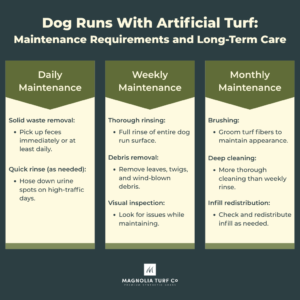
Daily Maintenance
Solid waste removal: Pick up feces immediately or at least daily.
This prevents odor buildup, keeps the surface clean, reduces fly attraction, and takes two to three minutes daily.
Use standard waste bags. Dispose in regular trash or a dedicated pet waste system.
Quick rinse (as needed): Hose down urine spots on high-traffic days.
This is particularly important in hot weather, helps maintain freshness, takes two to three minutes, and only requires a regular garden hose.
This isn’t always necessary, but it is recommended during heat waves or after heavy use.
Weekly Maintenance
Thorough rinsing: Full rinse of entire dog run surface.
Use a garden hose with a spray nozzle. Focus on high-traffic and potty areas. This removes dust and pollen and dilutes urine residue. Takes 10–15 minutes.
Best done in the morning or evening to avoid water waste from immediate evaporation.
Debris removal: Remove leaves, twigs, and wind-blown debris.
Use a leaf blower or rake. This prevents organic matter breakdown on turf. Takes 5–10 minutes. More frequent in fall or near trees.
Visual inspection: Look for issues while maintaining.
Check for lifted edges or seams. Note any drainage problems. Identify areas needing extra attention. Takes two to three minutes while rinsing.
Monthly Maintenance
Brushing: Groom turf fibers to maintain appearance.
Use a stiff-bristle push broom or power broom. Brush against the grain to lift matted fibers. Pay attention to high-traffic areas. Takes 15–20 minutes for the average dog run.
Brushing prevents permanent matting and keeps turf looking newer longer.
Deep cleaning: More thorough cleaning than a weekly rinse.
Use PE-51 enzyme cleaner or a similar product. Spray on surface, let sit 10–15 minutes, and rinse thoroughly. This breaks down organic matter and neutralizes odors. Takes 30–40 minutes, including wait time.
Infill redistribution: Check and redistribute infill as needed.
High-traffic areas lose infill over time. Add infill to thin spots. Brush in thoroughly. Takes 15–20 minutes when needed.
Seasonal Maintenance
Spring:
- Deep clean entire surface after winter
- Check drainage performance during spring rains
- Inspect seams and edges for winter damage
- Add infill if needed after winter settling
Summer:
- Increase rinsing frequency due to heat
- Monitor for heat-related turf expansion
- Ensure adequate drainage during storm season
- Check shade structure integrity
Fall:
- More frequent debris removal (leaves)
- Deep clean before winter
- Inspect and repair any damage before cold weather
- Verify drainage before winter rains
Winter:
- Less intensive maintenance needed (in most Texas/Florida climates)
- Continue regular waste removal
- Rinse less frequently unless needed
- Monitor for unusual weather impacts
Products and Tools
Essential cleaning products:
- Enzyme-based pet odor eliminator: $15–30 per gallon
- Garden hose with adjustable nozzle: $20–40
- Basic spray nozzle works fine, no special equipment needed
Useful tools:
- Stiff push broom: $25–40
- Leaf blower: $50–200 (if not already owned)
- Power broom (optional for large areas): $100–300
- Rake for debris: $15–30
Infill supplies:
- Replacement zeolite infill: $30–50 per 50-lb bag
- One bag covers approximately 100–150 sq ft at 1-inch depth
- Purchase as needed when redistribution isn’t sufficient
Common Maintenance Mistakes
Skipping regular waste removal creates odor problems that require intensive cleaning.
Daily removal is easier than weekly deep cleaning. This prevents organic matter from breaking down in turf. Takes minimal time but prevents major issues.
Over-cleaning with the wrong products can damage turf.
Avoid bleach or harsh chemicals. Don’t use high-pressure washers (damages backing). Stick to pet-safe, turf-safe enzyme cleaners.
Ignoring infill maintenance causes problems.
Turf mats down permanently without adequate infill. Drainage slows when infill is depleted. Add infill when depth drops below one inch.
Neglecting drainage compounds small problems.
Standing water indicates problems that need immediate attention. Don’t assume they’ll resolve naturally. Small drainage problems become big ones if ignored.
Odor Control
Odor develops when organic matter (urine, feces residue) breaks down in turf and base.
Prevention:
- Daily waste removal
- Weekly rinsing
- Monthly enzyme treatment
- Adequate infill with antimicrobial properties
Treatment when odor occurs:
- Deep clean with enzyme product
- Extra rinse of problem areas
- Add fresh zeolite infill to absorb odors
- For persistent odor: professional deep cleaning (rare)
Quality turf with proper drainage and regular maintenance shouldn’t develop persistent odor. If it does, drainage is likely inadequate.
Long-Term Care
5-year maintenance: Surface cleaning and assessment.
- Professional deep clean if desired: $200–400
- Inspect for wear patterns
- Add infill to entire surface if needed
- Check seams and edges
10-year maintenance: Mid-life refresh.
- Professional grooming service: $300–600
- Replace depleted infill entirely
- Repair any damage to turf
- Verify drainage still functioning properly
15-year performance: With proper care, high-quality turf lasts 15–20 years.
- Expect some fading (normal UV exposure)
- Possible fiber wear in highest-traffic areas
- Base should still be solid if installed correctly
- Warranty typically covers manufacturing defects
Maintenance Time Investment
Average time per week: 30–40 minutes total
- Daily waste removal: 14–21 minutes (7 × 2–3 minutes)
- Weekly rinse and debris removal: 15–20 minutes
Average time per month: 2.5–3.5 hours total
- Weekly tasks: 2–2.5 hours
- Monthly deep clean and brushing: 30–60 minutes
Comparison to natural grass (dog run area):
- Weekly mowing: 20–30 minutes
- Weekly watering management: 15–30 minutes
- Biweekly fertilizing/treating: 20–30 minutes
- Monthly reseeding bare patches: 30–60 minutes
- Total per month: 6–10 hours
Artificial turf reduces maintenance time by 60–70% compared to natural grass in dog run applications.
When to Call Professionals
Routine maintenance is DIY and straightforward.
Call professionals for:
- Persistent odor that doesn’t respond to enzyme treatment
- Drainage problems developing after installation
- Seam separation or significant edge lifting
- Major damage from digging or tearing
- Comprehensive refresh at 10+ year mark
We provide post-installation support for all our installations, including maintenance guidance and service if issues arise. That 15-year warranty covers manufacturing defects and installation problems, giving you peace of mind through the turf’s lifespan.
Common Pitfalls and Expert Tips
We’ve installed hundreds of dog runs. We’ve also repaired hundreds of failing installations. What follows is what goes wrong and how to avoid it.
Installation Pitfalls
Skipping or skimping on base preparation
This is the number one reason dog runs fail. Companies skip proper base work to save money and underbid competitors. It catches up within one to three years.
What happens:
- Turf settles unevenly, creating low spots
- Water pools because drainage was inadequate
- Turf edges lift due to insufficient foundation
- Surface becomes uncomfortable and unusable
How to avoid:
- Don’t skip the three- to four-inch base layer
- Use crushed granite or decomposed limestone, not sand or dirt
- Compact thoroughly with proper equipment
- Grade for drainage before installing turf
The base work isn’t visible once turf is installed. That’s why it gets skipped. It’s also why it matters.
Choosing turf based on price alone
Budget turf costs less for a reason. It performs differently.
What happens:
- Perforated backing clogs within months
- Cheap backing deteriorates in sun
- Fibers mat down permanently under traffic
- Odor develops despite cleaning efforts
How to avoid:
- Prioritize drainage rate (900+ inches/hour)
- Verify flow-through backing, not perforated
- Confirm antimicrobial treatment
- Ensure PFAS-free materials
Inadequate drainage planning
Even high-drainage turf pools water if the base isn’t graded properly.
What happens:
- Standing water after rain
- Urine doesn’t drain even with proper turf
- Odor develops in low spots
- Turf base deteriorates from constant moisture
How to avoid:
- Create positive slope (minimum 1% grade)
- Install French drains on problem sites
- Address existing drainage issues before installation
- Don’t assume turf alone solves drainage
Poor seaming technique
Seams show when done incorrectly. Worse, they separate over time.
What happens:
- Visible lines across turf surface
- Separation creates trip hazard
- Gaps collect debris and waste
- Professional repair costs $300–600
How to avoid:
- Use proper seaming tape and adhesive
- Ensure blade direction matches on both pieces
- Let adhesive cure fully before use
- Consider professional installation for projects requiring seams
Design Pitfalls
Undersizing the dog run
Small spaces don’t give dogs room to move.
What happens:
- Dog still uses rest of yard
- Investment doesn’t solve the problem
- Dog run becomes just a potty area
- Wasted money on underutilized space
How to avoid:
- Size for your dog’s adult weight, not current puppy weight
- Allow room for play behavior, not just standing
- Better to go 200 sq ft larger than too small
No shade planning
Unshaded turf in Texas and Florida summer sun reaches 120–150°F.
What happens:
- Dog won’t use the run during peak heat hours
- Turf becomes uncomfortable even morning and evening
- Space sits unused during summer
- Additional cost to add shade later
How to avoid:
- Plan shade coverage for 30–50% of area
- Install shade structure before or during turf installation
- Use natural tree shade where available
- Don’t cheap out on this because it determines usability
Ignoring access and traffic patterns
Poorly placed gates create inconvenience.
What happens:
- You avoid using the dog run because it’s inconvenient
- Dog doesn’t get exercised in space regularly
- Maintenance gets skipped due to poor access
- Defeats purpose of having dedicated space
How to avoid:
- Place the gate where you naturally exit the house
- Ensure gate width accommodates your movement
- Consider yard layout when determining placement
- Plan for how you’ll access for maintenance
Maintenance Pitfalls
Inconsistent waste removal
Skipping daily cleanup creates compounding problems.
What happens:
- Organic matter builds up in turf fibers
- Odor develops and becomes difficult to eliminate
- Deep cleaning required instead of simple maintenance
- Turf lifespan reduced
How to avoid:
- Remove solid waste daily (takes two to three minutes)
- Make it part of a regular routine
- Keep waste bags readily available
- Don’t let it slide even when busy
Using the wrong cleaning products
Not all cleaners are turf-safe or effective.
What happens:
- Harsh chemicals damage turf backing
- Wrong products don’t eliminate pet odors
- Turf discoloration or deterioration
- Expensive turf replacement needed
How to avoid:
- Use enzyme-based cleaners designed for pet turf
- Avoid bleach, ammonia, harsh chemicals
- Don’t use pressure washers (damages backing)
- Follow manufacturer’s recommendations
Letting infill deplete
High-traffic areas lose infill over time.
What happens:
- Turf mats down in worn areas
- Drainage slows without adequate infill
- Appearance deteriorates
- Permanent damage to turf backing
How to avoid:
- Check infill depth monthly
- Add infill to thin spots before damage occurs
- Brush infill into fibers after adding
- Budget $50–100 annually for replacement infill
Expert Tips From 10,000+ Installations
Tip 1: Oversize rather than undersize
An extra 100–200 square feet costs $1,300–2,200 more but makes a significant difference in function. Dogs use space when they have room to move. Cramped spaces become potty areas only.
Tip 2: Invest in proper base work
This is not the place to save money. The $1,200–1,600 difference between proper base and minimal base determines whether your turf lasts 15 years or needs replacing in seven.
Tip 3: Plan drainage for worst-case scenario
Design for heavy rain, not average conditions. Drainage that handles the worst storm handles everything else easily. Inadequate drainage shows up immediately in Texas thunderstorms or Florida rainy season.
Tip 4: Shade isn’t optional in our markets
Texas and Florida summers make unshaded turf unusable four to five hours daily. Plan shade from the start. Adding it later costs more and leaves you with an unusable dog run for at least one summer.
Tip 5: Choose materials based on performance, not price
The $3–4 per square foot difference between budget and premium pet turf shows up every day for 15 years. Performance differences are real and significant.
Tip 6: Create a maintenance routine
Consistency matters more than intensity. Daily three-minute waste removal prevents problems that require an hour-long deep cleaning later.
Tip 7: Address problems immediately
Small drainage issues become big ones. Edge lifting that’s minor now becomes major repair later. Fix problems when they’re small and cheap.
Tip 8: Don’t DIY unless you’re confident
Base preparation requires specific knowledge and proper equipment. Mistakes create problems that aren’t easily fixed. Professional installation costs more upfront but prevents costly failures.
Tip 9: Verify flow-through backing
Many companies claim “excellent drainage” but use perforated backing. Get specifications in writing. Flow-through backing at 900+ inches per hour is the only acceptable option for pet applications.
Tip 10: Long-term thinking saves money
Quality costs more initially. Shortcuts cost more eventually. We’ve replaced enough budget installations to know which approach actually saves money over 10–15 years.
Red Flags When Hiring Contractors
Watch for:
- Vague answers about drainage rates and backing type
- Reluctance to provide detailed material specifications
- Significantly lower bid than competitors (usually means shortcuts)
- No warranty or very limited warranty
- No references from pet turf installations
- Pressure to decide immediately
- Generic “artificial turf” without specifics
Green flags:
- Specific product specifications in writing
- Detailed explanation of base preparation process
- References from dog owners with installations 5+ years old
- Comprehensive warranty (10+ years)
- Free consultation with site assessment
- Transparent pricing breakdown
Final Expert Advice
Dog runs with artificial turf work when done right. They fail when corners get cut.
The pattern we’ve seen repeatedly: Homeowners choose cheap installation, have problems within two to three years, then pay for complete replacement with proper installation. Total cost exceeds doing it right initially.
Alternatively: proper installation, minimal maintenance, satisfied dogs, clean yards, and no problems for 15 years.
The difference isn’t luck. It’s base preparation, material selection, and installation quality.
If you’re going to invest in a dog run, invest enough to do it right. The cost difference between adequate and excellent is 20–30%. The performance difference is significant.
Frequently Asked Questions
Is artificial turf safe for dogs?
Yes, when you choose the right product. Quality pet turf is non-toxic, PFAS-free, and specifically designed for pet use.
Look for:
- PFAS-free certification
- Lead-free materials
- Antimicrobial coating (Microban or similar)
- UV-stabilized fibers that don’t break down into particles
We’ve installed artificial turf for hundreds of dog owners over 10 years. Dogs of all sizes, breeds, and ages use it daily without health issues.
The key is choosing premium pet-specific turf, not general landscape turf or budget products with unknown material composition.
How do you prevent artificial turf from smelling?
Proper drainage and regular maintenance prevent odor.
Drainage matters most: Flow-through backing at 900+ inches per hour means urine passes through immediately with no pooling and no accumulation. Combined with antimicrobial infill (zeolite) below the surface, odor-causing bacteria don’t develop.
Maintenance requirements:
- Remove solid waste daily
- Rinse weekly with hose
- Monthly treatment with enzyme cleaner
- Annual deep cleaning for heavily used areas
Quality turf with proper drainage and basic maintenance doesn’t develop persistent odor. If odor occurs, it usually indicates inadequate drainage or neglected maintenance, not a turf problem.
How long does artificial turf last in a dog run?
Quality pet turf lasts 15–20 years with proper installation and maintenance.
Factors affecting lifespan:
- Base preparation quality (major factor)
- Turf specifications (flow-through backing, reinforced construction)
- Number and size of dogs using the space
- Maintenance consistency
- UV exposure (important in Texas and Florida)
Budget installations with perforated backing and minimal base work often fail within five to seven years. Proper installation with premium materials lasts 15–20 years.
Our 15-year warranty reflects confidence in our materials and installation process.
Can dogs dig through artificial turf?
Quality pet turf resists digging, but determined dogs can sometimes penetrate edges.
Prevention:
- Secure edges properly with 6-inch nails every 6–8 inches
- Use perimeter boards for extra security
- Extend turf 6–12 inches beyond visible area and bury edges
- Add extra infill weight (2+ inches) for diggers
For dogs with strong digging instincts:
- Install dig-resistant barrier beneath turf
- Create designated digging pit (sand area separate from turf)
- Address behavioral cause of digging (boredom, hunting behavior)
Most dogs don’t attempt digging on properly installed turf with adequate infill. The secure surface doesn’t trigger digging behavior the way loose soil does.
Does artificial turf get hot for dogs’ paws?
Yes, in direct summer sun during peak heat hours (12–4 pm), turf can reach 120–150°F when ambient temperature is 100°F.
Solutions:
- Provide shade coverage for 30–50% of dog run
- Rinse turf with hose before use (cools surface immediately)
- Schedule outdoor time for morning (before 10 am) and evening (after 6 pm)
- Choose lighter-colored turf (reflects more heat than darker green)
Heat is manageable with planning. Unshaded concrete or asphalt gets even hotter. The advantage of turf: A hose rinse cools it instantly. Can’t do that with concrete.
All our Texas and Florida installations include shade recommendations because we know heat management is critical for year-round usability.
How much maintenance does artificial turf require for dogs?
Minimal compared to natural grass, but not zero.
- Daily: Solid waste removal (2–3 minutes)
- Weekly: Rinse with hose, remove debris (15–20 minutes)
- Monthly: Deep clean with enzyme treatment, brush fibers (45–60 minutes)
- Total time: 30–40 minutes per week on average
Compare to natural grass maintenance:
- Mowing: 20–30 minutes weekly
- Watering: 15–30 minutes weekly
- Fertilizing: 20–30 minutes biweekly
- Reseeding bare patches: 30–60 minutes monthly
- Total: 6–10 hours per month
Artificial turf reduces maintenance time by 60–70% while providing better performance and appearance.
Can you install artificial turf over existing grass?
No, for proper installation you must remove existing grass and topsoil.
Why removal is necessary:
- Organic matter beneath turf decomposes and creates settling
- Grass roots continue growing and can penetrate backing
- Proper drainage requires a three- to four-inch base layer
- Inadequate foundation causes premature failure
Proper installation process:
- Remove existing grass and three to four inches of topsoil
- Install crushed granite or limestone base
- Grade for drainage
- Compact thoroughly
- Install turf over prepared base
Installing over existing grass saves money initially but creates problems within one to two years. Do it right from the start.
What’s the best artificial turf for dogs?
Pet-specific turf with these specifications:
Drainage: Flow-through backing rated at 900+ inches per hour. This is the most critical specification.
Backing construction: Polyurethane coating with drainage layer. Not simple perforated backing.
Antimicrobial properties: Microban or similar treatment. Controls odor-causing bacteria.
Pile height: 1.5–2 inches. Shorter drains better and cleans easier.
Blade design: W-, S-, or C-shaped reinforced blades that bounce back under compression.
Safety: PFAS-free, lead-free materials.
UV protection: Critical for Texas and Florida to prevent degradation.
Our pet turf meets all these specifications. We’ve tested cheaper alternatives. They don’t perform the same over time.
How do you clean artificial turf with dogs?
Regular maintenance keeps turf fresh and odor-free.
Daily:
- Remove solid waste with bags or pooper scooper
- Quick rinse of heavy-use areas if needed
Weekly:
- Hose down entire surface with spray nozzle
- Remove leaves and debris with blower or rake
- Focus extra rinsing on designated potty areas
Monthly:
- Apply enzyme-based pet odor eliminator
- Let sit 10–15 minutes
- Rinse thoroughly
- Brush fibers with stiff broom to lift matted areas
- Check and add infill where depleted
Annually:
- Deep clean entire surface
- Replace or supplement infill
- Inspect for any damage or wear
Products we recommend:
- PE-51 enzyme cleaner or equivalent
- Standard garden hose with spray nozzle
- Stiff push broom for brushing
Avoid harsh chemicals, bleach, or pressure washers. They damage turf backing and aren’t necessary for cleanliness.
Does artificial turf drain well for dogs?
Yes, when installed properly with the right product.
What “drains well” means:
- Urine passes through immediately with no pooling
- Rain clears quickly even during heavy downpours
- No standing water after storms
- Odors don’t develop from trapped moisture
Requirements for proper drainage:
- Flow-through backing: 900+ inches per hour capacity
- Proper base: Three to four inches crushed granite, graded for slope
- Adequate slope: Minimum 1% grade (one inch drop per eight feet)
- Infill selection: Zeolite antimicrobial infill
Perforated backing (common in budget installations) clogs within months. Water and urine pool. Odors develop. That’s not a “pet turf” problem; it’s a “wrong product” problem.
We’ve installed dog runs in clay soil, sandy soil, and everything between. Proper installation with high-quality materials handles all conditions.
What do you put under artificial turf for dogs?
Proper base preparation prevents 90% of installation problems.
Standard installation layers (bottom to top):
- Compacted native soil: Graded for drainage
- Crushed granite or decomposed limestone: Three to four inches, compacted
- Optional weed barrier: Landscape fabric (not plastic)
- Artificial turf: With flow-through backing
- Infill: Zeolite antimicrobial infill, one- to two-inch depth
For sites with poor drainage:
- Drainage pipe beneath base layer
- French drain along downhill edge
- Extended base depth (six inches instead of four)
The base layer is critical. It provides:
- Solid foundation that prevents settling
- Drainage path for water and urine
- Stable surface for turf installation
Don’t skip or skimp on base preparation. It’s the difference between an installation that lasts 15 years versus one that fails in five.
Is artificial grass good for a dog potty area?
Yes, artificial turf works exceptionally well for dog potty areas when properly installed.
Advantages over natural grass:
- Drains faster (no pooling or muddy spots)
- Doesn’t develop bare patches from urine
- No grass staining on fur
- Cleaner surface (less dirt tracked inside)
- No lawn chemicals or fertilizers
Advantages over other surfaces:
- More comfortable than concrete or gravel
- Better odor control than wood chips
- Lower maintenance than natural grass
- Professional appearance year-round
Requirements for success:
- Flow-through backing for immediate urine drainage
- Antimicrobial infill (zeolite) for odor control
- Proper base preparation with drainage slope
- Regular maintenance (daily waste removal, weekly rinse)
Thousands of dog owners use artificial turf for potty areas specifically. It’s become the preferred solution because it works better than alternatives with less ongoing maintenance.
How often should you replace artificial turf with dogs?
Quality pet turf lasts 15–20 years with proper installation and maintenance. Replacement isn’t typically necessary within the warranty period.
Signs that replacement is needed:
- Significant fiber wear (matting that doesn’t brush back)
- Backing deterioration (visible damage or brittleness)
- Seam separation that can’t be repaired
- Persistent odor despite deep cleaning
- Drainage failure due to backing degradation
Most common cause of premature replacement: inadequate installation, not product failure.
Budget installations with perforated backing and minimal base work often need replacement within 7–10 years. Proper installation with premium materials typically lasts 15–20 years.
Extending turf lifespan:
- Consistent maintenance prevents premature wear
- Address problems early (repair, don’t ignore)
- Add infill when depleted
- Protect high-traffic areas with mats if needed
Our 15-year warranty covers manufacturing defects and installation issues. That’s confidence based on a decade of successful installations that are still performing well.
Get Started With Your Dog Run Project
A properly installed dog run with high-quality artificial turf solves real problems. Your dog gets dedicated space. Your yard stays intact. You stop tracking mud through the house.
The decision comes down to doing it right. Proper base preparation, flow-through backing that actually drains, antimicrobial infill that controls odors, and installation techniques that prevent problems are essential. We don’t cut corners.
We’ve installed dog runs for hundreds of pet owners across Dallas, Houston, Austin, San Antonio, Tampa, and Sarasota. We know what works in Texas heat and Florida humidity. We know which turf specifications matter and which ones don’t. We know how to prep sites with poor drainage and how to handle challenging terrain.
Our process:
- Free on-site consultation to assess your space and discuss your dog’s needs
- Detailed proposal covering materials, installation process, timeline, and costs
- Professional installation with proper base preparation and premium materials
- Post-installation walkthrough to ensure you understand maintenance requirements
- 15-year warranty backing all installations
What proper installation includes:
- Three- to four-inch base layer of crushed granite or decomposed limestone
- Precise grading for drainage (minimum 1% slope)
- Professional compaction with proper equipment
- Premium pet turf with 900 inches/hour flow-through backing
- Microban antimicrobial coating for odor control
- PFAS-free materials safe for your dog
- Zeolite infill with antimicrobial properties
- Professional seaming and edge securing
- Final grooming and inspection
Getting started is straightforward:
- Schedule a free consultation to discuss your project
- We’ll assess your site, measure the space, and discuss your specific requirements
- You’ll receive a detailed proposal with transparent pricing
- Once approved, installation typically completes within 2–4 days
- You’ll have a functional, durable dog run that lasts 10–20 years
Whether you’re in Dallas dealing with clay soil, Houston managing high humidity, or Tampa fighting sandy conditions, we’ve solved these challenges before. We know the difference between adequate and excellent because we’ve repaired enough failing installations to understand what actually matters.
Common installation failures we see:
- Skipped base preparation (turf settles and fails within 3–5 years)
- Wrong product selection (perforated backing that clogs)
- Poor drainage planning (standing water and odors)
- Inadequate edge securing (turf lifts and separates)
We don’t cut these corners ever. Our installations last because we do the work others skip.
Call us to schedule your consultation. We’ll walk your property, discuss options, answer questions, and provide a clear path forward. We’ll give you straight talk about what will work for your situation, with no pressure.
Your dog deserves a proper outdoor space. Your yard deserves to survive. Let’s make both happen.
About Magnolia Turf:
- Serving Dallas, Houston, Austin, San Antonio, Tampa, and Sarasota
- Free consultation and site assessment
- Transparent pricing and detailed proposals
- 15-year warranty on all installations
- 10,000+ successful projects backing our expertise