Most homeowners searching for ways to save money on artificial turf hope to find a shortcut on materials, labor, or the base layer. Those shortcuts don’t lower the real cost of your project. They just kick those costs down the line.
At Magnolia Turf, we install over two million square feet of artificial turf every year across Texas and Florida. That volume means we’ve worked in every soil type, drainage condition, and climate scenario this region throws at a turf installer.
We’ve been called in more times than we can count to fix installations that looked fine on day one and failed within the first year, and that pattern has a consistent cause: someone tried to lower the upfront price the wrong way.
Here’s what we know about where the money actually goes, where you can legitimately save, and where cutting costs creates a much more expensive problem.
Cheapest Way to Lay Artificial Grass: Quick Answer
The cheapest way to lay artificial grass is to reduce your square footage and choose a lower-grade product. Cutting 200–300 sq ft saves $1,600–$2,800; stepping down one product tier saves roughly $1 per square foot. Cutting corners on the sub-base, face weight, or drainage features costs far more in repairs and reinstallation than the upfront savings.
Why the “Cheapest” Way to Lay Artificial Grass Often Costs More
The most common cost-saving move we see is hiring the lowest bidder. A homeowner gets three quotes: $7 per square foot, $8, and $9. Going with $7 saves around $2,000 on a typical project, and on paper that makes sense.
Here’s what happens next: within the first rainstorm, the sub-base erodes and the turf becomes uneven. Seams become visible, wrinkles appear, and dogs find the loose edge and start pulling it up. The homeowner calls us, and we have to tear out what was installed and start over.
That $2,000 in savings is gone, plus they’re now paying for a second installation. No one wins on that deal except the installer who moved on to the next quick job.
Where You Can Cut Artificial Grass Costs Without Cutting Corners
Two levers actually lower your project cost without affecting long-term performance.
Reduce Your Square Footage
Every installation is priced per square foot. At $8.30 to $9.50 per square foot for a standard residential project in Texas or Florida, cutting 200 to 300 square feet off your planned area saves $1,600 to $2,800. That’s a real, meaningful reduction.
Rethink your layout. You may not need turf all the way to the fence line, and not every side yard has to be covered. Often the savings add up fast.
Choose a Less Expensive Product
From our lowest-priced product to our highest, the difference is about $1 per square foot. On a 1,500-square-foot project, that’s $1,500 in savings. The lower-end products still drain well and hold up under normal use, with a lower face weight that’s a reasonable tradeoff for yards without heavy foot traffic.
Past those two levers, projects go wrong.
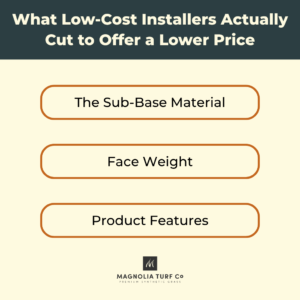
What Low-Cost Installers Actually Cut to Offer a Lower Price
When a competitor quotes $6 or $7 per square foot vs. $8 to $9, the savings come from somewhere. Here’s where they usually come from.
The Sub-Base Material
The sub-base is the layer of crushed stone beneath the turf. Magnolia uses decomposed granite or crushed limestone, installed four inches deep. Some installers substitute crushed concrete instead, which costs about a quarter of the price.
Crushed concrete compacts well, which is why it looks fine at first, but it becomes solid concrete beneath your turf and water doesn’t move through it. If you have dogs, urine sits on top and odor builds; when it rains, water pools on the surface. Decomposed granite and limestone drain like gravel: water moves through fast, into the soil, and it’s gone.
Face Weight
Turf thickness is measured in face weight: our products run around 80 ounces, while low-cost products often come in at 50. At 80 ounces, blades spring back after foot traffic, hold their shape in extreme heat, and look natural five or 10 years in; at 50 ounces, you’ll see matting and thinning within the first few summers. That difference works out to about 50 to 60 cents per square foot, and budget installers frequently don’t disclose the spec, so ask any installer what face weight they’re using.
Product Features
Flow-through backing, Microban antimicrobial coating, UV inhibitors, and shaped blades each add a small amount per square foot but make a real difference over 15 years. Microban inhibits bacterial growth on the turf surface, so pet urine odors and organic residue don’t build up between rinses, keeping your yard fresher with less effort. UV inhibitors keep the color from breaking down under Texas sun, so your turf looks the same in year 12 as it did in year one.
Without flow-through backing, drainage is limited to holes punched every few inches, and that can’t keep up with a Texas downpour or Florida’s rainy season.
Why Texas and Florida Make Cheap Installations Fail Faster
Most guides about finding the cheapest way to lay artificial grass were written for moderate climates. Texas and Florida are different, and that difference matters.
Texas Heat
Inferior turf products don’t have the structural blades to withstand extreme heat combined with foot traffic. Flat, thin blades bend under the sun and stay matted. If you’ve seen turf that looks like flattened confetti after a Texas summer, you’ve seen what underfunded face weight looks like at 100 degrees.
The W-, S-, and C-shaped blades we use have a structural spine that lets them stand back up after use. Without a well-compacted base, the ground itself can buckle under heat-related expansion. And if an installer used crumb rubber infill to save money, it absorbs heat and makes the surface much hotter underfoot.
Florida Rain
Florida gets rainfall that can overwhelm a poorly drained installation in a single afternoon. Flow-through backing drains at 900 inches per hour, 2,900% faster than standard hole-punched backing. Florida’s climate demands that spec.
An inadequate sub-base in Florida traps moisture beneath the turf surface, which breeds mold and mildew. Poor drainage compounds the problem. Fixing that kind of installation means a full tear-out, treating the base, and starting over at a cost far higher than a proper installation would have been.
What a Professional Artificial Grass Installation Actually Costs
For context, here’s how the numbers compare on a 1,000-square-foot backyard.
A basic DIY installation runs $2 to $8 per square foot in materials alone, so 1,000 square feet runs $2,000 to $8,000 before tool rental, haul-off, or repairs. DIY can work for small, flat, simple spaces under about 200 square feet. For anything larger or more complex, the margin for error grows fast, and common mistakes, including skipping proper compaction, improper grading, and poorly executed seams, often require professional help to fix.
A professional artificial grass installation from Magnolia runs $8.30 to $9.50 per square foot for most residential products, depending on project size and turf selection. A 1,000-square-foot backyard typically runs $8,500 to $9,500 all-in.
That price includes tear-out and haul-off, four inches of decomposed granite sub-base, premium turf with flow-through backing and Microban coating, installation by crews who have completed thousands of projects across Dallas, Houston, Austin, San Antonio, Tampa, and Sarasota, and a 15-year warranty: if anything goes wrong with materials or workmanship over that period, we fix it, no negotiation.
An installation that fails in three to five years costs more per year than one that lasts 15 or more. The math doesn’t favor the shortcut.
Frequently Asked Questions About Artificial Grass Installation Costs
What’s the most effective way to lower the cost of an artificial grass installation?
Reduce your square footage. Every installation is priced per square foot, and trimming even 200 to 300 square feet from your plan saves thousands without affecting quality. The choice of turf product is the next lever, but the difference between the lowest and highest-end products is only about $1 per square foot.
What do low-cost installers typically skip to offer a lower price?
The sub-base material is the most common shortcut. Crushed concrete costs about a quarter of what decomposed granite costs, so lower-priced installers often use it instead. The result is an installation that looks fine at first but doesn’t drain properly. Thinner turf products and missing features like flow-through backing and UV inhibitors are the other common cuts.
How much does professional artificial grass installation cost in Texas or Florida?
For most residential projects in Texas and Florida, professional installation runs $8.30 to $9.50 per square foot, depending on project size and turf selection. A 1,000-square-foot backyard typically runs $8,500 to $9,500 all-in, including tear-out, sub-base, turf, infill, and installation. Larger projects typically see lower per-square-foot pricing.
Does a cheap installation really end up costing more long-term?
In most cases, yes. Installations that fail in three to five years require complete tear-out and reinstallation. A professional installation that lasts 15 to 20 years costs less per year, even with a higher upfront price. We’ve replaced dozens of failed installations, and nearly every homeowner said they wished they’d done it right the first time.
Can homeowners do their own prep work to save money?
Ask your installer. Some homeowners clear old vegetation and debris before the crew arrives, which can simplify the job. Magnolia’s team handles full site preparation as part of our installation process, but bring it up during your estimate conversation if you want to handle some of that work yourself.
The Smart Way to Get the Best Value on Artificial Grass
The cheapest way to lay artificial grass isn’t about finding a low-cost installer or the thinnest product on the market. It’s about being smart with square footage and honest about where quality actually matters.
We’ve completed over 10,000 installations across Dallas, Houston, Austin, San Antonio, Tampa, and Sarasota. David Turner has been on the job through every one of those markets, which means the person giving you an estimate has personally seen what fails in Florida clay, what holds up in Texas heat, and what every corner-cutting shortcut eventually costs a homeowner. We’ve fixed the ones that looked good on day one and failed by year two, and that pattern is predictable and avoidable.
Contact Magnolia Turf for a free estimate and an honest assessment of what your project needs. No pressure. Just straight answers from people who’ve seen every shortcut in the book.
Related Reading: Artificial Turf Maintenance: Complete Care Guide | Artificial Grass Installation Process | Artificial Grass for Pets