Table of Contents
- What Is Synthetic Grass?
- Who Benefits From Synthetic Grass?
- Synthetic Grass Materials and Construction
- Complete Guide to Synthetic Grass Types by Application
- How to Choose the Right Synthetic Grass for Your Project
- Cost Comparison by Synthetic Grass Type
- Synthetic Grass Design Ideas and Inspiration
- Frequently Asked Questions About Synthetic Grass
- Common Synthetic Grass Mistakes to Avoid
- Get Started With Your Synthetic Grass Project
- Related Resources
- References and Standards
Introduction
Not all synthetic grass is created equal. The turf that works beautifully for a backyard lawn will fail miserably on a putting green. The product that handles dog waste like a champ might be wrong for a playground.
We’ve installed over 10,000 artificial turf projects across Texas and Florida. We’ve repaired hundreds of failing installations where homeowners chose the wrong turf type for their application or went with an installer who cut corners on base work.
The pattern is always the same: wrong product, wrong installation, problems within two to five years.
This guide breaks down everything you need to know about synthetic grass types: the materials, specifications, and applications that matter. You’ll learn exactly what to look for, what to avoid, and how to match the right product to your specific project.
Whether you’re researching for a backyard transformation, a pet area, or a commercial installation, you’ll walk away knowing more about synthetic grass than most installers. We’re just providing the facts and reasoning, based on a decade of doing this work the right way.
What Is Synthetic Grass?
Modern synthetic grass has come a long way from the crunchy, carpet-like AstroTurf of the 1960s. Today’s artificial turf looks and feels remarkably like natural grass when you choose the right product and install it correctly.
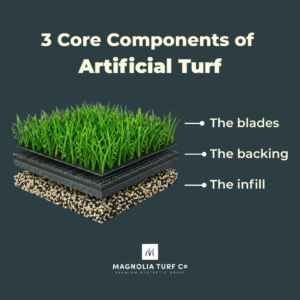
Every artificial turf system has three core components:
The blades are what you see and walk on. They’re made from synthetic polymers (typically polyethylene, nylon, or polypropylene) engineered into specific shapes and heights depending on the application. Quality products use multi-colored blades with built-in thatch layers to replicate natural grass’s variation.
The backing holds everything together and handles drainage. Flow-through backing drains 900 inches of liquid per hour, which is 2,900% faster than standard hole-punched backing. The difference becomes obvious the first time it rains or your dog uses the lawn.
Learn about our products’ drainage capabilities.
The infill sits between the blades, providing weight, support, and stability. Options include silica sand, antimicrobial infills like Envirofill with Microban, and specialty products like OptiFILL+ for odor control. The right infill depends on how you’ll use the space.
Learn about our infill options.
Why application matters: A putting green needs short, dense nylon fibers for ball roll. A pet area needs antimicrobial backing with superior drainage. A playground requires specific shock absorption ratings for safety certification. Using the wrong product in any of these situations creates problems you can’t fix without starting over.
Who Benefits From Synthetic Grass?
Synthetic turf makes sense for a lot of people, but not everyone. Here’s who sees the biggest return on their investment:
Homeowners tired of lawn maintenance. No more mowing, fertilizing, watering, or fighting with weeds. In Texas, that means no more summer weekends spent battling the heat to keep grass alive. Your water bill drops, your weekends open up, and your yard looks good year-round.
Pet owners dealing with the mud-and-odor cycle. Natural grass and dogs don’t mix well. You end up with brown spots, muddy paws, and persistent odors. Properly installed pet turf with flow-through drainage and antimicrobial treatment eliminates these problems. We’ve installed pet turf for hundreds of dog owners, and the ones who invested in proper systems from the start are glad they did.
Families with kids who want safe, usable outdoor spaces. Quality turf provides a consistent, cushioned surface that handles heavy use without developing bare spots or turning to mud. For dedicated play areas, IPEMA-certified playground turf meets national safety standards for falls from playground equipment.
Golf enthusiasts who want home practice facilities. A properly built putting green lets you practice year-round without driving to the course. The difference between a good putting surface and a bad one comes down to material selection and installation precision. Learn about our putting green installations.
Commercial property managers seeking long-term solutions. Multi-family properties, office complexes, and public spaces benefit from turf’s durability and reduced maintenance costs. The higher upfront investment pays off through lower water bills and zero landscaping labor over 15+ years.
Synthetic Grass Materials and Construction
The technical specifications of artificial turf determine how it looks, feels, and performs. Here’s what matters:
Fiber Materials
Polyethylene (PE) is the standard choice for residential and pet turf. It’s soft, realistic-looking, and holds up well under normal family use. It’s the sweet spot for balancing quality and cost.
- Material cost: $1.40–$3.50 per square foot
- Lifespan: 12–16 years with proper installation
- Best for: Residential lawns, general landscaping
Nylon is the most durable fiber. It resists heat better, bounces back from heavy use, and maintains its appearance longer. If you have dogs or kids who spend hours outside daily, nylon pays for itself through longevity.
- Material cost: $2.20–$5 per square foot
- Lifespan: 15–20 years
- Best for: High-traffic areas, putting greens, extreme climates
Polypropylene (PP) is the budget option. It works for accent areas or spaces that don’t see heavy use. In Texas heat, it can fade faster and feel hotter underfoot than other options.
- Material cost: $0.90–$3 per square foot
- Lifespan: 8–12 years
- Best for: Low-traffic decorative areas
Blade Technology
Blade shape affects durability, appearance, and heat retention. Quality turf uses W-, S-, and C-shaped blades instead of flat blades. Shaped blades stand upright better and create a more natural appearance. They resist matting under heavy use, too.

Flat blades are the ones to avoid. They lack structural support, mat down quickly, and look like “confetti” within a few years. Any quality manufacturer will use engineered blade shapes.
Backing Systems
Flow-through backing is the gold standard. Our products drain at 900 inches per hour, which is 2,900% faster than standard hole-punched backing. For pet areas especially, drainage speed affects odor control and cleanliness.
This matters in Texas thunderstorms and Florida downpours. It matters more if you have pets. Proper drainage prevents odor issues and keeps your turf usable year-round.
Hole-punched backing relies on perforations spaced every three inches. It works adequately for basic applications but can’t keep up with pet use or heavy rain.
Backing material matters for odor control, too. Polyurethane backing resists odor absorption better than latex, particularly for pet applications.
Infill Options
Silica sand is the standard for basic residential installations. It provides weight and stability without adding significant cost. You’ll need two to three pounds per square foot.
Envirofill with Microban is our recommendation for pet areas. It’s acrylic-coated sand infused with antimicrobial technology that inhibits bacteria and odor 24/7. It costs about double what standard sand does but prevents odor issues.
OptiFILL+ is a natural mineral infill that absorbs and neutralizes ammonia from urine. It’s non-toxic, safe for pets, and effective at odor control.
Learn more about our infill options.
Complete Guide to Synthetic Grass Types by Application
Each application has different requirements, and using the wrong type of synthetic grass creates problems.
Landscape Turf (Residential Lawns)
What you need: A natural look that handles moderate foot traffic and Texas weather.
Key specifications:
- Face weight: 60–90 oz/yd² (higher = plusher, more durable)
- Pile height: 1.5–2 inches for realistic appearance
- Blade material: Polyethylene with color variation and thatch
- Drainage: 30+ inches/hour minimum
What to look for: Multi-toned blades with built-in brown and green thatch that mimics natural grass variation. Matte finishes rather than shiny, plastic-looking products. S-shape or W-shape blades for durability and low glare.
For a natural look, you want at least 60 oz face weight. For heavy-use areas, 75–90 oz performs better. A 50 oz product might save you $1/sq ft upfront but look thin and worn in five years. A 75 oz product looks lush throughout its 15-year lifespan.
Products like Supreme 90 (90 oz face weight, 1.875″ pile height) deliver the lush, realistic look that makes neighbors ask if your lawn is real.
Pet Turf Systems
What you need: Drainage that handles daily use, antimicrobial properties that prevent odor, and durability for digging and roughhousing.
Key specifications:
- Face weight: 50–70 oz/yd²
- Pile height: 1–1.60 inches (shorter for easier cleaning)
- Drainage: 900+ inches/hour (flow-through backing required)
- Antimicrobial: Microban coating on backing and blades
The deciding factor: Drainage matters most. Products rated at 30–40 inches per hour might work for lawns, but pet areas need 900+ inches per hour to flush urine quickly and prevent odor buildup.
Pet turf isn’t residential turf with a dog on it. Without proper features, you’ll fight persistent urine odors that won’t rinse away, bacterial growth in poorly draining areas, matted spots where your dog runs that won’t bounce back, and backing that deteriorates from constant moisture exposure.
Our Pet Turf 60 uses 100% permeable flow-through backing, Microban antimicrobial treatment, and 1.75-inch pile height with reinforced blade design. These specifications aren’t arbitrary. They’re based on 10,000+ installations and knowing what performs long-term.
Learn more about our pet turf installations.
Playground Turf
What you need: Safety certifications, proper shock absorption, and non-toxic materials.
Key specifications:
- Face weight: 40–65 oz/yd²
- Pile height: 1.25–1.75 inches
- Safety standard: IPEMA certification, ASTM F1292 compliance
- Fall rating: Matched to equipment height (typically 6–10 feet)
Safety requirements: IPEMA-certified playground systems must achieve a Head Injury Criterion (HIC) below 1,000 and peak G-force under 200 at the rated fall height. This isn’t optional. It’s what separates safe play surfaces from liability risks.
To comply with ASTM F1292, turf playground systems are tested as complete assemblies (turf + pad + base), and the fall height rating is only valid when installed to the tested specification.
Shock pad requirements:
- Medium-density foam: Rated for falls up to five feet
- High-density foam: Rated for falls up to eight feet
- Custom assemblies can achieve 10+ foot ratings
Shock pad underlayment adds $2–3 per square foot for impact absorption. Anywhere children play demands these extra safety considerations.
Material safety: All playground turf needs lead-free certification (under 50 ppm per California standards) and PFAS-free certification. Our Kid Play 60 meets all safety standards and uses Luster Guard technology to reduce surface temperature.
Putting Green Turf
What you need: Consistent ball roll, professional-level speed, and precision installation.
Key specifications:
- Face weight: 35–65 oz/yd²
- Pile height: 0.5–1 inch (much shorter than synthetic grass for lawns)
- Blade material: Nylon (texturized for truest roll) or slit-film PE
- Stimp rating: 8–10 for home greens, 10–13 for professional practice
Material choice matters: Magnolia Nylon Putt uses texturized monofilament nylon for the truest ball roll with multidirectional consistency. Magnolia Tour Putt uses slit-film polyethylene to replicate natural bent grass’s feel. Both can be tuned to roll 10+ on the Stimp meter.
Putting greens demand tighter tolerances and premium materials. The turf itself is different: It’s a shorter pile designed for true ball roll. Installation requires careful attention to slopes and breaks.
Installation precision: This isn’t a DIY project. Contours, breaks, and speed consistency depend on expert-level base preparation and seaming.
Learn about our putting green installations.
Pool Surround Turf
What you need: Chlorine resistance, fast drainage, slip resistance, and heat management.
Key specifications:
- Pile height: 1.0–1.8 inches
- Drainage: High-performance flow-through backing
- UV stability: Required for constant sun exposure
- Fiber type: UV-stabilized polyethylene
Heat consideration: Pool areas often get direct sun for extended periods. Light-colored blades and products with heat-reflective technology help manage surface temperature, though any turf will warm in direct sun. Simple solution: Rinse your turf with water to cool it instantly for immediate use.
Turf pile heights of 1–1.5 inches with open, fast-drain backing and minimal loose infill are recommended around pools to balance softness with traction and drainage.
Sports Field Turf
What you need: Certified performance, professional-grade durability, and proper shock absorption for athletic use.
Key specifications:
- Pile height: 1.6–2.4 inches (40–60 mm)
- Certifications: FIFA Quality or FIFA Quality Pro for football/soccer
- Infill: Engineered systems for traction and shock absorption
- Testing: 20+ performance criteria for professional certification
Certification levels: FIFA Quality suits recreational and community fields (40–60 playing hours/week). FIFA Quality Pro meets requirements for professional and international play with tighter tolerances.
Synthetic Grass Type Comparison Table

How to Choose the Right Synthetic Grass for Your Project
Choosing the right turf isn’t complicated once you understand what matters. Follow this decision process:
Step 1: Identify your primary use case. What will this space primarily be used for? A family backyard with occasional dog access has different needs than a dedicated pet run. A casual putting area differs from a serious practice green. Start with the primary function.
Step 2: Assess traffic levels.
- Low traffic (decorative areas): Standard synthetic grass works fine.
- Moderate traffic (family yards): Mid-range face weight (60–75 oz) with durable blade shapes.
- High traffic (pets, sports, heavy use): Higher face weight (75–90 oz), nylon content, commercial-grade construction.
Step 3: Factor in Texas and Florida climates. Our heat and sun exposure are harder on turf than northern climates. Prioritize UV-stabilized fibers that won’t fade, W-shape or S-shape blades that diffuse heat, light colors that absorb less heat, and nylon content near reflective windows (melting point matters; turf fibers can melt at around 175°F).
Step 4: Address multi-use scenarios. Many projects combine uses: a lawn that doubles as a play area, or a pet section adjacent to a patio. In transition zones, the more demanding application dictates turf choice. You can use different products in different zones, but seaming requires professional execution.
Step 5: Match specifications to needs.

Cost Comparison by Synthetic Grass Type
High-quality synthetic grass is an investment. Knowing what factors drive costs can help you budget appropriately and avoid surprises.
Cost Ranges by Application (2026, Texas/Florida Markets)

We typically quote $8–$11 per square foot of synthetic grass for standard residential installations. That includes proper base preparation, premium materials with flow-through backing and Microban coating, and professional installation by experienced crews. We don’t skip steps to hit a price point.
What drives price differences:
- Materials (40–50% of cost): Turf quality, infill type, and accessories
- Labor (50–60% of cost): Excavation, base preparation, and installation expertise
- Base preparation: Three to four inches of crushed granite adds about $3–4/sq ft but determines longevity
- Project size: Smaller projects (under 400 sq ft) have higher per-square-foot costs from fixed labor
- Complexity: Intricate shapes, slopes, and seams add installation time
Long-Term Value
Lifespan by material:
- Polypropylene: 8–12 years
- Polyethylene: 12–16 years
- Nylon: 15–20 years
Warranty coverage: Our products include a 15-year warranty covering fading, manufacturing defects, and balding. That’s confidence backed by 10,000+ successful installations.
ROI calculation: A properly installed turf system eliminates mowing, watering, fertilizing, and reseeding costs. Most homeowners see payback within 2.5–4 years compared to natural grass maintenance costs.
Moving from budget to premium turf typically adds $2–4 per square foot to your project cost. Over a 15-year lifespan, that’s pennies per day for turf that maintains its appearance, resists matting, and lasts years longer.
Get a free estimate for your project.
Synthetic Grass Design Ideas and Inspiration
The best turf installations combine the right product with smart design. Here’s what works:
Lawn transformations: Replace problem areas where grass struggles, like under trees, on slopes, or in high-traffic paths. Combine turf with hardscaping for visual interest and reduced maintenance.
Pet area designs: Dedicated dog runs with drainage-optimized turf, separate from main lawn areas. Consider raised borders to contain infill and define the space. Rinse stations nearby make maintenance easier.
Putting green layouts: Contoured greens with multiple pin positions for variety. Fringe areas using different turf for chipping practice. Integrate with synthetic grass lawns for seamless transitions.
Play areas: Define zones with different turf types: soft landing areas under equipment, durable traffic paths, and open play spaces. Shock pads cushion falls where playground equipment sits.
Pool surrounds: Turf strips between pavers create clean lines and comfortable walkways. Proper drainage integration prevents pooling. Match turf color to complement hardscape choices.
Frequently Asked Questions About Synthetic Grass
What type of artificial grass is best for dogs?
Pet turf with flow-through backing (900+ inches/hour drainage), Microban antimicrobial coating, and pile height around 1.5–1.75 inches for easy cleaning. Drainage matters most. Products with standard hole-punched backing can’t keep up with daily pet use and will develop odor problems. We’ve installed pet turf for hundreds of dog owners. Proper systems remain clean and odor-free with basic maintenance.
Is synthetic turf safe for children’s playgrounds?
Yes, when properly certified. Look for IPEMA-certified systems that meet ASTM F1292 (impact attenuation with HIC below 1,000 and G-max under 200) and ASTM F1951 (accessibility for wheelchairs). Fall height ratings need to match or exceed your equipment height. All materials need lead-free certification (under 50 ppm) and PFAS-free certification.
How long does each type of artificial grass last?
With proper installation: Polypropylene lasts 8–12 years. Polyethylene lasts 12–16 years. Nylon lasts 15–20 years. Budget materials or poor installation cuts these ranges. We’ve seen cheaper products showing obvious wear in five to seven years.
Can I install different turf types in adjacent areas?
Yes, but seaming between different products requires professional skill. Plan transition points carefully, at natural boundaries like walkways or borders. Different pile heights meeting each other look awkward and create failure points.
What’s the difference between nylon and polyethylene turf?
Nylon is denser, more resilient, and heat-resistant, making it ideal for putting greens and high-traffic areas. Polyethylene is softer, more realistic in appearance, and better suited for lawn and pet applications. Nylon costs 30–50% more than comparable PE products but pays for itself through longevity in demanding applications.
How do I verify my installer used quality materials?
Ask for product spec sheets showing face weight, pile height, backing type, and certifications. Look for UV stabilizers, antimicrobial treatments, and PFAS-free/lead-free certification. Request manufacturer warranty documentation; it needs to match what was specified. If they can’t provide specifics, they’re probably not committed to quality.
Does artificial grass get too hot in Texas summers?
Turf does get warm in direct sun, typically June through August between noon and 4 p.m. Premium materials stay cooler than cheaper options. Nylon and polyethylene heat less than polypropylene. Light colors stay cooler than dark. Most homeowners find heat is only an issue during peak afternoon sun. Simple solution: Rinse your turf with water to cool it instantly for immediate use.
What certifications do I need to look for?
PFAS-free and lead-free certification for all applications. IPEMA certification and ASTM F1292/F1951 compliance for playgrounds. UV stabilizer documentation for hot climates. Manufacturer warranties of 15+ years for quality products. We only install PFAS-free products. Your family’s health isn’t negotiable.
Common Synthetic Grass Mistakes to Avoid
Mistakes We Fix Regularly
Choosing the wrong type of synthetic turf. Using lawn turf for a pet area, or budget polypropylene for a putting green. Matching product to use case matters more than saving a few dollars per square foot.
Skipping or skimping on base preparation. This is the most common and most expensive mistake. Proper sub-base means three to four inches of crushed granite or limestone, graded and compacted to 85–95% density. It adds about $3–4/sq ft but determines whether your turf lasts 15 years or fails in five.
We’ve repaired hundreds of failing installations. Almost every time, the problem isn’t the turf itself. It’s what’s underneath, or more accurately, what’s not underneath. Companies skip base work since it’s expensive and time-consuming. That’s exactly why you can’t skip it.
Wrong infill selection. Standard silica sand in a pet area creates odor problems. Crumb rubber where heat matters makes surfaces uncomfortable. Skipping antimicrobial options where they’re needed leads to bacterial growth. Match infill choice to application requirements.
Poor seaming technique. Seams that show, buckle, or separate over time. This comes from improper adhesive application, mismatched grain direction, or inadequate seam tape. Quality seaming is invisible. If you can see it, someone made a mistake.
Inadequate drainage planning. Not accounting for where water goes after it drains through the turf. Proper installation includes drainage planning for the entire system, not just the turf surface.
Pro Tips From 10,000+ Installations
Base depth for Texas soils. Our expansive clay soils require full four-inch base depth, not the two to three inches that might work elsewhere. Don’t let anyone tell you otherwise.
Questions to ask any installer:
- How many inches of base material will you install? (Three to four inches minimum)
- What type of base material? (Class II road base, decomposed granite, or crushed limestone)
- What’s the backing’s drainage rate? (900+ in/hr for pet areas)
- What type of infill will you use? (Match it to your needs; antimicrobial for pets)
- Can I see the product spec sheets?
- What warranty do you provide on materials AND installation?
Maintenance varies by type:
- Lawn turf: Occasional brushing, debris removal
- Pet turf: Regular rinsing, enzyme treatment monthly
- Putting greens: Brushing to maintain speed, periodic infill leveling
- Playground turf: Safety inspection, debris removal, infill maintenance
Best installation timing for Texas: Spring and fall are ideal. Moderate temperatures work best for adhesive curing and comfortable working conditions. Summer installations work but require early starts. Avoid installation during extended rain forecasts.
Get Started With Your Synthetic Grass Project
Choosing the right synthetic grass type is the first step. Proper installation makes it last.
We’ve installed over 10,000 artificial turf projects across Texas and Florida. Every one starts with proper base work. We don’t take shortcuts. We don’t make exceptions.
What makes our installations different:
Proper sub-base every time. Three to four inches of decomposed granite or crushed limestone, properly compacted. This base work keeps your turf looking great for 15 years, not five.
Premium materials that matter. Flow-through backing draining 900 inches per hour. Microban antimicrobial coating. PFAS-free products. Reinforced blade technology. Face weights of 60–90 oz, depending on your needs.
Owner accountability. Our owner, David Turner, personally oversees every installation. We’re not a franchise. We’re locally owned, and our reputation depends on your satisfaction.
Transparent pricing. You’ll get a detailed line-item breakdown showing exactly where your investment goes. No surprise fees or pressure tactics.
15-year warranty backing. We stand behind our materials and installation since we know they’ll last.
We’re not the cheapest option. We’re the right one.
Ready to get started? Get a free estimate or call us. A real human being will answer the phone.
We serve homeowners across Texas and Florida: Dallas, Houston, Austin, San Antonio, Tampa, and Sarasota.
Related Resources
- Artificial Grass Installation Cost: Complete Pricing Guide
- Pet Turf Solutions: Specialized Features for Dog Owners
- Putting Green Installation: Custom Backyard Greens
- Artificial Turf FAQs: Answers to Common Questions
- Cost Calculator: Estimate Your Project Investment
References and Standards
- IPEMA (International Play Equipment Manufacturers Association): Playground equipment and surfacing certification standards
- ASTM F1292: Standard specification for impact attenuation of surfacing materials within the use zone of playground equipment
- ASTM F1951: Standard specification for determination of accessibility of surface systems under and around playground equipment
- FIFA Quality Programme for Football Turf: Laboratory and field test requirements for synthetic sports pitches
- California Proposition 65: Lead content standards (50 ppm maximum) for artificial turf products