Most artificial turf installations don’t fail at the turf. They fail at what’s underneath, what’s around the edges, and the corners that installers cut to win the job on price.
After completing more than 10,000 installations across Texas and Florida, we know which corners installers cut and which ones lead to a teardown in three years. We don’t cut any of them on yours.
The result of cutting corners is the same every time: wrinkled turf, standing water, bad smells, and a yard that looks worn out within five years.
Here are the five mistakes we see most often. Skip them and your yard will look great for 15 years. Make any one of them and you’ll be paying twice.
Quick Answer About Artificial Turf Mistakes
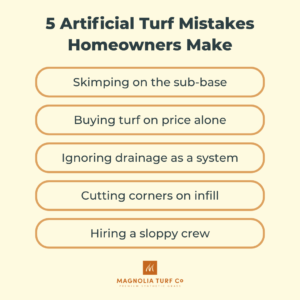
Homeowners make five common artificial turf mistakes:
- Skimping on the sub-base
- Buying turf on price alone
- Ignoring drainage as a system
- Cutting corners on infill
- Hiring a sloppy crew
You can avoid all five by hiring an installer who walks you through the full spec sheet (sub-base material, backing drainage rate, blade polymer, infill type) and stands behind the work with a long-term warranty.
Artificial Turf Mistake 1: Skimping on the Sub-Base
The sub-base is what your turf sits on. The standard is three to four inches of decomposed granite or crushed limestone, compacted at least 10 times with a commercial-grade plate compactor.
Done right, you get a stable, free-draining surface that won’t move or settle for the life of the installation. Done wrong, the whole yard comes apart.
We get calls all the time from homeowners whose turf has sunk into dips or eroded after heavy rain. The cause traces back almost every time to two inches of sub-base instead of four, hand-tamping instead of plate compaction, or crushed concrete instead of natural rock.
Crushed concrete is the cheapest option, which is why some installers use it. It compacts easily, but over time it hardens into actual concrete. Now water hits the turf, drains through, and has nowhere to go.
We use only decomposed granite or crushed limestone. Both compact well, both drain well, and both stay porous for the full life of the installation.
Artificial Turf Mistake 2: Buying Turf on Price Alone
Most homeowners assume the bulk of an artificial turf quote goes to the turf itself. It doesn’t.
The turf accounts for roughly 20% of a turn-key installation cost. The other 80% covers sub-base material, prep work, infill, edging, and labor. So when someone tries to save 10 or 20 cents per square foot by picking a cheaper turf, they’re cutting from the wrong line item.
Blade quality determines whether your yard looks great in 10 years or worn out in two. Cheaper turf uses C4 or C6 polymer blades that mat down under foot traffic. Our turf uses a C8 polymer blade structure, the most durable available, which stays upright with kids and dogs running on it daily.
Saving 30 cents a square foot today costs you the entire installation in five years. The math doesn’t work.
Artificial Turf Mistake 3: Ignoring How Drainage Actually Works
Drainage is a system, not a single feature. The turf backing and the sub-base have to work together.
A traditional hole-punched backing drains around 30 to 35 inches of liquid per hour. Our Triflow Backing drains 900+ inches of liquid per hour, so your yard is walkable right after a Texas downpour and pet odor doesn’t have a chance to set in.
The backing only matters if what’s underneath can take the water. If your sub-base doesn’t drain, your turf can’t either, no matter what backing it has.
Ask any installer three questions before you sign: What’s the backing drainage rate? What sub-base material, and how many inches? How do you compact it?
If they can’t answer those clearly, they’re not the right installer.
Artificial Turf Mistake 4: Cutting Corners on Infill
Infill keeps the turf flat and the blades upright. It also adds cushioning underfoot.
We use two to three pounds of silica sand per square foot. Our crew works it into the turf with a power broomer until it settles at the base of the blades. Skip the infill or use too little, and the turf wrinkles, slides, and mats almost immediately.
For pet owners, infill choice matters even more. Standard silica sand absorbs urine and traps odor over time.
We use OptiFILL+ antimicrobial pet turf infill instead, a round acrylic-coated sand infused with Microguard antimicrobial protection that neutralizes bacteria and pet odors at the source. It costs more upfront and pays for itself the first hot week of summer.
Artificial Turf Mistake 5: Sloppy Crew Work
The first four mistakes are about materials. The fifth is about craft.
Cutting turf around trees, rocks, and pavers takes skill, and you only get one chance. A bad seam is visible from across the yard for the next decade.
A good crew also handles what you’ll never see. They lay a proper weed barrier under the sub-base so weeds don’t grow up through drainage holes. They secure the perimeter with five-inch ungalvanized nails every six inches, which rust and lock into the ground over time, keeping your edges anchored through years of foot traffic and weather.
Skip any of those, and your edges lift, your seams pull apart, and weeds find their way to the surface. The difference between an A+ and an F install is rarely the materials. It’s the crew.
How to Avoid These Artificial Turf Mistakes Before You Hire
Reputation matters most when hiring an artificial turf installer. Look past the website and the sales pitch to the actual track record.
Check Google reviews and Yelp. Find out how long they’ve been in business. If a company has been installing turf for less than a year or two, they’re learning on your yard.
A good installer also walks you through the spec sheet: backing type and drainage rate, sub-base material and depth, infill type and amount, blade polymer, and warranty terms. Vague answers on any of those mean it’s time to move on.
Frequently Asked Questions About Artificial Turf Mistakes
What’s the most important step in artificial turf installation?
Sub-base preparation is the most important step. Three to four inches of decomposed granite or crushed limestone get compacted at least 10 times before any turf goes down. The turf sits on this base, and if it moves or fails to drain, every other part of the installation suffers.
Can crushed concrete be used for an artificial turf sub-base?
We don’t recommend it. Crushed concrete is cheap and compacts easily, which is why some installers prefer it. Over time, it re-bonds and turns into a solid slab that doesn’t drain.
What drainage rate should artificial turf have?
Most artificial turf on the market drains around 30 to 35 inches of liquid per hour through a hole-punched backing. Magnolia installs Triflow Backing, which drains 900+ inches of liquid per hour. The higher the drainage rate, the less risk of pooling, odor, or matting.
No More Artificial Turf Mistakes
We install turf the way it should be installed: full sub-base preparation, premium turf, clean seams, and proper weed barriers on every project.
David Turner, our owner, personally oversees every installation, so the same standards apply to a 500-square-foot side yard as to a 5,000-square-foot backyard. Every install is backed by our industry-leading 15-year warranty, which means if seams pull, edges lift, or drainage fails in that window, we replace it at no cost to you.
If you’re considering artificial turf for your yard, get a turf quote from a company that walks through every spec with you and stands behind their work.