If you’re shopping for artificial turf, you’re probably comparing products: blade types, colors, face weights, warranties.
That’s the wrong way to shop.
After more than 10,000 installations across Texas and Florida, we can tell you why some yards still look great at 15 years and others fail in five. The answer isn’t the turf. It’s what’s underneath, especially the drainage.
Here’s why artificial turf drainage matters more than most homeowners realize and what to look for before you hire.
Quick Answer About Artificial Turf Drainage
Artificial turf drainage is a system of two parts: the turf backing (which moves water vertically) and the sub-base (which moves water away from the turf). Both have to work together, or neither works. Premium drainage uses a high-flow backing such as Triflow Backing, which drains 900+ inches of liquid per hour, paired with three to four inches of decomposed granite or crushed limestone sub-base. The wrong materials, especially crushed concrete, cause pooling, smell, mold, and eventual structural failure.
The Misconception About Artificial Turf Cost
Most homeowners assume that when they get a turn-key quote, the bulk of the price is the turf itself. It isn’t.
Roughly 20% of a turn-key install cost goes to the actual turf. The other 80% covers sub-base material, prep work, drainage system, infill, edging, and labor. So when someone tries to upgrade or downgrade the turf to save or spend money, they’re focused on the smallest line item in the project.
Residential turn-key prices in our DFW market typically run between roughly $7 and $10 per square foot, depending on turf type, project size, and site conditions. Across that range, the turf itself accounts for maybe a dollar of variation. The drainage system underneath accounts for whether your yard works for 15 years or fails in three.
How Artificial Turf Drainage Actually Works
A turf drainage system has two parts: the backing (the bottom layer of the turf) and the sub-base (the rock underneath). Both have to work, or neither does.
The backing handles vertical water flow. Rain hits the surface, passes through the blades and infill, and exits through holes in the backing. The faster it drains, the less time water spends sitting on or in the turf.
The sub-base handles where the water goes next. If the rock under the turf doesn’t drain, water has nowhere to go, and you end up with pooling, smell, and turf that wrinkles or settles.
Artificial Turf Drainage: Triflow Backing vs. Hole-Punched Backing
Most artificial turf on the market uses a hole-punched backing. The manufacturer drills holes through the bottom of the turf at regular intervals, and water has to find one of those holes to pass through.
Hole-punched backings drain at about 30 to 35 inches of liquid per hour. That sounds like a lot until you remember that a heavy Texas thunderstorm can drop two inches of rain in an hour.
The water doesn’t fall just on the holes. It falls on the entire surface and has to migrate to the holes to drain.
Our Triflow Backing drains 900+ inches of liquid per hour and is triple-hole-punched. The math: a 30-inch-per-hour backing leaves water sitting on your turf during heavy rain, while 900 inches of liquid per hour moves it through almost as fast as it lands.
That difference matters most for households with pets and anyone in a region with heavy rainfall. Lingering water means lingering odor, slow-drying turf, and standing water that breeds mold and algae.
Why DFW Soil Makes Artificial Turf Drainage Even More Important
If you live in the Dallas-Fort Worth area, your yard probably sits on clay soil that holds water and drains poorly. Without a proper sub-base, water passing through the turf has nowhere to go.
That’s why we don’t compromise on sub-base depth. We use three to four inches of decomposed granite or crushed limestone, compacted at least 10 times with a commercial-grade plate compactor. Both materials drain well and stay porous, even after years of compaction.
Crushed concrete is the most common shortcut. It’s cheap and easy to compact, which is why some installers prefer it. Over time, it re-bonds and turns into a solid slab, which means a turf draining fine on top, water hitting a slab underneath, and a yard that pools every time it rains.
What Happens When Artificial Turf Drainage Fails
Drainage failure isn’t a single problem. It’s a cascade.
First comes pooling. Water sits on or in the turf longer than it should, exposing the backing and infill to extended moisture.
Then comes smell. Pet urine that doesn’t drain gets trapped in the infill, bacteria break it down, and ammonia builds up where it won’t wash out.
Then come algae and mold. Constant moisture under the turf creates the right environment, especially in shaded areas, which destroys the look of the yard and creates a hygiene issue.
Finally comes structural failure. The trapped water erodes the sub-base, the turf settles into uneven dips, and the seams pull apart. The only fix at that point is to tear out the project and start over.
Three Artificial Turf Drainage Questions to Ask Any Installer
Before you sign with a turf company, ask three questions.
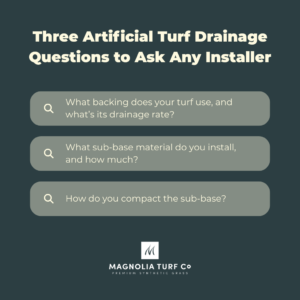
What backing does your turf use, and what’s its drainage rate? If they say “hole-punched” or quote a rate of 30 to 35 inches of liquid per hour, that’s standard turf. If they can’t tell you the rate at all, they don’t know their own product.
What sub-base material do you install, and how much? The right answer is decomposed granite or crushed limestone, three to four inches deep. Less than that, or any mention of crushed concrete, is a red flag.
How do you compact the sub-base? The right answer is a commercial-grade plate compactor running multiple passes. Hand-tamping or rolling alone isn’t enough.
If you don’t get clear answers on all three, the company isn’t ready to do drainage right.
Frequently Asked Questions About Artificial Turf Drainage
How fast should artificial turf drain?
The faster the better. Most artificial turf on the market drains around 30 to 35 inches of liquid per hour through a hole-punched backing. Our Triflow Backing drains 900+ inches of liquid per hour, which reduces pooling, odor, and mold risk.
What sub-base material is best for artificial turf?
The best sub-base is decomposed granite or crushed limestone, three to four inches deep, compacted with a commercial-grade plate compactor. Both materials drain well and stay porous. Crushed concrete is cheaper but turns into a solid slab over time and ruins drainage.
Why does my artificial turf smell after rain?
This is almost always a drainage problem. Either the turf backing isn’t draining fast enough, the sub-base under the turf is holding water, or both. The trapped moisture lets bacteria break down organic matter (especially pet urine) and release odor.
Ready for Artificial Turf Drainage Done Right?
We’ve spent more than a decade installing turf systems where the drainage works as hard as the turf does: three to four inches of natural rock sub-base, Triflow Backing rated at 900+ inches of liquid per hour, and compaction done with the right equipment on every job.
David Turner, our owner, personally oversees every installation, so the drainage system gets built right, whether your project is a 600-square-foot patio or a full backyard. Every install is backed by our industry-leading 15-year warranty, which means if drainage fails, seams pull, or edges lift in that window, we make it right at no cost to you.
If you’re considering artificial turf for your yard, get a free quote today.