We get calls every day from homeowners asking about AstroTurf, synthetic grass, artificial turf, fake lawn, and a dozen other names for the same product. After more than 10,000 installations across Texas and Florida, we’ve heard them all. So, what is fake grass called, exactly?
Here’s the straight answer: artificial turf, artificial grass, synthetic turf, synthetic grass, fake grass, fake turf, artificial lawn, synthetic lawn, faux grass, and yes, AstroTurf, all refer to the same product. The industry is relatively new, so no single standard name exists.
Most professionals use “artificial turf” or “artificial grass” interchangeably. But the name you use matters far less than what’s actually in the product you’re buying.
Call three different companies asking for “artificial grass,” and you might get three completely different products at three different quality levels. That’s the part worth your attention.
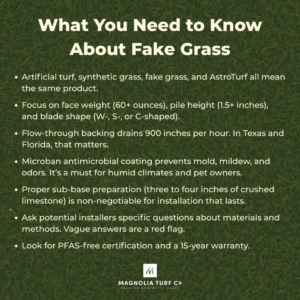
What You Need to Know About Fake Grass
- Artificial turf, synthetic grass, fake grass, and AstroTurf all mean the same product. Use whichever term you prefer.
- The name matters less than the specifications. Focus on face weight (60+ ounces), pile height (1.5+ inches), and blade shape (W-, S-, or C-shaped).
- Flow-through backing drains 900 inches per hour. In Texas and Florida, that matters.
- Microban antimicrobial coating prevents mold, mildew, and odors. It’s a must for humid climates and pet owners.
- Proper sub-base preparation (three to four inches of crushed limestone) is non-negotiable for installation that lasts.
- Ask potential installers specific questions about materials and methods. Vague answers are a red flag.
- Look for PFAS-free certification and a 15-year warranty.
Artificial Turf, Synthetic Grass, Fake Lawn: Same Name, Different Quality
When you call around for quotes, every company will know exactly what you’re talking about, whether you say artificial grass, synthetic turf, or fake lawn.
The terminology isn’t the issue. The name tells you nothing about quality.
Here’s what separates good turf from the stuff that looks like a green welcome mat after two years.
Face weight matters. This measures how much fiber is in the turf per square yard. Anything under 60 ounces is a low-end product. Look for turf above that threshold for residential installations that hold up over time.
Pile height affects realism. When the pile runs too short, it looks like carpet. When it runs too thin, it starts looking obviously fake. For residential lawns, aim for at least 1.5 inches of pile height.
Blade shape determines durability. Premium turf uses W-, S-, and C-shaped blades with a reinforced spine. These shapes bounce back after foot traffic instead of matting down.
Flat blades, which you’ll find in lower-quality products, flatten out and start looking like confetti within a few years.
Backing type controls drainage. This is where most shortcuts happen. Standard turf uses hole-punched backing with drainage holes spaced every three inches. That works fine in dry climates.
In Texas and Florida, where afternoon thunderstorms can dump inches of rain in minutes, you need flow-through backing. Flow-through backing drains liquid at 900 inches per hour compared to standard hole-punched systems. That’s roughly 2,900% faster drainage.
At Magnolia Turf, we’re vertically integrated. We wholesale turf, distribute it, and install it ourselves. That means we control what products go into the ground and can be selective about quality rather than installing whatever is lowest-cost on the market.
Why “AstroTurf” Isn’t the Artificial Grass Gold Standard Anymore
Asking for “AstroTurf” by name is a dead giveaway of your age. People over 60 tend to use that term because AstroTurf was the original. Everyone else typically says artificial turf or artificial grass.
Manufacturers invented AstroTurf in the late 1960s, and the Houston Astrodome made it famous. It was a big step forward at the time, but that original product was green plastic rolled over concrete. Today’s artificial grass looks nothing like it.
Modern residential artificial grass has come a long way. Today’s premium products include features that didn’t exist a decade ago.
Thatch layers add realism. These are brown and tan curly fibers near the base that replicate the look of dead grass in natural lawns. Thatch adds depth and makes the turf look lived-in rather than factory-fresh.
Color blending creates natural variation. Instead of a single flat green, quality turf uses multiple shades (field green, apple green, olive) to mimic how real grass looks with subtle color differences across a lawn.
Delustering technology removes artificial sheen. Early fake grass had an obvious plastic shine that screamed “synthetic” from across the street. Modern turf uses microscopic ribs on the blades (called LusterGuard technology) to diffuse sunlight and eliminate that unnatural look.
Choosing turf based on a famous name from 1965 doesn’t make sense when the technology has changed this much. Focus on specific features and performance specs, not brand recognition.
What Texas and Florida Homeowners Need to Know About Synthetic Turf
Climate matters more than most people realize when selecting artificial turf. What works in Arizona doesn’t necessarily work in Houston or Tampa.
Drainage is key in storm-prone regions. Texas thunderstorms and Florida afternoon downpours can overwhelm standard drainage systems. Flow-through backing that handles 900+ inches per hour prevents flash flooding on your lawn surface and keeps water from pooling.
Heat management requires the right technology. Artificial turf can get hot in direct sunlight, particularly between noon and 4 p.m. during summer months. Quality products use UV inhibitors to prevent fading and degradation from intense sun exposure. A quick rinse with water can lower surface temperature for several hours.
Humidity demands antimicrobial protection. In Florida especially, moisture gets trapped in warm conditions. That’s a recipe for mold, mildew, and bacterial growth.
Microban antimicrobial coating works around the clock to inhibit that growth, which is why we include it on every installation. It’s particularly important for pet owners dealing with the combination of humidity and animal waste.
PFAS-free products protect your family. PFAS (per- and polyfluoroalkyl substances) are sometimes called “forever chemicals” because they don’t break down in the environment. Independent labs have tested and verified our products as PFAS-free. Your kids and pets spend time on your lawn, so the materials need to be safe.
What to Ask Artificial Turf Contractors Before You Hire
Don’t call and say, “I want fake grass installed.” That’s too vague to get quality materials and proper installation. Here’s what to ask instead.
Ask about the sub-base. This is where most installers cut corners. Proper installation requires three to four inches of crushed limestone or decomposed granite, compacted correctly.
If someone quotes you a price that seems too good to be true, ask how deep their base preparation goes. Anything less than three inches means sinking, wrinkles, and drainage problems down the road.
Ask about blade construction. Flat blades cost less but won’t hold up. Look for W-, S-, or C-shaped blades with a structural spine.
Ask about backing and drainage. Find out whether they use flow-through backing or hole-punched backing. In Texas and Florida climates, flow-through is the right choice.
Ask about antimicrobial coating. Microban or equivalent protection matters, especially for pet owners.
Ask about PFAS testing. Reputable companies can show you independent verification that their products are PFAS-free.
Ask about the warranty. Quality installation backed by quality products comes with a 15-year warranty. If a company can’t stand behind their work that long, ask why.
Red flag: If a contractor can’t answer these questions or tells you “it’s all the same stuff,” keep calling.
Frequently Asked Questions About Artificial Grass
Is AstroTurf better than artificial grass?
AstroTurf is a brand name, not a quality indicator. The original AstroTurf from 1965 has nothing in common with modern residential products. Focus on specific features like drainage rate, blade construction, and antimicrobial coating rather than brand recognition.
What’s the most common term professionals use?
In the industry, we say “artificial turf” or “synthetic turf” for sports applications and “artificial grass” for residential lawns. These terms are interchangeable, and any installer will know what you mean regardless of which one you use.
Does artificial grass work in Texas and Florida heat?
Yes, when you choose the right product. Look for UV-resistant materials, flow-through backing that drains 900+ inches per hour, and antimicrobial coating for humidity. At Magnolia Turf, we only install products selected for hot, humid climates.
What term should I avoid?
No wrong term exists. Call it fake grass, artificial turf, synthetic lawn, or AstroTurf. The name doesn’t matter. Asking the right questions about specifications, installation methods, and warranty coverage does.
Ready to Learn More?
Now you know what fake grass is called. More importantly, you know what to ask for when you’re ready to move forward.
If you’re considering artificial turf for your Texas or Florida home, we’re happy to walk you through product specifications, show you samples, and explain exactly what goes into an installation that lasts.