The best grass for shade in Texas is Zeon Zoysia or Palmetto St. Augustine. Zeon needs only three to four hours of direct sunlight, while Palmetto can survive on four to five hours.
That’s the honest answer.
But after 10 years in business and more than 10,000 artificial turf installations across Texas, I’ve watched hundreds of homeowners try these shade-tolerant grasses. Most end up calling us 12 to 18 months later with the same story: the grass looked great at first, then turned into a mud pit.
Here’s what those “best shade grass” blog posts don’t tell you, and what actually works if you’re tired of replacing your lawn every couple of years.
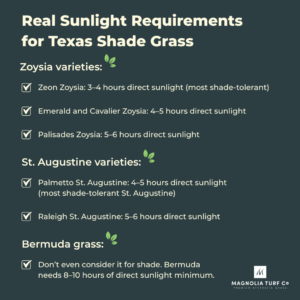
The Real Sunlight Requirements for Texas Shade Grass
Every type of grass needs sunlight for photosynthesis.
Zoysia varieties:
- Zeon Zoysia: 3–4 hours direct sunlight (most shade-tolerant)
- Emerald and Cavalier Zoysia: 4–5 hours direct sunlight
- Palisades Zoysia: 5–6 hours direct sunlight
St. Augustine varieties:
- Palmetto St. Augustine: 4–5 hours direct sunlight (most shade-tolerant St. Augustine)
- Raleigh St. Augustine: 5–6 hours direct sunlight
Bermuda grass: Don’t even consider it for shade. Bermuda needs 8–10 hours of direct sunlight minimum. Plant it under trees, and you’ll have bare dirt within months.
“Direct sunlight” means actual sun hitting the grass. Not filtered light through a tree canopy. Not dappled shade. Direct sun.
If you have mature oak trees in your backyard, measure your sunlight honestly. Go outside every hour on a sunny day and take a photo. You’ll probably find you’re getting two to three hours of direct sun, not the four to five hours Palmetto needs.
What Happens When Shade Grass Fails in Texas
We get calls about this almost every day. Here’s the typical pattern.
A homeowner spends $2,500 to $3,000 installing St. Augustine sod in a shady backyard. Maybe they picked Palmetto because the internet said it was shade-tolerant. For the first couple of months, it looks fine.
Then, four seasons pass. The grass thins out because it isn’t getting enough sun. It can’t photosynthesize enough energy to stay healthy. Thin grass plus Texas heat plus the occasional rainstorm has only one result: mud.
If you have dogs, the timeline shortens. Shade-stressed grass is already weak. Add a 60-pound Lab running laps every day, and you’ve got a mud pit by month eight. The dog tracks that mud inside every time.
We’ve had customers tell us they resigned themselves to mopping the floors after every rainstorm. Your backyard doesn’t have to work that way.
Why Texas Makes Shade Grass Even Harder
Texas combines heat, drought, and difficult soil into conditions that compound the challenge.
Water restrictions limit what you can do. Austin and San Antonio have strict watering schedules. Shade grass actually needs more water than grass in full sun because it’s constantly stressed. When you can only water twice a week, shade grass suffers.
Texas soil doesn’t help. The clay-heavy soil in Dallas retains moisture in all the wrong ways, creating fungus problems. Houston’s humidity adds disease pressure. Austin’s limestone competes with tree roots for nutrients. None of these conditions favor struggling shade grass.
Summer heat amplifies the stress. When temperatures hit 100°F for weeks straight, grass needs extra energy to survive. Shade grass can’t produce that energy because it isn’t getting enough sun. It’s a losing equation.
It’s no wonder homeowners spend thousands on sod, treatments, and water, only to have to re-sod again in two to three years.
The Real Cost of Shade Grass in Texas (5-Year Comparison)
Let’s talk about the numbers.
Here’s what you’ll have to invest in a 1,000-square-foot natural grass path:
- Initial sod installation: $3,000
- Irrigation system (if needed): $2,000
- Extra water over five years: $2,000+
- Fungicide and pest treatments: $1,500
- Partial re-sodding (year three): $800
- Full replacement (year five): $3,000
Five-year total: $9,000 to $12,000+, and you still might end up with a mud pit.
Artificial turf path for 1,000 square feet:
- One-time installation with proper sub-base: $9,000
- Maintenance costs: Occasional rinsing
Five-year total: $9,000. No re-sodding. No treatments. No irrigation repairs. No mud.
The ROI breakpoint is about five years. After that, artificial turf starts saving you money every single year. And you never have to think about maintaining your lawn again.
Shade Grass and Dogs in Texas: The Worst Combination
This is the scenario we hear about most. Shady backyard plus dogs equals constant headaches.
Shade grass is already struggling. It’s thin, weak, and slow to recover from damage. Now add a dog that runs the same path every day, digs in the same spots, and urinates in multiple areas.
Dog urine burns are permanent in shade grass. The grass doesn’t have enough energy to recover. Traffic patterns turn into ruts. After a rainstorm, those ruts become mud trenches.
We received a call from a customer in Dallas after three years of living with this cycle. They had about 2,000 square feet of backyard with three beautiful oak trees. Great bones for landscaping. But under those trees sat dirt and mud.
The kids couldn’t play on it. The dogs couldn’t use it without tracking filth inside. They spent most of their time indoors because the yard was unusable most of the year.
After we installed artificial turf, they called to tell us they spend twice as much time outside. The kids play. The dogs run. Nobody mops the floor after rain.
Why Artificial Turf Works in Shade Where Grass Fails
Artificial turf doesn’t need sunlight. That’s the obvious advantage, but it’s worth stating clearly.
Drainage matters more than you’d think. In shade, moisture lingers. That creates odor and bacteria problems if drainage is poor.
We use turf with flow-through backing that drains 900 inches of liquid per hour. That’s 2,900% faster than typical turf with hole-punched backing. Rain clears in minutes, and dog urine doesn’t pool between drainage holes.
Antimicrobial coating handles the rest. Microban technology inhibits bacteria, mold, and mildew growth around the clock. Combined with proper drainage, this helps keep pet areas fresh without frequent cleaning.
PFAS-free products matter. “Forever chemicals” have been found in some turf products. We test ours through independent labs to verify they’re PFAS-free. Your children and pets deserve that standard.
Installation in Shade: Why Sub-Base Matters Even More
Shaded areas retain more moisture than sunny spots. That makes proper installation critical.
Cutting corners on sub-base preparation leads to water pooling, mold growth, and turf failure. We’ve seen it happen with budget installations. The homeowner saves $1,500 upfront and spends $8,000 fixing problems three years later.
- 3–4 inches of crushed granite or limestone
- Proper compaction for stability
- Grading to direct water away from your foundation
- Seam placement that accounts for moisture flow
This foundation keeps your turf performing for 15–20 years. We back that with a 15-year warranty because we know it works.
Shade Grass vs. Artificial Turf in Texas: How to Decide
Natural shade grass might work if:
- You have five or more hours of direct sunlight (not filtered)
- You can commit to intensive maintenance
- You have no water restrictions
- You don’t mind re-sodding every few years
- No pets or minimal foot traffic
- You enjoy spending three to four hours weekly on lawn care
Artificial turf makes more sense if:
- You have less than five hours of direct sunlight
- You’re tired of the maintenance cycle
- You’re dealing with water restrictions
- You have dogs or active kids
- You want a permanent solution
- HOA complaints about patchy lawn have worn you down
Frequently Asked Questions About Shade-Tolerant Grass
What is the most shade-tolerant grass in Texas?
Zeon Zoysia requires the least sunlight of any warm-season grass, needing only three to four hours of direct sun. Palmetto St. Augustine comes second at four to five hours. No natural grass survives in complete shade.
Will St. Augustine grass grow in full shade?
No. Even Palmetto, the most shade-tolerant St. Augustine variety, needs four to five hours of direct sunlight daily. In full shade, it will thin out and eventually die.
How much does shade-tolerant grass cost compared to artificial turf?
Initial St. Augustine installation runs $2,500–$3,000 for a 1,000-square-foot area. Over five years with water, treatments, and likely re-sodding, expect $9,000–$12,000 total. Artificial turf costs about $9,000 to install and has virtually zero ongoing costs.
Can any grass grow in complete shade in Texas?
No. All grass types require sunlight for photosynthesis. In complete shade, alternatives like mulch, pavers, or artificial turf are your only options for a usable surface.
Does artificial turf get too hot in shaded areas?
Artificial turf in shade stays significantly cooler than turf in direct sun. Temperature is rarely a concern in shaded installations.
Ready to Stop Fighting Your Shade?
If you’ve been through the cycle of sodding, treating, and re-sodding shaded areas, you know the frustration. It’s not a problem you can fix with better grass or more effort. It’s a problem with the conditions themselves.
Artificial turf solves shade problems permanently. One installation, 15-year warranty, no more mud. No more maintenance. No more replacing your lawn every few years.
Get a free estimate today. We’ll give you a straight assessment, not a sales pitch.