Most guides about the best artificial grass for backyard projects focus on product specs: pile height, face weight, and drainage rates. Those numbers matter, but they don’t tell the whole story.
After completing over 10,000 installations across Dallas, Houston, Austin, San Antonio, Tampa, and Sarasota, we’ve seen what actually fails in the field and what holds up. That experience is the difference between getting advice from someone who read a spec sheet and getting advice from someone who’s built the same yard in your climate hundreds of times.
Here’s what actually matters when you’re choosing artificial grass for your backyard.
Best Artificial Grass for Backyards: Quick Answer
The best artificial grass for a backyard uses shaped blades (W-, S-, or C-shaped), flow-through backing that drains 900+ inches of liquid per hour, UV inhibitors to prevent fading, and a face weight of at least 60 ounces.
Pair the right product with three to four inches of compacted sub-base, and you’ll have a yard that looks realistic and holds up for 15+ years.
How to Pick the Right Type of Artificial Grass for Your Backyard
Before comparing specs, make sure you’re looking at the right category of turf.
Artificial grass comes in distinct types: landscape turf, pet turf, commercial turf, and sports turf. Each is designed for a different purpose, and buying the wrong category means paying for performance you don’t need or missing the performance you do.
For backyards, landscape turf is what you want. It’s designed to look realistic, with multiple shades of green, brown thatching woven into the base, and a matte finish with no shine or shimmer. The goal is simple: your neighbors walk by and wonder who’s maintaining your lawn.
If you have dogs, you’ll need pet-specific turf with antimicrobial coating and better drainage. We cover that in more detail below.
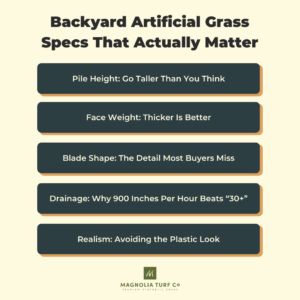
Backyard Artificial Grass Specs That Actually Matter
Two specs separate quality landscape turf from the stuff that looks like carpet within a year: pile height and face weight.
Pile Height: Go Taller Than You Think
The best artificial grass for your backyard should be at least 1.5 inches tall. Shorter turf might look fine as a sample in a showroom, but once it’s installed and filled with infill sand, a one-inch product shrinks to about half an inch of visible blade. It starts looking flat and artificial.
This is one of the most common mistakes we see homeowners make. They pick a sample that looks great on the table, then wonder why their installed turf looks like indoor carpet. Go 1.5 inches or taller, and you’ll get the lush, realistic appearance that made you want artificial grass in the first place.
Face Weight: Thicker Is Better
Face weight measures how much yarn is packed into each square yard of artificial grass. Don’t go under 60 ounces. Our landscape products range from 60 to 75 ounces, and we steer most homeowners toward the higher end of that range.
Thicker turf looks more like healthy grass. It holds up longer, too, especially in harsh climates like Texas and Florida, where sun and heat break down thinner products faster.
A 60-ounce product in Dallas summer heat will mat down quicker than a 75-ounce product, and that matting is how a yard that looked great at installation starts looking fake a few years in. Choosing a higher face weight is how you protect that investment for the long haul.
Blade Shape: The Detail Most Buyers Miss
The shape of each individual blade affects how your turf performs under foot traffic. W-shaped, S-shaped, and C-shaped blades have a reinforced structural spine that helps the fibers bounce back after being stepped on.
Traditional flat blades lack that spine. They bend, mat down, and start to look like confetti.
Shaped blades perform better in independent Lisport testing, which simulates years of heavy traffic to measure how well turf resists flattening. Those third-party results give you proof the turf can handle real use, not just a showroom demo. If a company can’t tell you about their blade shapes or Lisport results, ask why.
Drainage: Why 900 Inches per Hour Beats “30+”
Most turf companies advertise drainage at “30 or more inches per hour.” That’s the minimum for hole-punched backing, where water drains through large holes spaced every three inches.
Flow-through backing works differently. Tiny open holes across every millimeter of the surface let water pass freely through the entire turf. Our flow-through products drain 900 inches of liquid per hour.
After a Texas thunderstorm or a Florida afternoon downpour, that difference matters for any backyard artificial grass installation. No pooling, no standing water, no waiting for your yard to dry out before the kids can use it.
Realism: Avoiding the Plastic Look
Quality turf uses multiple shades of green plus a brown thatch layer at the base to mimic real grass. But color alone won’t prevent the artificial “shine” that gives away cheaper products.
LusterGuard technology uses microscopic ribs on the surface of the turf yarn. These ribs scatter sunlight instead of reflecting it, eliminating the mirror effect that makes lower-quality turf look plastic under direct sun. Your yard looks like real grass year-round, not a green carpet that gives itself away the moment the sun hits it.
Why Installation Makes or Breaks Backyard Artificial Grass
A premium product with poor installation will fail faster than a mid-range product installed correctly.
The sub-base is where proper installation quality shows up. We use three to four inches of decomposed granite or crushed limestone, compacted until it won’t settle or move. We spend most of the project on base prep alone, an entire day of compacting and grading, so no uneven spots develop over time.
That prep is what keeps your turf lying flat and draining perfectly for the life of the warranty, not just the first few years. Companies that use one to two inches of sub-base instead of three to four save time upfront, and their customers pay for it later with sinking, wrinkles, and water that has nowhere to go.
Our owner, David Turner, personally oversees every installation. You’re not dealing with a franchise or a subcontracted crew who’s never met the person whose name is on the truck. When the owner’s reputation is on the line with every project, the work gets done right.
We back all of that with a 15-year warranty. That’s 15 years of knowing if anything goes wrong with materials or workmanship, we stand behind the job.
When you’re comparing installers, ask how thick their sub-base will be and what material they use. If they can’t give you a specific answer, that tells you plenty.
Best Backyard Turf for Dog Owners vs. Pet-Free Yards
Not every backyard needs the same product. Dogs change the equation.
For yards with dogs: We recommend pet-specific artificial turf with 100% permeable flow-through backing. Urine needs to drain straight through, not sit on the surface, where it creates odor and harbors bacteria. Pair that with Envirofill, a specialized antimicrobial sand infill that neutralizes pet odors at the source, so your yard stays fresh even on the hottest days.
Add Microban antimicrobial coating built into the turf itself, and you have two independent lines of defense against bacteria, mold, and ammonia odors. That combination means a yard your dogs use daily that you can actually enjoy being in.
For yards without dogs: You can go with the most realistic-looking products. Our Olive 72 is the best-looking turf we offer: soft, comfortable to walk or lie on, and it looks like a perfectly maintained lawn. If pets aren’t part of the picture, it’s hard to beat for pure aesthetics.
Texas and Florida Backyards Need Different Features
A backyard artificial grass product that works well in California won’t necessarily hold up in Dallas heat or Tampa humidity. Climate-specific selection matters.
Texas backyards deal with extreme heat and often sit on clay soil. UV inhibitors prevent color fading under relentless sun, so your turf keeps the same rich color it had on installation day rather than washing out to a faded tan after a summer or two.
The sub-base needs to be three to four inches of crushed limestone or decomposed granite to drain properly through clay. On the hottest days, rinsing the turf with water or using cooling organic infills helps keep surface temperatures manageable.
Florida backyards face a different challenge: humidity and daily afternoon thunderstorms. Flow-through backing isn’t optional here. It’s a requirement.
That 900-inch-per-hour drainage rate handles sudden downpours without puddling, so your yard is usable again within minutes. In Florida’s humidity, Microban antimicrobial technology keeps mold, mildew, and bacteria from taking hold.
Questions to Ask Before You Buy Backyard Artificial Grass
Choosing the right turf is half the decision. Choosing the right installer is the other half. Here are the questions to ask during consultations:
- How thick will your sub-base be, and what material do you use?
- What are the product specs: pile height, face weight, blade shape, and drainage rate?
- Does the turf include antimicrobial coating? Is it PFAS-free?
- Do you use weed fabric? What type of infill sand?
- Can you show me a portfolio of completed installations?
- What does your warranty cover, and how long does it last?
If an installer gets vague on sub-base preparation or can’t explain their product specs, keep looking. Watch for non-galvanized nails, too.
Quality installers use nails that rust and swell into the earth to anchor the turf permanently, which keeps edges tight and prevents the lifting and curling that happens when nails back out over time. Galvanized nails don’t do that.
Get a free estimate, and we’ll walk you through every one of these questions upfront.
PFAS-Free Backyard Turf: Why It Matters for Your Family
Some artificial turf products contain PFAS, sometimes called “forever chemicals.” These per- and polyfluoroalkyl substances don’t break down in the environment, which means they can accumulate in soil, water, and the bodies of people and animals who come into contact with them.
All our products undergo independent testing to confirm they’re 100% PFAS-free. You’re not taking our word for it. Third-party verification means you have documentation that your yard is safe.
Your backyard is where your kids play and your dogs roll around, so we treat chemical safety as the baseline, not an optional feature.
Frequently Asked Questions
What is the best artificial grass for backyards?
The best artificial grass for backyards uses shaped blades (W-, S-, or C-shaped) with reinforced spines, flow-through backing draining 900+ inches per hour, antimicrobial coating, and UV protection.
Match the product to your climate and make sure the installer uses three to four inches of compacted sub-base. That combination gives you a yard that looks great and holds up for 15+ years.
How long does backyard artificial grass last?
Quality artificial grass with proper installation lasts 15+ years. Lower-quality products or poor installation can show wear in two to three years. Sub-base preparation is the biggest factor in long-term performance, which is why it’s the first question to ask any installer.
What pile height is best for a backyard?
Go with 1.5 to two inches for residential backyards. Shorter pile looks like carpet once installed and filled with sand, which is exactly the look you’re trying to avoid. Higher face weight (65–75 ounces) paired with the right pile height gives you the most realistic, durable result.
Does artificial grass get hot in Texas?
Artificial grass does heat up under direct sun. Lighter color blends reflect more heat than dark greens, and rinsing with water or using cooling organic infills can reduce surface temperature on the hottest days. Proper product selection for your specific Texas market makes a noticeable difference in how usable your yard is during peak summer.
Is artificial grass safe for dogs?
Yes, with the right features. Look for flow-through backing for instant drainage, Microban antimicrobial coating for odor and bacteria control, and PFAS-free materials. Pair these with Envirofill antimicrobial infill for a yard that stays clean, odor-free, and safe for the animals using it daily.
The Best Artificial Grass for Your Backyard
The best artificial grass for your backyard isn’t the one with the most impressive spec sheet. It’s the right product for your climate, your family, and your lifestyle, installed on a proper sub-base without shortcuts.
We’ve completed over 10,000 installations across Texas and Florida. That means we’ve seen every site condition, soil type, and climate challenge these markets can throw at a yard, and we know exactly what works. Every project starts with a free consultation where we assess your yard, discuss how you’ll use the space, and recommend products based on what we know performs well in your market.
Get a free estimate, or call us to get started.