Artificial turf drainage depends on two factors: backing type and base preparation. Flow-through backing drains 900+ inches of liquid per hour, while hole-punched backing drains at roughly 35 inches per hour.
That difference determines whether your yard handles a Texas thunderstorm without a problem or turns into a puddle after a light shower.
What’s the Best Artificial Turf Drainage? Quick Answer
The best artificial turf drainage system combines flow-through backing with a four-inch compacted gravel base. This setup handles heavy rain, pet urine, and pool splash-out without standing water. Cheap turf with hole-punched backing and a thin base fails within a few years.
Get a free estimate to see what proper drainage looks like for your yard.
How Does Artificial Turf Drainage Work?
Water hits the turf surface and passes through the backing into the sub-base below. From there, it drains into the soil or a connected drainage system.
Speed depends on the backing. Flow-through backing lets water pass through the entire surface evenly. Hole-punched backing forces water through small perforations spaced every few inches, creating bottlenecks.
The sub-base matters just as much. A proper four-inch gravel base, compacted and graded correctly, moves water away from the surface fast. Skip the base work or use only two inches, and water pools underneath the turf. That leads to settling, odor, and turf failure.
Learn more about how installation affects turf lifespan.
Flow-Through Backing vs. Hole-Punched Backing
Most artificial turf companies use hole-punched backing. They punch small holes through a solid backing material at regular intervals. Water can only drain through those holes, and the rest of the backing blocks it.
Our flow-through backing works differently. Water drains through the entire backing surface, not just through holes. The artificial turf drainage rate is 900+ inches of liquid per hour, compared to only 30 inches per hour for hole-punched backing.
Here’s why that matters in Texas and Florida:

We’ve installed over 10,000 yards across Texas and Florida, so we’ve seen every type of drainage failure up close. Hole-punched backing is the number one reason turf installations fail early. Water sits on the surface, bacteria build up, and the turf starts to smell and break down.
Learn what makes our installations different.
Why Artificial Turf Drainage Matters in Texas and Florida
Texas thunderstorms can dump two to three inches of rain in an hour, while Florida averages 50+ inches of rain per year.
Clay soil in Dallas and Houston drains poorly on its own. In parts of Florida, sandy soil drains too fast and doesn’t support turf.
Both states need a drainage system that can handle extreme weather. A four-inch compacted gravel base paired with flow-through backing moves water through quickly. It doesn’t matter what the soil underneath looks like.
Texas homeowners face another drainage-related problem: heat. When water pools under turf and doesn’t drain, it creates humidity trapped between the turf and the ground. That accelerates mold and bacterial growth, which means your yard smells and your turf breaks down faster.
Our Microban® antimicrobial coating reduces bacteria by 99%, so your kids and pets can play on a clean surface year-round. Combined with proper drainage, it keeps the turf odor-free. (Learn about our pet turf built for heavy use.)
Florida homeowners deal with constant humidity and tropical storms. Turf with poor drainage gets waterlogged during the rainy season and never fully dries.
Our installations of artificial turf in Tampa and artificial grass in Sarasota are built to handle those conditions, so your yard stays dry and usable even during the peak rainy season.
What Happens When Artificial Turf Drainage Fails?
Bad drainage causes problems that worsen over time. Standing water on the surface means slipping hazards and unusable outdoor space. Water trapped under the artificial grass causes the base to move and settle unevenly.
For pet owners, poor artificial turf drainage is especially bad. Urine sits on the surface instead of passing through. Bacteria build up, and the turf starts to smell.
No amount of cleaning fixes a drainage problem. Seams lift when water collects underneath. Edges curl. The turf surface develops bumps and dips.
Most of the failed installations we’ve repaired come down to two shortcuts: thin base work and hole-punched backing. Ask your installer about both before you sign a contract.
How to Tell If Your Artificial Turf Has Drainage Problems
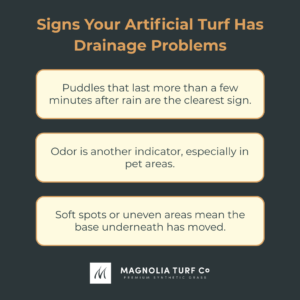
Puddles that last more than a few minutes after rain are the clearest sign. Healthy artificial grass with flow-through backing and a proper base drains in seconds, not minutes.
Odor is another indicator, especially in pet areas. If rinsing doesn’t fix the smell, water isn’t moving through the backing properly.
Soft spots or uneven areas mean the base underneath has moved. Water erosion under the turf causes the gravel to displace, and the surface follows it.
If you’re dealing with these problems, the fix is usually a complete reinstallation with proper materials. Patching bad drainage doesn’t work long-term. Contact us for a free estimate, and we’ll assess the situation.
Frequently Asked Questions About Artificial Turf Drainage
How fast does artificial turf drain?
It depends on the backing. Our flow-through backing drains 900+ inches of liquid per hour. Standard hole-punched backing drains at about 35 inches per hour.
Base prep matters just as much as the backing.
Does artificial turf drain pet urine?
With flow-through backing and a four-inch gravel base, pet urine drains immediately. Our Microban® antimicrobial coating reduces bacteria by 99%, which prevents odor buildup. Hole-punched backing traps urine on the surface.
Can artificial turf handle heavy rain in Florida?
Our installations in Tampa and Sarasota handle Florida’s 50+ inches of annual rainfall without issues. Flow-through backing combined with a properly graded gravel base keeps water moving through the system, not sitting on top of it.
Do you need a French drain under artificial turf?
Most residential installations don’t need a French drain. A four-inch compacted gravel base with proper grading handles drainage. Properties with severe water flow issues, like yards at the bottom of a slope, may need additional drainage infrastructure.
What base material is best for artificial turf drainage?
Crushed limestone or decomposed granite compacted to four inches is the standard for long-lasting installations. Crushed concrete is cheaper but drains poorly. Base material and depth affect how long your turf lasts.
Read more about the importance of choosing the right turf infill.
Will artificial turf drainage work on a slope?
Proper grading during installation directs water flow and prevents erosion. Sloped yards actually drain better than flat yards when the base is built correctly.
How long does well-drained artificial turf last?
Our turf lasts 15–20 years with proper drainage and minimal maintenance. Every residential installation comes with a 15-year warranty. Turf with poor drainage fails in two to three years.
Get Artificial Turf Drainage Done Right
We’ve completed 10,000+ installations across Dallas, Houston, Austin, San Antonio, Tampa, and Sarasota, so we know what your local soil and weather demand. Our owner, David Turner, personally oversees every project, which means you won’t get handed off to a random subcontractor.
We use flow-through backing, a four-inch gravel base, Microban® antimicrobial coating, and PFAS-free, lead-free materials, so your yard drains properly and stays safe for kids and pets.
Get a free estimate for your project, or call us today to talk about your drainage needs. We’ll explain exactly what we’ll do and give you a detailed quote with no surprises.